
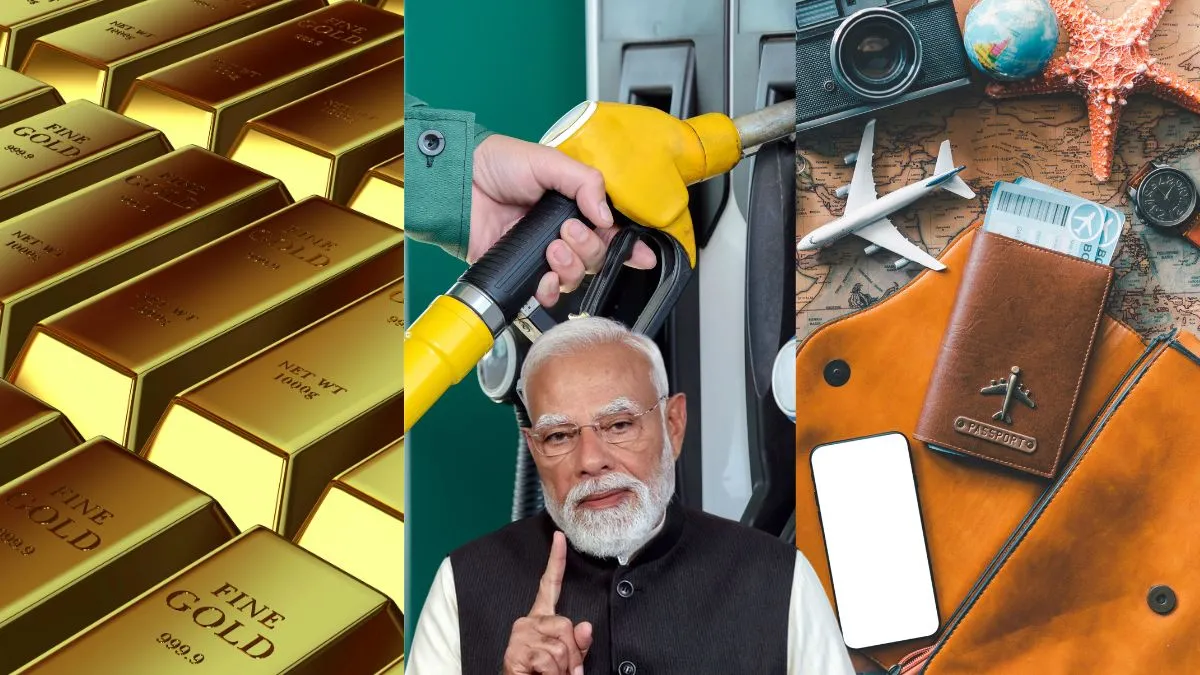
Prime Minister Narendra Modi, while addressing a gathering in Hyderabad last week, made three key appeals to citizens to tackle the consequences of the ongoing crisis in West Asia on the Indian economy amid rising crude oil prices and disruptions in global supply chains. He urged people to postpone gold purchases for a year, avoid non-essential foreign travel, and reduce fuel consumption.
India imports nearly 80% of its crude oil requirements, and any rise in global oil prices directly increases the country’s import bill. Since crude oil is purchased in dollars, a strengthening US dollar further strains India’s foreign exchange reserves. A similar situation exists with gold, as India imports the yellow metal in large quantities every year.
How Does Gold Impact Foreign Exchange Reserves?
India is the world’s second-largest consumer of gold after China and imports substantial quantities every year. In FY26, India spent around $72 billion on gold imports—roughly $6 billion per month.
This heavy demand increases dollar outflows, putting pressure on the current account deficit and weakening the Indian rupee. A weaker rupee, in turn, makes gold and other imports more expensive.
According to Kedia Advisory, the Prime Minister’s appeal to limit non-essential gold purchases reflects concerns about rising import bills and external sector stability amid geopolitical tensions.
Over the past few years, the rupee has depreciated from around Rs 74–75 per US dollar in 2021 to below Rs 95 in 2026, a decline of nearly 27–28%. Rising crude prices and global uncertainties have further intensified this pressure.
Recommended For You
Ajay Kedia, founder of commodity firm Kedia Advisory, said, "India is heavily dependent on imports of crude oil, edible oil, electronics, and fertilisers, which are crucial for economic growth and domestic consumption. However, gold imports are primarily linked to investment, jewellery, and fashion demand, so gold purchases can be deferred, as they are not part of everyday needs."
This concern becomes more critical as India’s foreign exchange reserves have declined from around $728.49 billion in early March 2026 to approximately $690.69 billion, reflecting volatility driven by rising import costs.
What If Gold Is Not Purchased for a Year?
Gold alone accounts for nearly 10% of India’s total import bill. In FY26, India’s total imports stood at around $775 billion, with gold imports contributing $72 billion.
If gold demand declines significantly, the impact on dollar outflows could be substantial. A 30–40% reduction in gold imports could save around $20–25 billion, while a 50% drop could save up to $36 billion.
This saving is significant, as it is nearly half of India’s estimated current account deficit. Reduced gold imports would directly ease pressure on foreign exchange reserves and stabilise the rupee.
How Will the Government Save Money on Petrol?
India imports nearly 89% of its oil requirements. Rising crude oil prices—from about $70 per barrel to around $113 per barrel over the past year—have sharply increased the country’s import bill.
In FY26 alone, India spent approximately $134.7 billion on crude oil imports. Any further increase in global prices could significantly strain foreign exchange reserves.
Independent commodity expert Anuj Gupta said, "If the demand for petrol and diesel in the country decreases, consumption will decrease, and the government will not be pressured to import more crude."
He added that the government is actively promoting electric vehicles to reduce dependence on fossil fuels, which could benefit both the economy and the environment in the long run.
Maths Behind Foreign Exchange Reserves
India’s foreign exchange reserves currently stand at around $690.69 billion, according to compiled data. These reserves had risen to about $728 billion earlier in the year but declined due to global uncertainties and rising import costs.
The International Monetary Fund (IMF) estimates that India’s current account deficit could reach $84.5 billion in 2026, or about 2% of GDP. A higher current account deficit indicates that dollar outflows exceed inflows, increasing pressure on the economy.
Average Expenditure on Foreign Travel
Foreign travel is another major contributor to dollar outflows. According to industry estimates, the average cost of a week-long international trip for Indian travellers in 2026 ranges from Rs 50,000 to Rs 1.5 lakh per person.
For Southeast Asian destinations, costs can exceed Rs 2 lakh, while trips to Europe or the US often go beyond Rs 2 lakh.
A budget Europe trip (7 days) typically costs between Rs 80,000 and Rs 1.3 lakh per person, while a 10-day trip may range from Rs 1.5 lakh to Rs 2.5 lakh. Luxury travel packages can cost Rs 3 lakh to Rs 6 lakh or more.
Flight fares vary widely: Delhi/Mumbai to London, Paris, or Frankfurt: Rs 25,000–Rs 65,000
Delhi/Mumbai to Amsterdam or Rome: Rs 40,000–Rs 70,000
Chennai/Bengaluru to Europe: Rs 45,000–Rs 75,000
Overall, foreign travel packages—including flights, visas, hotels, and other expenses—can range between Rs 50,000 and Rs 3 lakh per person.
With the rupee weakening and the dollar strengthening, international travel and education abroad are becoming increasingly expensive, further adding to India’s foreign exchange outflow.
PM Modi’s Appeal And Its Significance
The Prime Minister’s appeal aims to reduce unnecessary dollar outflows and ease pressure on India’s external sector. Spending on gold imports, foreign travel, and fuel consumption significantly impacts the country’s current account deficit and foreign exchange reserves.
(With Inputs From jagran.com)