
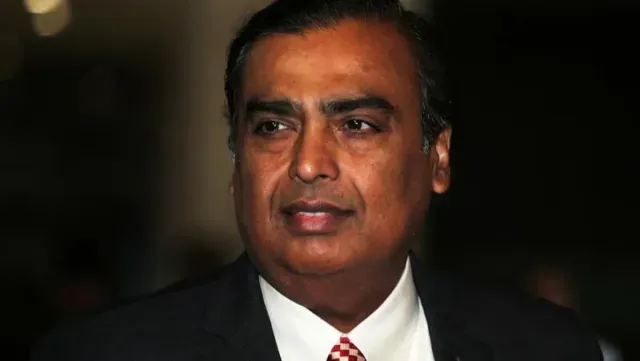
- Reliance welcomes Starlink competition in India's satcom sector.
- Musk alleged Ambani's "vested interests" blocked Starlink entry.
- Reliance emphasizes adherence to India's laws and regulations.
Days after business tycoon Elon Musk hit out at Indian businessman Mukesh Ambani, Reliance Industries has responded that it welcomes competition in India's satellite communications space, including Musk's Starlink, while emphasising that every participant in the sector must adhere to the rule of law and existing national regulations.
This comes days after SpaceX Chief Executive Officer Elon Musk on October 8 targeted the Indian conglomerate, alleging that vested interests were blocking Starlink's entry in India. He alleged Starlink's satellite internet services were being delayed due to pressure from domestic business interests, leading the tech billionaire to question, "Is Ambani the real boss of India?"
Unfortunately, we are being blocked by certain oligarchs in order to maintain their monopolistic chokehold on the Indian people. You can guess who they are … This is a crime against the people of India!
— Elon Musk (@elonmusk) October 7, 2026
In a post on X, Musk had said, "The ridiculous arguments by Ambani’s army of Internet shills make no sense. On the one hand, they say Starlink couldn’t possibly compete with the amazing low prices offered by Ambani’s de facto monopoly in India, and then, in the same breath, they essentially claim that Starlink would be too strong of a competitor! This is absurd hypocrisy and hyperbole."
The ridiculous arguments by Ambani’s army of Internet shills make no sense On the one hand, they say Starlink couldn’t possibly compete with the amazing low prices offered by Ambani’s de facto monopoly in India and then, in the same breath, they essentially claim that Starlink would be too strong of a competitor! This is absurd hypocrisy and hyperbole. The reality is that competition would greatly benefit the average citizen in India by giving them more choices, as it always does. Ambani’s profits will be lower, but he is not going out of business. And, obviously, if Starlink is too expensive in India, no one will buy it, so SpaceX will need to make pricing affordable.
— Elon Musk (@elonmusk) October 10, 2026
What Reliance Said
Reacting to the allegations, one of the country's top industries said, "In light of recent remarks about Reliance and the Indian market, we wish to place the facts on record. Like every Indian enterprise, Reliance has grown in an India that welcomes investment and innovation, homegrown or international, that improves the lives of the people. That openness rests on the rule of law. As the Government of India has stated, it applies the same process to every applicant, Indian or foreign. Jio's own satellite services await clearances."
Statement from Reliance Industries In light of recent remarks about Reliance and the Indian market, we wish to place the facts on record. Like every Indian enterprise, Reliance has grown in an India that welcomes investment and innovation, homegrown or international, that improve the lives of the people. That openness rests on the rule of law. As the Government of India has stated, it applies the same process to every applicant, Indian or foreign. Jio's own satellite services await clearances. At Reliance, we have never feared competition. We see it as the truest test of who serves the customer best. Jio itself entered India's crowded telecom market in 2016 as the newest player, with not a single customer. In just ten years, Jio has earned the trust of over 530 million customers and given Indians some of the best digital infrastructure and most affordable data in the world. We welcome competition in satellite communications, including Starlink. Every player, Jio included, must serve the people of India and abide by the laws and policies of the land.
— Reliance Industries Limited (@RIL_Updates) October 16, 2026
It further said, "At Reliance, we have never feared competition. We see it as the truest test of who serves the customer best. Jio itself entered India's crowded telecom market in 2016 as the newest player, with not a single customer. In just ten years, Jio has earned the trust of over 530 million customers and given Indians some of the best digital infrastructure and most affordable data in the world. We welcome competition in satellite communications, including Starlink. Every player, Jio included, must serve the people of India and abide by the laws and policies of the land."
Meanwhile, Musk claimed that greater competition could reduce the profits of existing players but said it would not necessarily threaten their business.
"The reality is that competition would greatly benefit the average citizen in India by giving them more choices, as it always does. Ambani’s profits will be lower, but he is not going out of business," he wrote.
Musk had earlier alleged monopolistic practices in the Indian telecommunications landscape and questioned regulatory barriers faced by Starlink's commercial rollout.
"Dear Prime Minister Ambani, Please accept my humble apologies for not realising that you are the real boss of India. Naturally, you would prefer to maintain your monopolistic exploitation of the great people of India, but would you nonetheless consider allowing Starlink to compete?" Musk posted.
Separately, the Indian government and Elon Musk also engaged in a verbal spat after the Department of Telecommunications (DoT) rejected allegations.
The government had dismissed allegations of blocking Starlink's satcom services, saying it was mandatory for all satcom licensees in the country to comply with security standards.
The government has granted satcom licences to Musk's Starlink, Reliance Jio's JioSatcom, and Bharti-backed Eutelsat OneWeb. However, none of the three companies can begin commercial services until the required security assessments and spectrum-related approvals are completed.
The Telecom Ministry said security assessments were currently underway for all three licensees.
ALSO READ: 'Will You Consider Allowing Starlink?': Elon Musk Attacks Ambani Again Over Satcom License
According to the ministry, a licensed satcom provider can move to the spectrum allocation stage after completing the mandatory security process. It maintained that all three companies were currently at "broadly the same regulatory stage".
Minister of State for Communications Chandra Sekhar Pemmasani said the pending security clearance was with the Ministry of Home Affairs and was not specific to any one company.
You may also like to watch
"The Department of Telecommunications has given temporary spectrum along with licences to all satcom companies. Now the matter is pending with the Home Ministry for security clearance. They will receive it as soon as the approval is granted. This has nothing to do with any one company," Pemmasani said on the sidelines of the India Mobile Congress.