
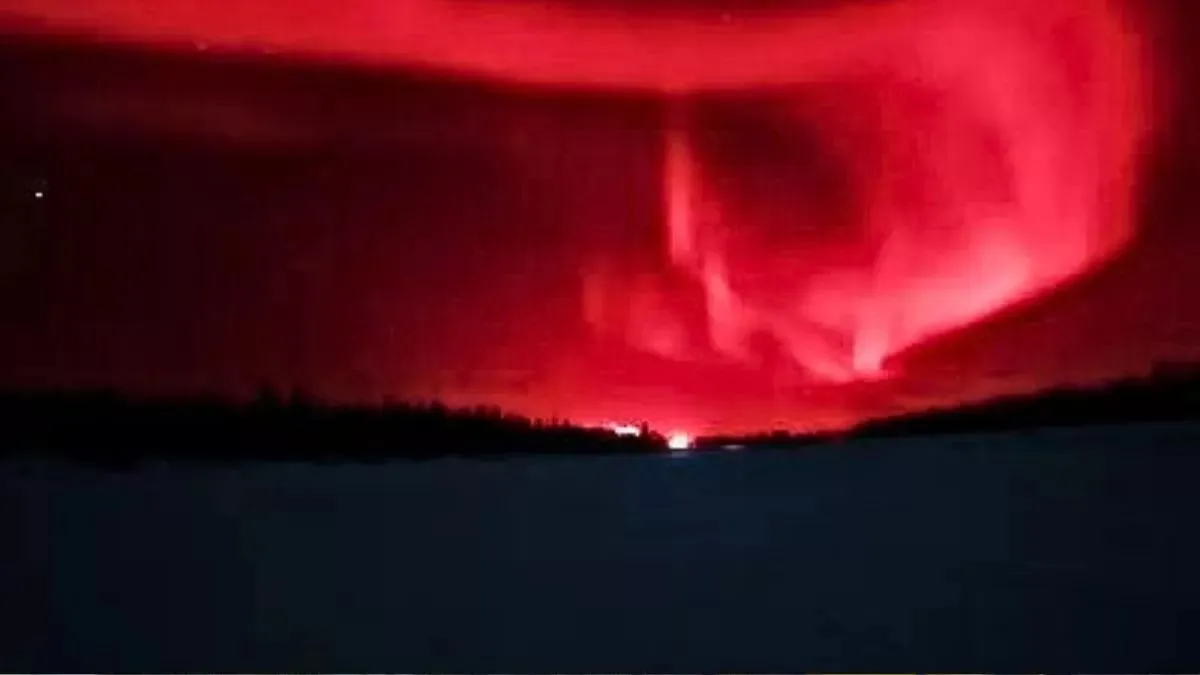
A vibrant crimson hue, in a rare celestial spectacle, illuminated the night sky over portions of Ladakh in a stable auroral red act, the Hanle Dark Sky in the Himalyas, due to the magnetic storms launched towards Earth. According to news agency PTI, the solar storms, or coronal mass ejections, are from the AR13664 region of the sun and has produced several high-energy solar flares. Some of the flares are travelling towards earth at a speed of 800 km/s, scientists at the Centre of Excellence in Space Sciences in India (CESSI), Kolkata, said.
Stable Auroral Red Arcs (SAR arcs) captured from Hanle Dark Sky Reserve, UT Ladakh on 11.05.24 at 0100 hrs. A very rare phenomenon for Mid Latitude like Hanle. Eta Aquarid meteor shower added more beauty to the Aurora, visible in the top right of the photo. pic.twitter.com/RNp7J8wh2q
— stanzin norla (@snorl) May 11, 2024
Speaking about the solar storm, astronomer and professor RC Kapoor said that this is an X-ray flare that NASA has spoken about, and the flares are associated with large sunspots on the surface of the sun. He added that the sunspots have a very strong magnetic field, and because of that, there is a sudden release of energy in the form of X-rays and ultraviolet radiation that reach the earth, causing disturbances in the ionosphere.
Kapoor also added that there is nothing to fear about it, but technological life may be affected. He said that the satellites in orbit around the Earth in the thin ionosphere can get affected due to the flares.
स्वस्थ लोकतंत्र के लिए प्रमुख दलों का एक मंच से अपना विज़न देश के समक्ष रखना एक सकारात्मक पहल होगी।
— Rahul Gandhi (@RahulGandhi) May 11, 2024
कांग्रेस इस पहल का स्वागत करती है और चर्चा का निमंत्रण स्वीकार करती है।
देश प्रधानमंत्री जी से भी इस संवाद में हिस्सा लेने की अपेक्षा करता है। pic.twitter.com/YMWWqzBRhE
In Ladakh, astronomers at the Hanle Dark Sky Reserve saw a red glow on the northwest horizon in the sky from about 1 a.m. on Saturday that continued till early dawn.
"We were fortunate to witness Aurora activities on our all-sky camera during regular telescope observations," Stanzin Norla, an engineer at the Hanle Dark Sky Reserve, told PTI.
Recommended For You
He added that a faint red glow was visible to the naked eye along the horizon, and then the event was captured in much detail by a DSLR camera installed at the Hanle Dark Sky Reserve.
"It streaked through the sky from about 1 am till 3:30 am," Stanzin said, adding that the skies turned red along the horizon and to a pinkish hue later.
Another engineer, Dorje Angchuk, at the Indian Astronomical Observatory in Hanle, described the event as a stable auroral red arc, which was a rare occurrence over the skies in Ladakh.
View this post on Instagram
"Auroras seen near the north or south poles are dynamic events. They keep changing. But the one witnessed at Ladakh was more stable. It is called the stable auroral red arc. The steady glow remained in the sky for a couple of hours," Angchuk said.
The CESSI said the sun produced strong solar flares beginning Wednesday, resulting in five outbursts of plasma capable of disrupting satellites in orbit and power grids here on Earth.
The US' National Oceanic and Atmospheric Administration (NOAA) is calling this an unusual event, pointing out that the flares seem to be associated with a sunspot that's 16 times the diameter of Earth. An extreme geomagnetic storm in 2003 took out power in Sweden and damaged power transformers in South Africa.
(With input from agencies)