
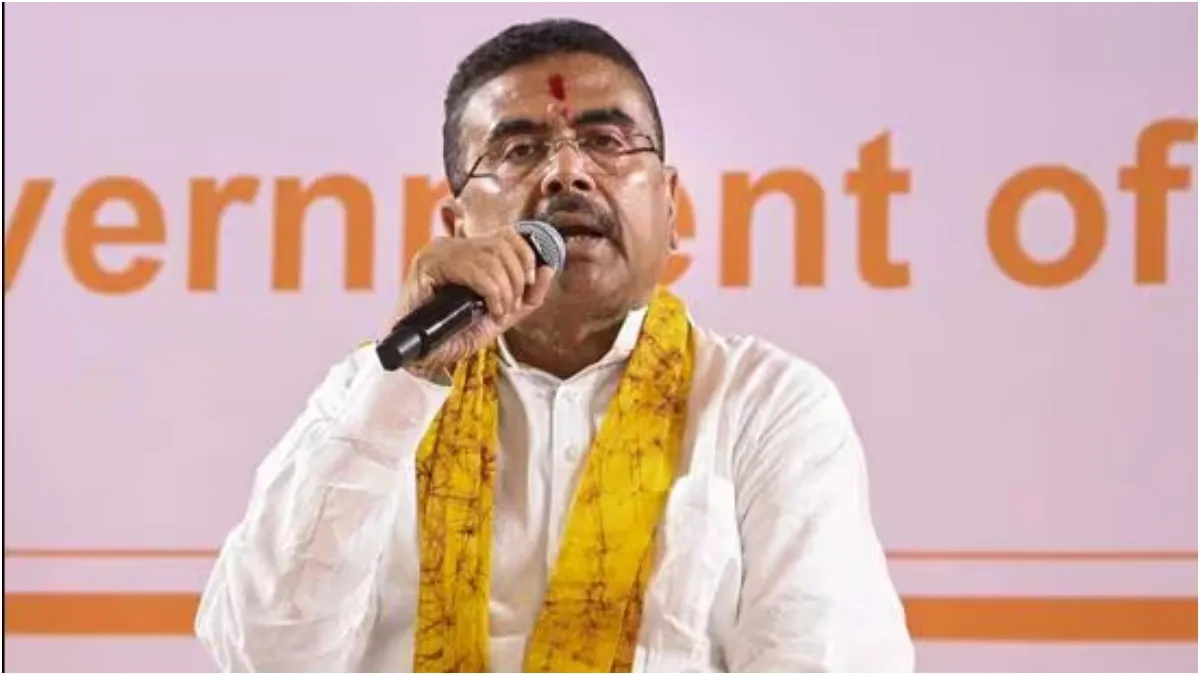
The BJP government in West Bengal has moved to institutionalise its "detect, delete and deport" policy as it directed all district administrations to set up "holding centres" for suspected illegal foreigners and foreign prisoners awaiting repatriation.
The move is apparently giving an administrative shape to one of the key political themes of the party.
The order for setting up the 'holding centres' was issued by the state Home and Hill Affairs Department's Foreigners' Branch on May 23.
The order has asked the district magistrates to build the infrastructure required to house "apprehended foreigners" and "released foreign prisoners" till the time of deportation.
The order cited a Union Home Ministry advisory from May last year that laid down the procedures for handling Bangladeshi nationals and Rohingyas found staying illegally in India.
"In this connection, it is requested to take initiative/appropriate action for setting up of Holding Centres in the district for apprehended foreigners as well as for the released foreign prisoners awaiting deportation/repatriation," the order said.
The copies of the communication have been sent to the Director General of Police (DGP), police commissionarates, superintendents of police (SPs), and the Foreigners Regional Registration Office in Kolkata.
Though framed as a procedural exercise aligned with central guidelines, the directive comes days after Chief Minister Suvendu Adhikari publicly rolled out a tougher anti-infiltration framework and declared that his government had adopted a "detect, delete and deport" policy -- a phrase long embedded in the BJP's Bengal vocabulary on infiltration and border politics.
What does Home Ministry advisory say?
According to the Home Ministry guidelines, suspected illegal immigrants can be kept in facilities like 'holding centres' for up to 30 days while their nationality and documents are verified.
On determining the citizenship of the suspected persons, DMs or officers of equivalent rank would take the final call.
As part of the framework, the administration may also collect biometric data, upload information to a central portal and eventually transfer identified illegal immigrants to border authorities for repatriation.
While talking to news agency PTI, a senior official said the government's move is intended to ensure district administrations remain "prepared and compliant" with existing procedures.
"The districts have been asked to create the necessary infrastructure so that such cases can be dealt with in a regulated manner till legal formalities are completed," he said.
The decision carries national security significance yet is a major political move by the BJP government, especially after the transition in governance, the party's political standing against illegal immigration and a long-made promise to deal with it upon assuming power.
A few days ago, CM Suvendu Adhikari announced that infiltrators detained by Bengal Police would be directly handed over to the BSF for deportation instead of being routed through prolonged legal processes.
During a meeting with senior BSF officers for transferring land for fencing work in stretches along the Bangladesh border, Adhikari had declared that the state's anti-infiltration agenda had entered the implementation phase.