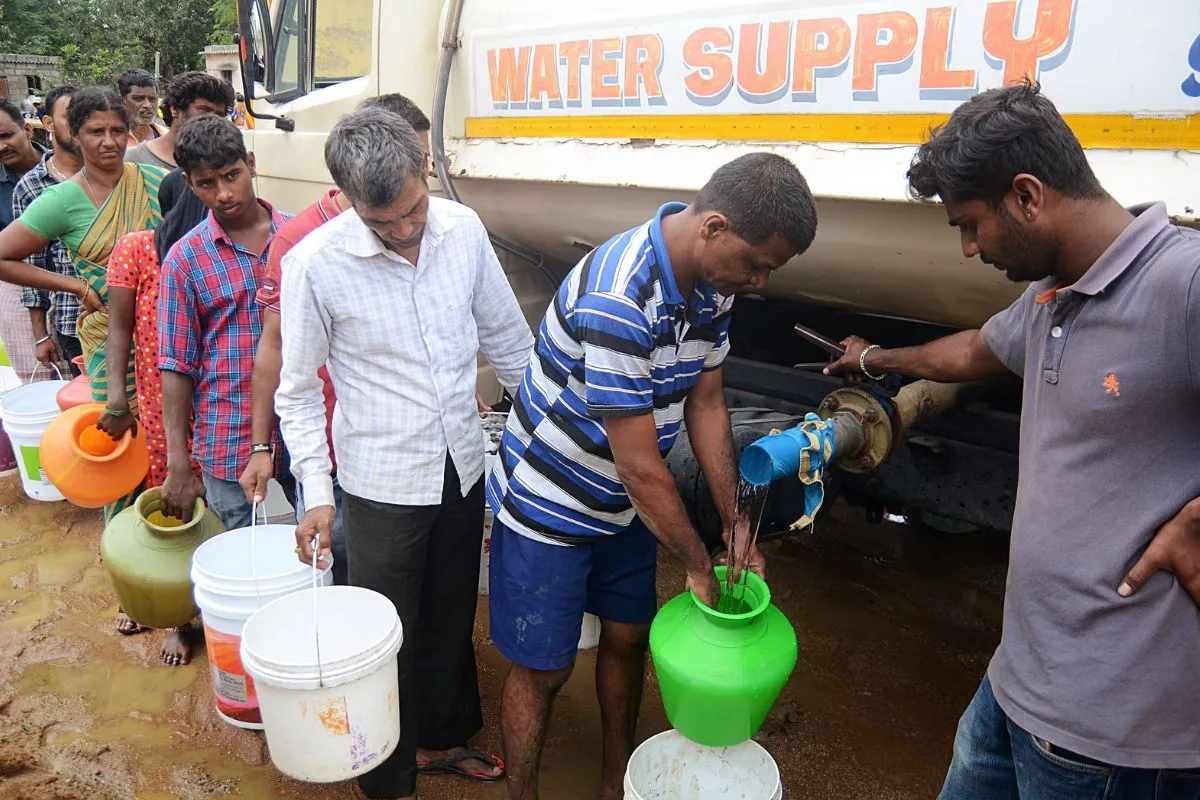
Bengaluru registered a surge in demand for water tankers amid boiling mercury. Along with the issue of groundwater quality, the rising demand for tankers has significantly contributed to the increase in prices of these tankers.
With the temperature touching 34 degrees Celsius already, the borewells in the outskirts of Bengaluru have reportedly dried up, leading to a spike in demand for water tankers in the area.
The price of a load of 12,000 litres of water has shot up to 1,500 to 1,700 already, while peak summer is yet to come. Earlier the same load of water was costed at 1,000 to 1,200 rupees as rice cap fixed by the civic administration in the summer of 2024, reported The Hindu.
Why The Price Hike
Tank owners have to cover extra miles to fetch water due to the nearby borewells getting emptied, the report said. A tank owner, Venkatesh Chandrappa, was reported as saying that with a 12000-litre water tank at 1480, they are not even able to extract the amount of water required.
“We are going as far as Muttenalluru, 30 km from Bengaluru’s periphery, to fetch water from borewells, as most of the borewells on the city’s outskirts are drying up. The cost of the extraction of water, even from borewells that are far from the city, is only increasing. Moreover, since the groundwater levels are plummeting even there, we can extract only four or five loads a day, as against over 10 loads otherwise. All these have added up to the cost,” The Hindu cited him.
Recommended For You
ALSO READ: 5 Best Bedroom Colour Ideas To Elevate Your Mood And Get Restful Sleep
Chandrappa explained to the media portal that though people have shifted to Cauvery water from tankers, they have not been able to fully trust the quality. “Even those who have opted for the Cauvery connection don’t fully trust it enough to cancel our contracts. They have only reduced the quantity they purchase,” the report quoted him as saying.
A study conducted by the BWSSB and the Indian Institute of Science (IISc) in January 2025 warned that groundwater levels could drop by up to 25 metres in some areas during March and April. The study identified 80 wards, including 110 villages, as being at high risk.
“We had alerted residents that groundwater levels would decline in summer and urged them to get a Cauvery connection, but many are yet to do so,” the report quoted Chairman of the Bangalore Water Supply and Sewerage Board (BWSSB), V. Ram Prasath Manohar.