
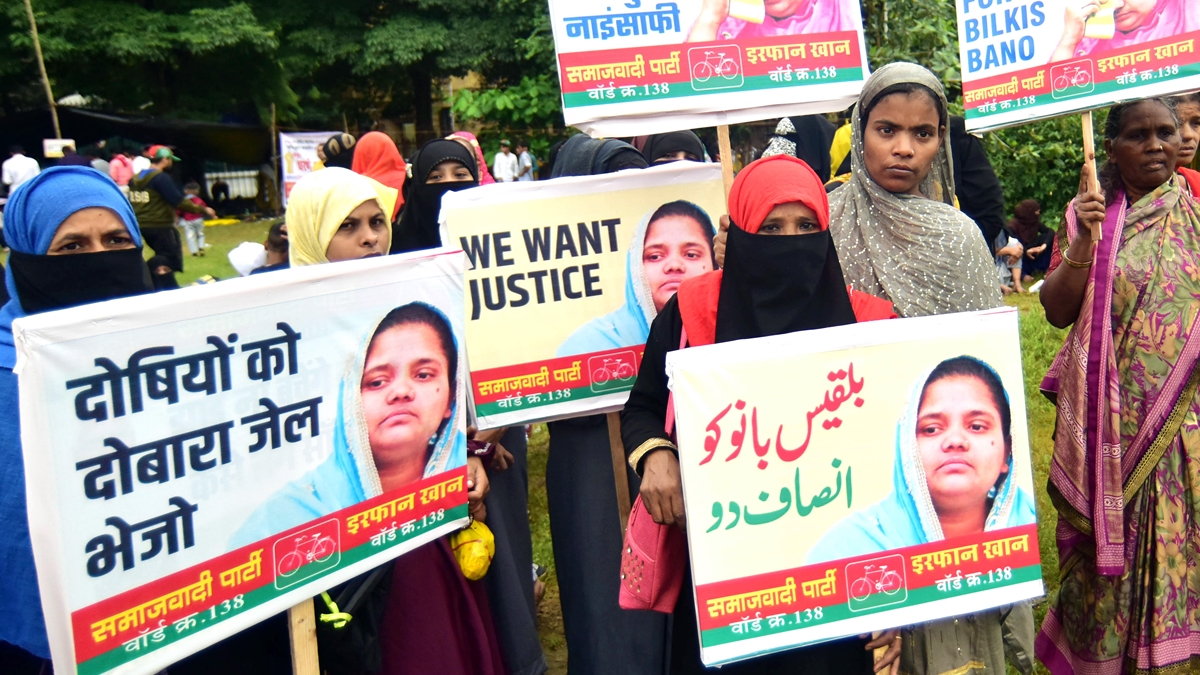
In a win for rape survivor Bilkis Bano, the Supreme Court on Monday quashed the Gujarat government order allowing early release of 11 convicts sentenced to life imprisonment for gang rapes and murders during the 2002 communal riots in the state. The Supreme Court order came over four months after the convicts were released on August 15, 2022, when the state government approved the remission of their sentence.
Bilkis Bano was one of the several victims who were subjected to mob brutality in the 2002 violence, which followed the Godhra riots. Bano was 21 years old and five months pregnant when she was gang-raped on March 3, 2002. Seven members of her family, including her three-year-old daughter, were killed by the convicts. After the early release of the guilty men in 2022, Bano and other petitioners approached the Supreme Court challenging the remission. A division bench, comprising Justices BV Nagarathna and Ujjal Bhuyan, which heard the petitions over 11 days, reserved its order on October 12.
Pronouncing the judgment on Monday, January 8, Justice Nagarathna said, "A woman deserves respect howsoever high or low she may otherwise be considered in society or to whatever faith she may follow or whatever creed she may belong to. Can heinous crimes against women permit remission? These are the issue which arise." The judge observed the case involved competing interests of victims and convicts. On one side are rights of the victims to justice and on the other side are the convicts' rights to another chance at remission.
Recommended For You
#WATCH | Firecrackers being burst outside the residence of Bilkis Bano in Devgadh Baria, Gujarat.
— ANI (@ANI) January 8, 2024
Supreme Court today quashed the Gujarat government's decision to grant remission to 11 convicts in the case of gangrape of Bilkis Bano. SC directed 11 convicts in Bilkis Bano case… pic.twitter.com/T7oxElwgcY
Bilkis Bano Case: Key Observations By SC Bench
1. The Supreme Court on Monday upheld Bano's petition challenging the early release of the convicts, saying it was "clearly maintainable" under Article 32 of the Constitution. Further, on the maintainability of other petitions filed as public interest litigation (PILs), Justice Nagarathna said, "We do not think it is necessary to answer this question since one of the victims herself has approached the court. The question of the maintainability of the PILs do not call for an answer, being rendered academic and is left open in an appropriate case. Consideration of the merits of Bano's petition is enough."
2. The apex court further stated that the exemption order by the State of Gujarat "lacks competence". The ruling cited Section 432 of the Code of Criminal Procedure, which mandates that the concerned government seek the opinion of the convicting judge while considering applications for premature release.
"This clearly means that the place of occurrence of the incidence or place of imprisonment are not relevant considerations, and they have been excluded from the definition of Section 432 of the Code of Criminal Procedure. The intent of the legislature is that the appropriate government is of the state within which a convict was tried and sentenced. The emphasis is on the place of trial and sentence, rather than the place of commission of offence or sentencing. This also takes within its ambit a situation where a trial is transferred from a competent court within the territorial jurisdiction of one state, to one in another state," Live Law quoted Justice Nagarathna as saying.
"On that short ground alone, the orders of remission has to be quashed. The competency of the State of Gujarat goes to the heart of the matter," Justice Nagarathna said.
ALSO READ: Massive Outrage After Bilkis Bano Gang Rape Convicts Released From Jail, Greeted With Sweets
3. Justice Nagarathna further highlighted that the government's direction was a nullity as it was was issued in a writ petition filed by one of the convicts, Radheshyam Shah, by suppressing material facts like an earlier decision of the Bombay High Court. "The convict played fraud on this court. The Gujarat High Court's order could not have been challenged in a writ petition, nor could it have been set aside in writ proceedings. Hence the said order is a nullity and non-est in law. Consequently, the May 2022 order is hit by fraud and is a nullity. It cannot be given effect to," she said.
4. Responding to whether the impugned remission orders were in accordance with law, Justice Nagarathna said, "Rule of law is breached because the Gujarat government usurped power not vested in it and abused its power. On that ground also, the remission orders deserve to be quashed."
5. The Supreme Court cancelled the release and ordered that the convicts be sent back to jail. Justice Nagarathna said, "If the convicts can circumvent the consequences of their conviction, the peace and tranquillity in the society will be reduced to a chimaera. The courts have to be mindful not just to the spelling of justice but also the content of it. It is the duty of this court to correct arbitrary orders at the earliest and to retain the foundation of trust of the public...We cannot forget the conduct of the convicts, particularly, the one who had abused the process of this court."
"The deprivation of liberty is justified inasmuch as they have been erroneously set at liberty. One cannot overlook the fact that they were in jail for a little over 14 years, with liberal paroles and furloughs. The status quo ante must be restored. Plea of protection of liberties of these convicts cannot be accepted by us. The rule of law must prevail. When the impugned orders are set aside, the consequences must follow," the ruling said.