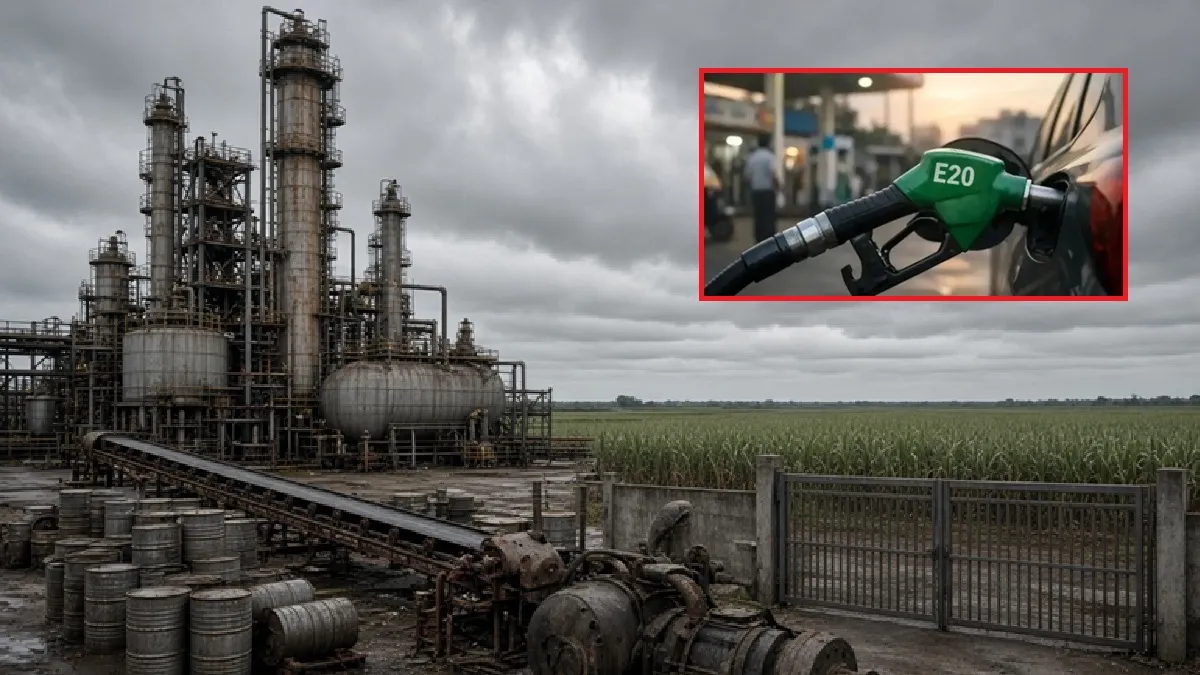
- India's ethanol production capacity exceeds 2,000 crore litres annually.
- Current ethanol demand significantly lags behind the installed capacity.
- Excess capacity puts Rs 1 lakh crore in bank loans at risk.
Jagran Correspondent, New Delhi | A fresh issue is emerging in India's ethanol market, which isn't being widely discussed. While ethanol production capacity in the country has rapidly increased to over 2,000 crore litres per year (approximately 478 plants), and new plants are being installed steadily, current demand is far below that.
This excess capacity is a major reason why the government is outright rejecting suggestions to restart the sale of E-0 (pure petrol) or E-10 (petrol mixed with 10 per cent ethanol) in the country despite all-round pressure on E-20.
Banks Have Lent Ethanol Sector Rs 1 Lakh Crore
Banks have lent this sector Rs 1 lakh crore. If blending is reduced, bank loans and investments worth thousands of crores will be at risk. According to information provided by the Ministry of Petroleum in Parliament, India's installed ethanol production capacity is currently approximately 2,000 to 2,019 crore litres per year.
Maharashtra, Uttar Pradesh, and Karnataka are leading the production. A Care Age Ratings report indicates that ethanol production is expected to add another 4 billion litres of production capacity by the current fiscal year, bringing the total capacity to around 2,400 crore litres. This capacity has increased more than fourfold from approximately 4.21 billion litres in 2014.
Recommended For You
12 Billion Litres Of Ethanol Demand Against Around 20 Billion Litres Production
Looking at the demand situation, the largest consumption is for petrol blending. E-20 blending is expected to require 12 billion litres of ethanol during the current fiscal year. Additionally, demand from industrial, pharmaceutical, and chemical sectors is expected to reach a maximum of 3.5 billion litres. Thus, the total effective demand stands at approximately 1,550 million litres.
ALSO READ: Normal Petrol Vs Power Petrol: Which Option Is Better For Turbo Vehicle Owners?
A significant portion of available capacity remains unused. E-20 petrol has been sold continuously across the country since December 2025, yet demand continues to lag behind capacity. Those involved in the ethanol industry say that despite the 7 billion litres of surplus capacity, plans are underway to develop an annual production capacity of 700-800 million litres.
No Indication Of Increasing Blending Percentage
Following the West Asian conflict, the central government indicated that ethanol blending would be increased in April 2026. The Petroleum Ministry has stated that 500 petrol pumps will begin selling E-85 (85 per cent blended petrol) by December 2026. But after this, the way the controversy regarding E-20 started in the entire country and the opposition is trying to corner the government on the issue, some sluggishness has started appearing in the government's preparations.
Chief Economic Advisor To GOI Advises To Sell E-10 And E-0
Despite the Petroleum Ministry's clear refusal to return to E-10 or E-0, V Ananth Nageswaran, Chief Economic Advisor to the Finance Ministry, has written an article advising to start selling E-10 and E-0 again.
Industry sources say that the ethanol production capacity already installed in India will only be fully utilised when E-30 or higher ethanol-blended petrol begins to be sold. At the current rate of demand growth, there will be a demand for 16 billion litres of ethanol by 2029-30. However, this growth will be gradual.
Export Could Be An Option
Until then, the burden of excess capacity will remain on industry and banks. Exports are an option, but there has been no clarity from the government on this issue. Exports of ethanol made from sugarcane, corn, and grains are currently prohibited. Exports of ethanol made from agricultural residues and biomass are permitted starting September 2025, but little progress has been made.
Some ethanol, totalling around 100 million litres, has been shipped to Tanzania, Angola, Kenya, Iraq, and Nepal. The industry is urging the government to explore export possibilities by talking to countries like Nepal and Indonesia.