
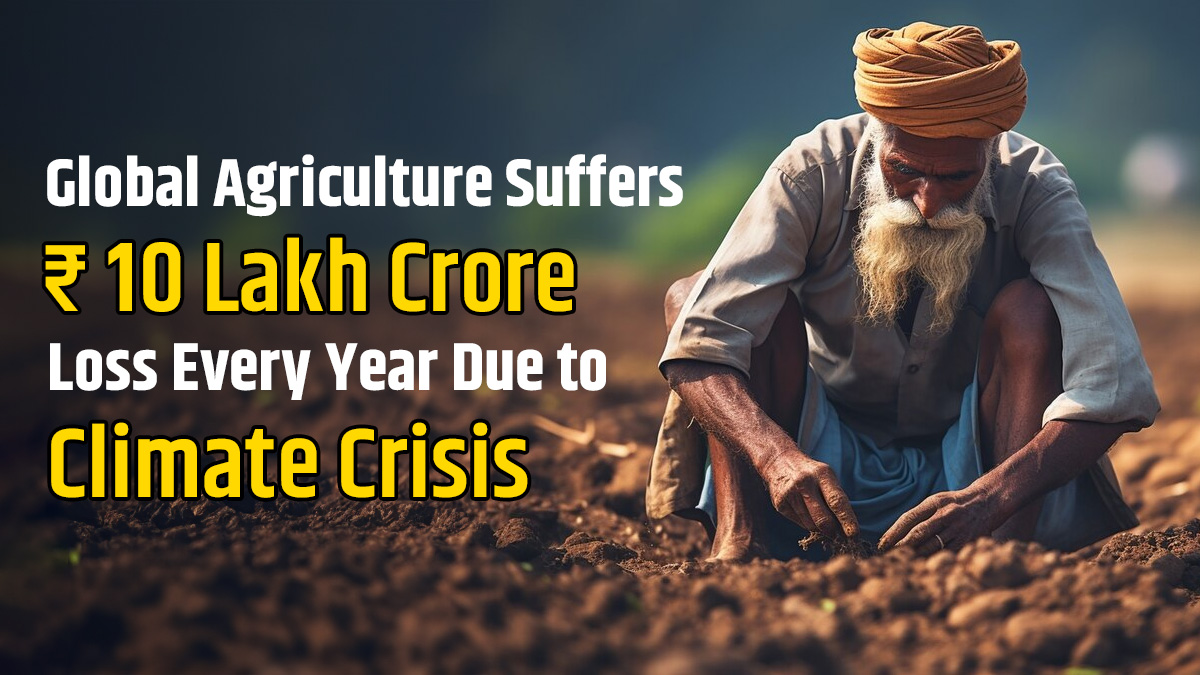
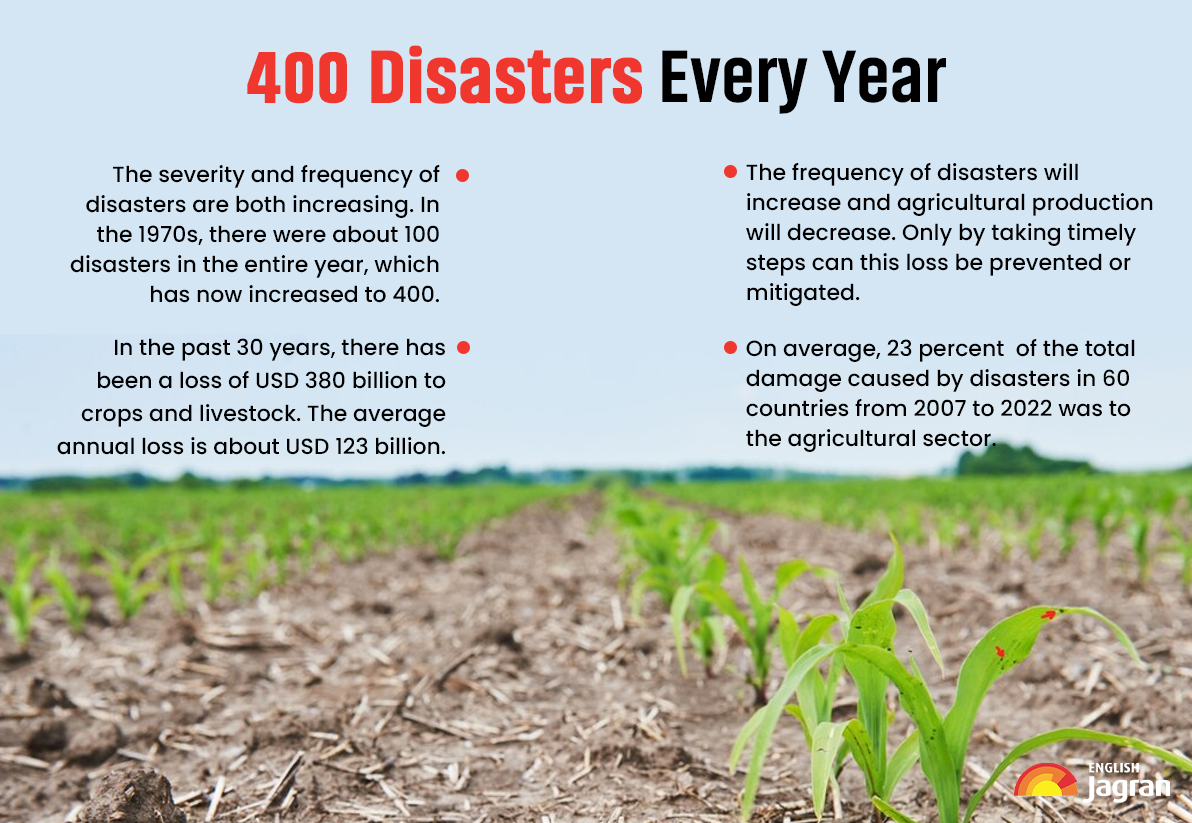
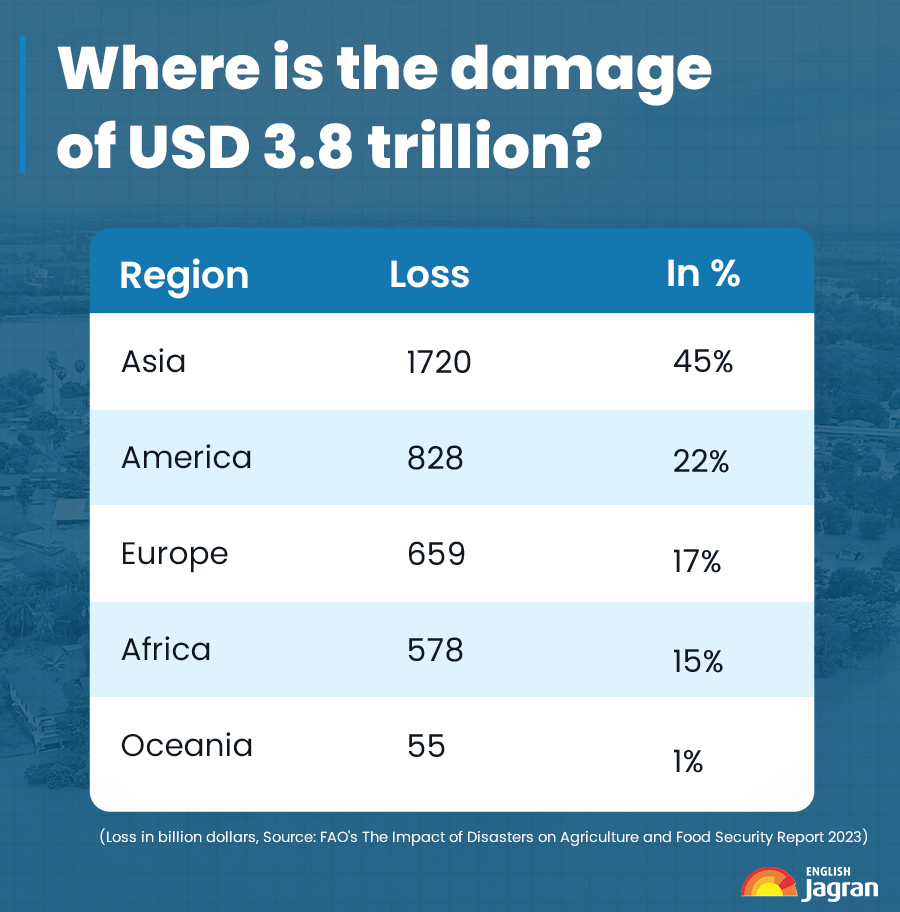
The impact of climate change on agriculture is increasing year by year. The number of disasters caused by climate change is rising every year, as is the damage caused by them. According to the United Nations Food and Agriculture Organization (FAO)'s 'The Impact of Disasters on Agriculture and Food Security Report 2023', there were about 100 disasters throughout the year in the 1970s, which has now increased to 400. This is due to climate change. In the last 30 years, disasters have caused damage of USD 38 billion to crops and livestock. The average annual loss is USD 123 billion, or about Rs 10 lakh crore. In other words, every year, production equivalent to five per cent of the world's agricultural GDP is lost due to these disasters. An analysis of data from 60 countries from 2007 to 2022 shows that about 23 per cent of the total damage caused by these disasters has been to the agricultural sector. In agriculture, drought is the primary cause of 65 per cent of the damage.
At the climate conference ‘COP 28’ held in Dubai, FAO, the Food and Agriculture Organization has released a new report - Loss and Damage in Agri-food Systems. The report found that climate-related events, such as extreme weather, sea level rise, and drought, are causing significant losses and damage to agricultural and food systems. These losses can manifest in a number of ways, including reduced crop yields, damaged infrastructure and lost livestock. The report also found that India is among the countries which are most vulnerable to the impacts of climate change. India is heavily reliant on rain-fed agriculture, and it has a large population of small and marginal farmers. These factors make India particularly susceptible to the impacts of climate change. In India, 70 per cent of rural households rely on agriculture for their livelihoods. As a result, climate change is a major threat to the livelihoods of millions of Indians.
Impact Of Climate Crisis In India
According to the report, climate change will play a significant role in shaping lives and livelihoods in the coming decades. This could lead to a decline in crop yields. For example, if the average temperature rises by one to four degrees Celsius, rice production will decrease by 10 to 30 per cent and maize production by 25 to 70 per cent. The impact will be more severe in states like Odisha, where 78 per cent of the fields produce rice.
The intensity and duration of heatwaves are increasing in India due to climate change. In March 2023, the temperature was three to eight degrees Celsius above average. This is the highest since temperature records began in 1901. Heatwaves have also damaged crops. In recent years, floods have also caused significant damage to agriculture in India. In 2022, floods occurred in many places during the monsoon season, causing damage of around USD 4.4 billion dollars.
Agricultural expert Devinder Sharma tells Jagran Prime, "We should not be surprised by the damage figures. All countries are suffering from this. According to a report, in India, there has been damage somewhere on 80 per cent of the days until September."
However, agricultural scientist Dr Ram Chet Chaudhary, who has worked for a long time at FAO, does not fully agree with the concerns expressed about India. He says, "This is just politics. It has been the tradition of other countries, especially Western countries, to blame India, to show India as inferior. India is still in a very good position right now; we export grains to many countries of the world."
However, Chaudhary points out three fundamental causes of the growing food problem in the world. First, natural disasters including floods, droughts, crop diseases or pests, etc. Second is war. Many countries in Africa and Asia have faced it. Third, there are some countries where there will always be a shortage of food, because the land available for cultivation and the favourable time available in a year are less than the population there.
Giving an example, he says, "I was in North Korea for some time. Wheat and maize are the main crops there. I estimated that even with maximum production, it will not be enough for the population there for the whole year. Self-sufficiency in food matters is very difficult for such countries. Import is necessary for them. Another thing, usually a farmer does not eat the seeds of crops. He keeps it for sowing crops next year. But if farmers in any place have started eating seeds, then it is a sign that the food problem is taking a serious shape there. He needs immediate help.
Livelihoods Of Millions Affected
FAO Director-General Qu Dongyu says that the Sustainable Development Goals can only be achieved when the agrifood system is made more efficient, inclusive, resilient, and sustainable. He said that change is extremely necessary because hundreds of millions of people around the world are deprived of nutritious food, more than 700 million people are grappling with the problem of hunger, and 80 per cent of the world’s rural population depends on the agrifood system for its livelihoods.
In fact, the agricultural food system (agrifood system) is inextricably linked to climate change. Every year, billions of dollars’ worth of crops and livestock are damaged, and on the other hand, the agricultural food system also plays a major role in climate change. The contribution of the agricultural food system in total greenhouse gas emissions is approximately 29 per cent. The loss and damage caused by climate change directly affects people who depend on agriculture because it affects their livelihood. The importance of this can also be understood from the fact that in 2020, the total turnover of the agrifood sector was USD 3.6 trillion dollars and 866 million people were working in this sector worldwide. In developing countries, it is the main source of income and food security for millions of people. The Global Report on Food Crisis 2023 reported that in 2022, the number of people facing severe food insecurity in 58 countries in 2022 reached 258 million.
Impact On Crop Quality
The Loss and Damage report, citing data released by the Intergovernmental Panel on Climate Change (IPCC) in 2022, states that rising temperatures have also affected the quality of crops. It has also had a negative impact on fish farming. There are some areas where the production of selected varieties of crops and livestock will not be possible in the coming times. Adaptation, i.e., acclimatisation, has reached its peak. The steps taken for adaptation can no longer prevent damage. Now these are causing loss and damage for various sectors including agriculture. The damage occurring after the limit of adaptation is considered loss and damage.
The full assessment of the damage to agriculture from the disaster has not yet been done, but this is the first assessment of the impact of the disaster on agriculture worldwide. The Loss and Damage report states that the available figures are insufficient and more data is needed to understand loss and damage in the agricultural food system. Chaudhary also says, “In my opinion, this report is not technically strong.”
Which Measures Would Be Better?
Although the rate of increase in emissions may have decreased, greenhouse gas emissions are still increasing by 1.5 per cent every year. Given this, it is believed that the impact of this on the agricultural food system will be even greater in the coming days. The frequency of disasters will increase and agricultural production will decrease. The FAO report states that damage can be reduced by adopting adaptation measures such as 'climate-smart farming'. Taking steps before a disaster is more effective in saving both life and livelihood. The FAO estimates that if one dollar is invested to prevent damage, people benefit up to seven dollars. Some of the benefits are also non-economic. For example, food security is strengthened, people do not have to sell their land or home, nor do they have to borrow money.
However, Devinder Sharma does not agree with many things. He says, “The new model of mitigation, that is, reducing emissions, will be more harmful. The World Economic Forum has coined a new term, climate-smart agriculture. This is, in a way, the agenda of the world's major corporations. This is all being done to justify handing over agriculture to corporations gradually. For example, take the use of artificial intelligence in farming. This will only be in the hands of companies or selected people. Climate-smart farming will be technology-based, the control of which will be with the companies. We should talk about climate-resilient farming so that control remains in the hands of the people. A report states that recently 61 new Food Barons have been created. They are setting the agenda for agriculture.
He says, "This is COP 28. There has been no effective impact of the conferences held in these three decades. The rate of increase in emissions may have decreased, but it is still increasing. Everyone is talking about changing the food system, but no one knows what the new system will be."
He says that the climate crisis is being used to push farmers out of farming. “In recent days, 3,000 farmers in the Netherlands were forced to vacate their fields. The same happened with 5,000 farmers in England. In New Zealand, a tax is being imposed on cattle farming as methane gas is emitted from cattle. Companies are raising insects to meet people’s protein needs. In Finland, plants are being grown with the help of elements and bacteria present in the air. This will require neither land nor farmers,” says Sharma.
According to the agricultural expert, "We will have to stop chasing GDP. We cannot achieve the target of 1.5 degrees Celsius without changing the path of development. If GDP increases, emissions will also increase. In my opinion, the ecological farming system is the best solution for this, which India has. The world needs to learn from India.
He explains, “Eight lakh farmers in Andhra Pradesh are doing chemical-free farming without chemicals. Their yield has also increased. The state aims to reach this to 60 lakh farmers by 2030. It can be adopted in other states by making changes according to their climate. This could be the best way to get the world out of this crisis.”
(Note: This story has been translated by Ankit Kumar for Jagran English.)