

- MP government buses returning after 21 years.
- New service under PPP model, Sugam Parivahan Seva.
- Aims to end private monopoly, improve public transport.
Naidunia Correspondent: Government buses may once again be seen running in Madhya Pradesh after many years. The buses of the Madhya Pradesh Transport Department, which once plied the roads of the state, are now going to make a comeback. The Mohan Yadav government of Madhya Pradesh has begun preparations for this and has issued instructions to prepare the framework for this entire plan. It is believed that under the 'Chief Minister Sugam Parivahan Seva', government buses will once again be put on the roads of the state.
Why Were Government Buses Discontinued?
The story of the closure of private buses, which dominate the roads of Madhya Pradesh today, began around 1990. Before 2000, many buses of the Madhya Pradesh Transport Corporation were sold. Following this, the Transport Department entered into a new contract with private bus operators. Under this arrangement, the buses and drivers were private, while the conductors were owned by Roadways, the Madhya Pradesh government, and were paid by the government.
ALSO READ: Delhi-Bound Trains from MP to Be Affected in July; Shridham Express to Run On Diverted Route
This government contract with private bus owners ended in 2005. Consequently, the Central government's share in the Madhya Pradesh Road Transport Corporation was 29.5 per cent and the state government's share was 70.5 per cent. The state government gradually stopped providing its share of funding for the buses, leading to massive losses.
Before closing the Transport Corporation, the government had three options:
Option 1: Operate the buses in a smaller setup, which would have cost approximately Rs 900 crore.
The second option: Reviving the Transport Department and operating buses in a full-fledged format, which would have cost approximately Rs 1,400 crore.
The third option: Completely shutting down the department, which would have cost Rs 1,600 crore to provide VRS to employees.
ALSO READ: MP To Get Its First-Ever Aerocity In Indore; Hub To Feature Offices, Malls, And Hotels
The then Babulal Gaur government chose the third option in January 2005, permanently halting the operation of government buses in Madhya Pradesh by granting VRS to most employees.
Strong Lobby Of Private Bus Owners
There is speculation that the private bus operators' lobby in Madhya Pradesh is very strong, and allegations of collusion and influence over the government and officials have surfaced from time to time. Previously, the Shivraj government had attempted to introduce government buses, but the plans were shelved in the face of this powerful lobby.
People's Woes
The lack of government roadways buses currently poses serious challenges to the public:
Arbitrary Fares: Passengers frequently complain that private bus operators charge arbitrary fares.
Lack of Strictness: The Transport Department has been accused of failing to take appropriate action against private buses.
Lack of Safety and Public Amenities: During festivals and holidays, private buses are overloaded and passengers are charged double the fare.
What Government's Sugam Parivahan Yojana?
Now, the government is bringing back government buses in the state under the PPP (Public Private Partnership) model. In this model, the government and the private sector work together to provide public services. A state-level holding company, Madhya Pradesh Passenger Transport and Infrastructure Limited, and seven subsidiary regional companies have been formed for this purpose.
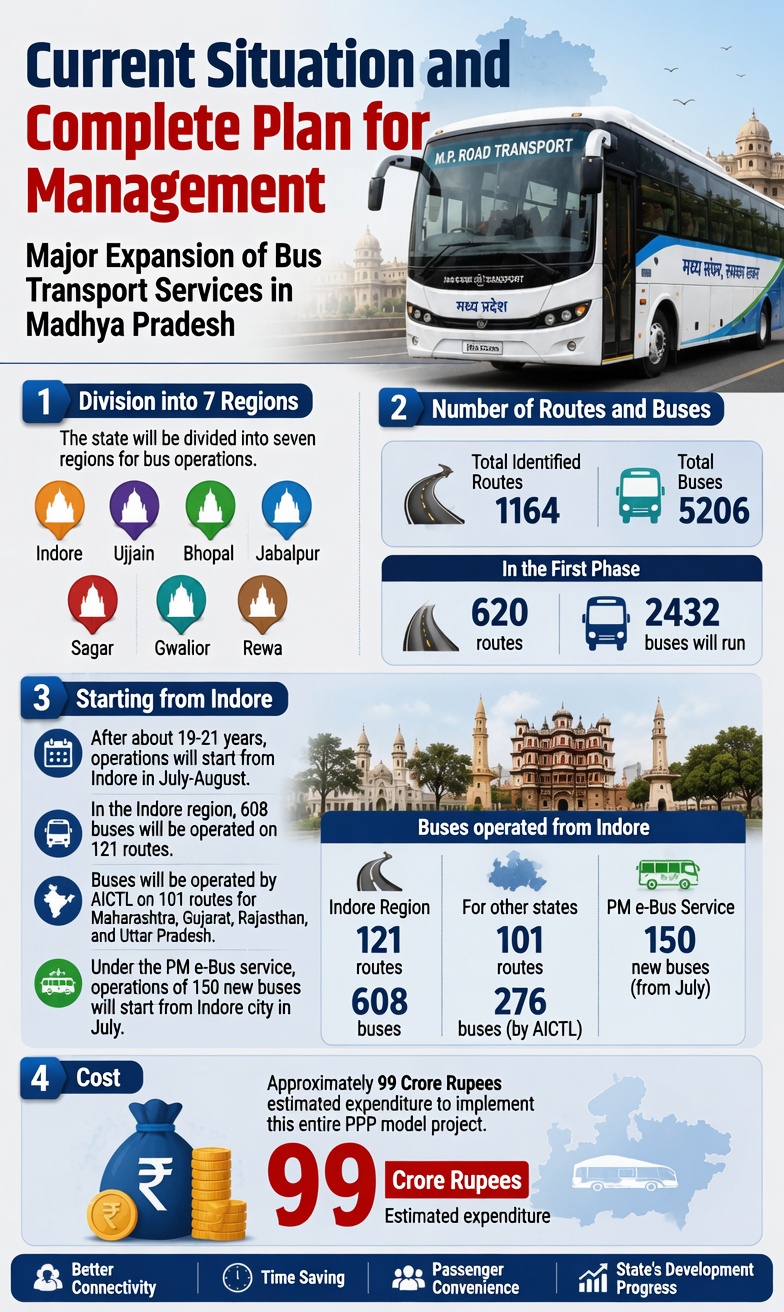
Current Status And Complete Operational Plan
Division into 7 Regions: The state will be divided into seven regions: Indore, Ujjain, Bhopal, Jabalpur, Sagar, Gwalior, and Rewa, where buses will be operated.
Routes and Number of Buses: A total of 1,164 routes of all categories have been identified in the state, with a total of 5,206 buses operating. In the first phase, 2,432 buses will operate on 620 routes.
Starting from Indore: After approximately 19-21 years, the service will begin in Indore in July-August. AICTL will operate 608 buses on 121 routes in the Indore region and 276 buses on 101 routes to Maharashtra, Gujarat, Rajasthan, and Uttar Pradesh. Additionally, 150 new buses will begin operating in Indore city in July under the PM e-Bus service.
Cost: The estimated cost of implementing this entire PPP-model project is approximately Rs 99 crore.
What Will Be The Benefits From The Project?
The introduction of government buses will eliminate the arbitrariness and monopoly of private operators. Passengers will enjoy affordable, safe, and fixed-fare travel. Connectivity will improve with the integration of interstate and suburban routes. This will create massive employment opportunities. A total of 1,330 positions (140 in the holding company and 1,190 in the regional companies) have been approved in the holding company and seven regional subsidiaries. These positions will be filled in a phased manner over the next four years on the basis of deputation, contract, and merger.
(With Naidunia Inputs)