
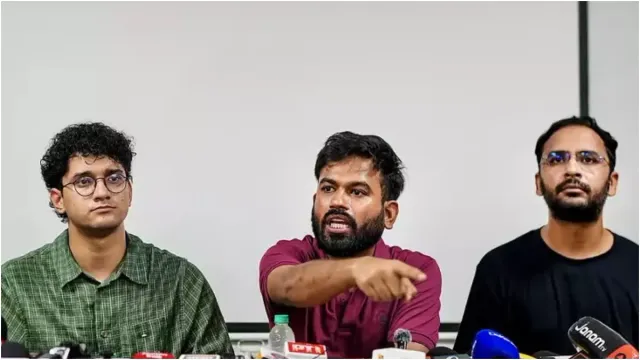
- Abhijeet Dipke granted bail by SEM court.
- Ranka, Das sent to judicial custody for trespassing.
- Court cited prior law violation for custody.
Cockroach Janta Party founder Abhijeet Dipke was released on bail by the SEM court on Saturday evening after furnishing a bond of Rs 50,000 and an undertaking that he would not disturb the peace. As he walked out of Mandir Marg police station, questions were raised on why Dipke-like relief was not granted to his two colleagues - Ashotosh Ranka and Saurav Das - whose five-day judicial custody ends today.
The development left people anticipating, as all three leaders, while getting a conditional bail on October 11, after being detained from the Air India flight over the October 10 protest call, were subject to similar conditions.
Das and Ranka were detained from Jantar Mantar on October 12 and put under preventive arrest. They were presented before the Executive Magistrate (SEM) court the next day and were sent to 5 days of judicial custody for trespassing at Jantar Mantar, the de-notified protest site, and breach of peace bond.
What reportedly differentiated their detention and subsequent arrest was that Das and Ranka had already broken the law by sneaking into a site not notified for protests, while restrictions under BNSS 163 were already in place and they were on conditional bail.
Recommended For You
In contrast, Dipke was detained before he could reach the Central Park at Connaught Place for a protest. While trespassing comprised an action to spread unrest, Dipke's detention was formally in line with a breach-of-peace case under Sections 126 and 170 of the Bharatiya Nagarik Suraksha Sanhita (BNSS).
Section 126 empowers the SEM Court to demand a bond for keeping the peace wile Section 170 allows Delhi Police to arrest a person to prevent a cognisable offence. Neither of these sections involves prosecution for an offence as such.
In Ranka and Das's case, reports suggest that the same sections were invoked along with allegations of trespass and obstruction of a public servant. The SEM court noted a serious apprehension that they would again violate the law and hence were sent to judicial custody.
However, the third CJP leader, Ajinkya Shinde, was released as he had no prior cases related to recent protests against him. Shinde was directed to execute a personal surety bond of Rs 5,000 and was bound down to keep the peace for six months.