
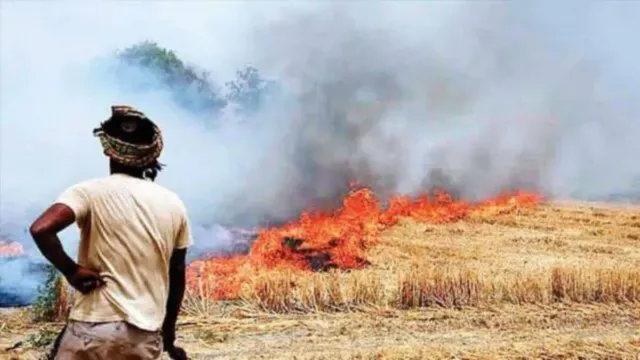
- Centre mandates ground monitoring of stubble burning after 3 PM.
- Farmers burn residue post-satellite detection to avoid capture.
- Haryana, UP show significant reduction; Punjab's reduction marginal.
The incidents of stubble burning have significantly reduced across the states year after year due to satellite monitoring, but the problem still persists, prompting the Central government to take additional measures. Union environment minister Bhupendra Yadav on Tuesday held a joint review meeting and asked Uttar Pradesh, Haryana, Punjab, Madhya Pradesh and Rajasthan to initiate ground monitoring, particularly after 3 PM.
Special focus was urged on Sangrur, Tarn Taran, Amritsar, Patiala, Gurdaspur, Kaithal, Karnal, Kurukshetra, Ambala, Fatehabad to assess crop-harvesting trends. This comes as several studies showed that several farmers are adopting a practice of burning the farm residue after 3 PM, when satellite movement creates a gap and hence does not capture images.
India's polar-orbiting satellites capture crop burning incidents between 10:30 am and 1:30 pm. District collectors must carry out ground assessments, and enforcement should include patrolling and flying squads, especially after 3 pm, when satellites do not pass over, Yadav said.
Agriculture Minister Shivraj Singh Chouhan called for 'war-footing' action while stressing the need for providing easy and affordable alternatives.
ALSO READ: Cleaner Delhi By Oct 31? CAQM Sets Hard Deadline To Clear Capital's Roadside Garbage And Debris
Speaking about reduction in farm fires, Chouhan said from September 15 to October 12, the incidents have seen a drop of 53.3 per cent in Haryana, around 32 per cent in UP as compared to last year.
However, Punjab has seen a marginal reduction as compared to last year. Meanwhile, Yadav has stressed linking the farm fire data with the Central Pollution Control Board (CPCB) and the Commission for Air Quality Management (CAQM) for more effective monitoring.
An Indian Space Research Organisation (ISRO) study in December last year suggested that farmers in Punjab and Haryana had shifted burning time from early afternoon to evening hours to avoid detection. ISRO flagged that such practices would lead to an underestimation of farm fires.
ALSO READ: Delhi's Air Quality Deteriorates Ahead Of Winter; Why 12 Hotspots Continue To Suffer? Details Inside
Notably, the air quality in Delhi starts worsening from September. Stubble burning usually happens around the same time. The bustling traffic, construction activities and Diwali firecrackers worsen the crisis further during peak winters.
Speaking about reduction in farm fires, Chouhan said from September 15 to October 12, the incidents have saw a drop of 53.3 per cent in Haryana, around 32 per cent in UP as compared to last year.
However, Punjab has seen a marginal reduction as compared to last year. Meanwhile, Yadav has stressed for linking the farm fire data with the Central Pollution Control Board (CPCB) and the Commission for Air Quality Management (CAQM) for more effective monitoring.
An Indian Space Research Organisation (ISRO) study in December last year suggested that farmers in Punjab and Haryana had shifted burning time from early afternoon to evening hours to avid detection. ISRO flagged that such practices would lead to an underestimation of farm fires.
Notably, the air quality in Delhi starts worsening from September. Stubble burning usually happens around the same time, adding to pollution woes of the capital. The bustling traffic, construction activities and Diwali firecrackers worsen the crisis further during peak winters.