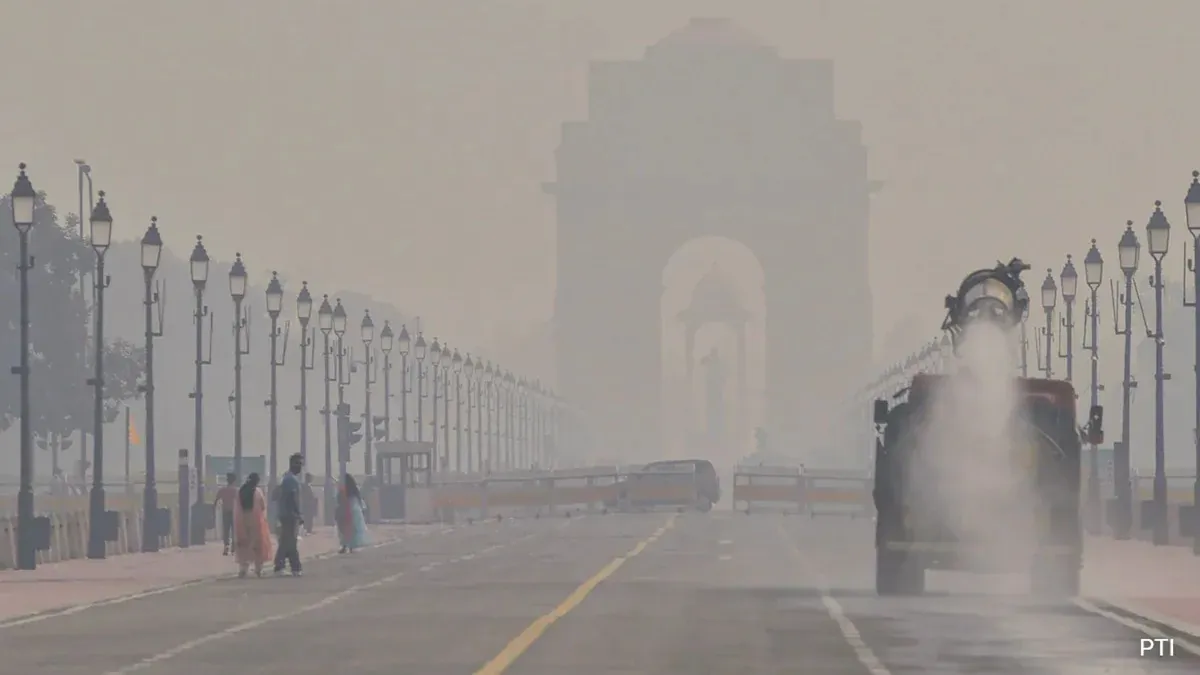
- Delhi's air quality 'very poor' (AQI 368), Nauroji Nagar 'severe'.
- Stubble burning, transport emissions major contributors to Delhi's pollution.
- Air quality expected to reach 'severe' category by November 6-7.
Delhi Air Quality: Delhi's air quality deteriorated sharply on Thursday morning, with the he Air Quality Index (AQI) standing at 368 in the 'very poor' category, edging closer to the severe threshold, as 22 monitoring stations recorded severe pollution levels. The AQI around Nauroji Nagar Ring Road was 416, categorised as 'Severe' by the CPCB (Central Pollution Control Board). Anand Vihar recorded AQI 293 at 7 am.
As air quality is expected to deteriorate further in the coming days, the national capital is bracing for worsening pollution as Diwali approaches.
#WATCH | Delhi: The Air Quality Index (AQI) in the area around Nauroji Nagar Ring Road is 416, categorised as 'Severe', as per the CPCB (Central Pollution Control Board). (Visuals shot at 07:10 am) https://t.co/1nZLAC9PA2
— ANI (@ANI) November 5, 2026
AQI In Delhi At 377 On Wednesday
Earlier on Wednesday, Delhi's air quality plunged to AQI 377, the highest since January 20. The index had settled at 378, making it the worst reading in 288 days.
ALSO READ: Gurugram Diwali Alert: Green Crackers Allowed For 2 Days, Full Ban From Nov 9 | Check Timings, Rules
IIT Delhi recorded the highest AQI at 458, followed by Jahangirpuri and Punjabi Bagh at 448 each, while Mundka recorded an AQI of 439. Of the 59 monitoring stations, 22 recorded 'severe' air quality, 32 were in the 'very poor' category and five recorded 'poor' air quality. According to the CPCB, an AQI between zero and 50 is classified as 'good', 51 and 100 as 'satisfactory', 101 and 200 as 'moderate', 201 and 300 as 'poor', 301 and 400 as 'very poor', and 401 and 500 as 'severe'.
Recommended For You
According to the Air Quality Early Warning System, Delhi's air quality is likely to remain in the very poor category on Friday. It is forecast to deteriorate further to the severe category from November 6 to 7. PM10 emerged as the dominant pollutant in Delhi on Wednesday, marking a shift from the previous three days when PM2.5 was the dominant pollutant. PM10 is generally associated with coarse particulate matter, including road dust and construction dust.
Stubble Burning Accounted For 20.2 Per Cent Of Pollution
According to the Decision Support System (DSS), transport emissions contributed 15.5 per cent to Delhi's pollution on Wednesday, while stubble burning accounted for 20.2 per cent. Delhi's other contributing sectors included industries (2.9 per cent), waste burning (1.3 per cent), construction (2.2 per cent), road dust (1.1 per cent), residential sources (3.8 per cent) and other sectors (1 per cent). Among the NCR districts, Ghaziabad contributed 7 per cent, Rohtak 3.8 per cent, Gurugram 2.7 per cent, Sonipat 2.2 per cent, Jind 1.8 per cent and Bhiwani 1.3 per cent. Other sources accounted for 28.5 per cent of the pollution.
Meanwhile, satellites detected 467 farm fires across the six study states on November 4, including 151 in Punjab, 10 in Haryana, 33 in Uttar Pradesh, 111 in Rajasthan, five in Uttarakhand and 157 in Madhya Pradesh.
(With Agencies Inputs)