
-1791293839745_v.webp)
- Francis Halzen awarded 2026 Nobel Prize in Physics.
- Recognized for IceCube Neutrino Observatory and ghost particles.
- Observatory detects high-energy neutrinos using Antarctic ice.
Nobel Prize In Physics: On Tuesday, the Royal Swedish Academy of Sciences has announced Belgian-American particle physicist Francis Halzen as the winner of the 2026 Nobel Prize in Physics. The 82-year-old Halzen has been awarded the Nobel Prize for his remarkable work of creating an observatory to detect high-energy neutrinos known as “ghost particles and establishing how they are made. The Nobel Prize is now added to extensive career achievements, including the Balzan Prize, the Bruno Rossi Prize, and election to the National Academy of Sciences. Currently, he is working with the University of Wisconsin–Madison as the Hilldale and Gregory Breit Distinguished Professor.
BREAKING NEWS The Royal Swedish Academy of Sciences has decided to award the 2026 #NobelPrize in Physics to Francis Halzen “for decisive contributions to the IceCube Neutrino Observatory and the discovery of high-energy neutrinos of astrophysical origin.” https://t.co/UcPBWk0RiK
— The Nobel Prize (@NobelPrize) October 6, 2026
What Are “Ghost Particles”?
Ghost particles are neutrinos that have almost no mass, electrically neutral, and travel straight through solid matter, including planets, even without hitting anything. These are produced by the Sun during energetic atomic collisions, exploding stars, and other cosmic events in the universe. In contrast to electromagnetic waves such as visible light, the direction from which they arrive points back to the source; neutrinos do not get affected by even the strongest magnetic fields. Since they rarely interact with matter, detecting them requires a colossal target.
-1791293515743.webp)
Image Credit: X
Also Read: What Happened When Nobel Prize Winner Karl Deisseroth Told Family About His Win | Watch Video
How Detectors Buried In Antarctica Detect Ghost Particles?
Every second, billions of neutrinos pass through us without interacting with a single atom. However, if on rare occasions they collide with a single atom, a flash of light appears. With a detector that large, scientists can detect that flash. To solve this, Francis Halzen and the team at the IceCube Neutrino Observatory used Antarctic ice to capture them.
Scientists drilled deep holes into the Antarctic ice cap at the South Pole and lowered over 5,000 light sensors down to 2,400 meters deep. They turned a gigantic block of ice into an enormous detector.
On rare occasions, when neutrinos hit an atom in the ice, they produce secondary charged particles. As these particles collide with black and ultra-clear ice, they emit a faint blue glow called Cherenkov radiation. The buried light sensors detect the exact timing and pattern of the blue light flash. Tracing the light pattern backwards, scientists can determine where in the universe these particles have come from. The process is similar to tracing the path of a bullet to its source.
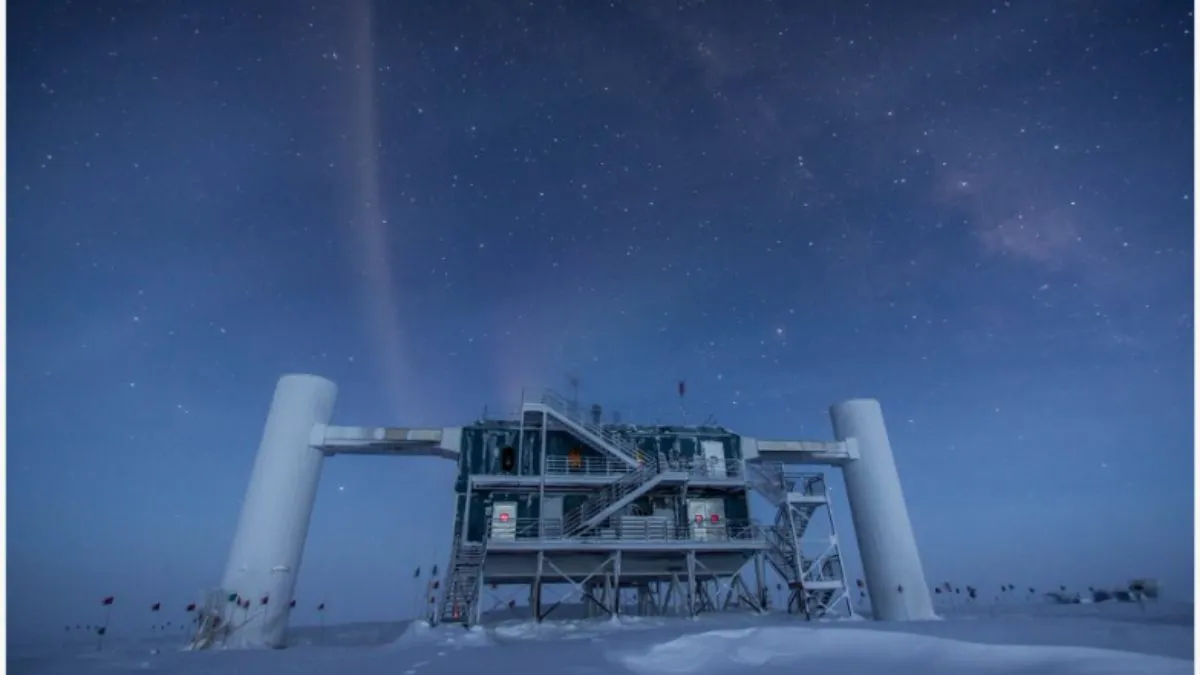
Image Credit: X
“The Astronomy Is Still To Come”
With the help of the IceCube observatory, the scientists have been able to determine that the high-energy neutrinos originate from within and far outside our galaxy. The quest to find the objects and processes that create them is still ongoing.
When asked about what could be learned about the universe through this method, Hazel said, "The real excitement is that I cannot answer that question yet. This is just an introduction to the science; the astronomy is still to come."
Also Read: Andhra Police Arrest 2 In Pakistan-Linked Espionage Case; 13 Navy Personnel Among 18 Probed