
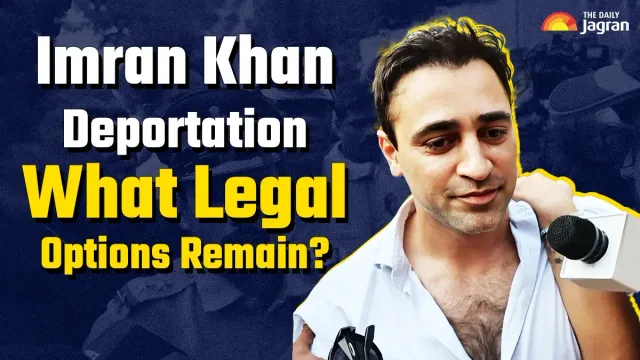
- Imran Khan to challenge 'Leave India' notice in High Court.
- Legal grounds include arbitrariness, procedural unfairness, OCI safeguards.
- Foreign nationals have constitutional rights under Articles 14 and 21.
A day after Bollywood actor Imran Khan was issued a ‘Leave India’ notice directing him to leave the country by October 28 over his participation in the CJP’s protest in Mumbai against the alleged irregularities in SIR, questions have arisen over the legal remedies available to him and the grounds on which he can challenge the order.
Imran Khan, the nephew of Bollywood superstar Aamir Khan, will also reportedly approach the Bombay High Court against the notice. The actor, who holds an American passport, participated in a protest at Mumbai’s August Kranti Maidan demanding the resignation of Chief Election Commissioner Gyanesh Kumar. He was also detained by Mumbai Police on October 10 during the protest.
According to his lawyer, Khan will challenge the notice before the High Court, with a petition expected to be filed next week. The case raises a significant constitutional question – How far can the State exercise its powers over foreign nationals without violating the principles of fairness and objectivity?
Recommended For You
While the Government of India has extensive powers to regulate the entry, stay and removal of foreign nationals, these powers are not absolute and remain subject to judicial scrutiny. The key distinction lies between the right to remain in India and the right to be treated in accordance with the law.
To examine the legal options available to Khan, The Daily Jagran spoke with Mohini Priya, Advocate-on-Record at the Supreme Court of India.
What Legal Remedies Are Available?
According to Mohini Priya, Khan can approach the Bombay High Court under Article 226 of the Constitution, seeking judicial review of the notice issued by the Foreigners Regional Registration Office (FRRO), as he holds an Overseas Citizenship Of India (OCI) card.
She identified several possible grounds for challenging the notice.
First, the absence of statutory justification.
The Immigration and Foreigners Act, 2025, empowers the government to regulate and remove foreign nationals. However, the authorities must identify the specific statutory provision, rule or condition of stay allegedly violated. Mere participation in a peaceful protest cannot automatically constitute grounds for deportation without reference to an applicable legal restriction.
ALSO READ: Imran Khan Asked To Leave India: Can OCI Cardholders Participate In Protests In India? What Law Says
Second, arbitrariness under Article 14.
If the government's order is based on unproven rumours, mistakes, or irrelevant reasons, Imran can argue that the decision is arbitrary; it may be challenged as arbitrary and indicative of a non-application of mind. (meaning it was made unfairly without proper thought or evidence).
Third, procedural unfairness under Article 21.
Khan may question whether he was given adequate notice of the allegations, access to relevant information and an opportunity to respond, subject to applicable statutory exceptions and legitimate security considerations.
Fourth, safeguards governing OCI status.
Section 7D of the Citizenship Act, 1955, prescribes grounds for and procedural safeguards governing the cancellation of Overseas Citizen of India (OCI) registration. If Khan holds valid OCI status, the relationship between these safeguards and the separate statutory power to remove a foreign national could become an important issue for judicial consideration.
In simple language, the key question for the court will be whether the government can bypass these OCI protections using general deportation powers.
Finally, proportionality.
If his actions at the protest involved no violence and no incitement to violence, Khan can argue that deportation is too extreme (disproportionate) for what actually happened, and that the authorities failed to look at the full picture.
Does the Indian Constitution Protect Foreign Nationals Like Actor Imran Khan?
Mohini Priya explained that Articles 19(1)(a) and 19(1)(b), which guarantee freedom of speech and peaceful assembly, apply exclusively to Indian citizens. Therefore, Khan, as an American citizen, cannot directly claim these fundamental rights.
However, Articles 14 and 21 extend protection to every person within Indian territory, irrespective of nationality. Article 14 guarantees equality before the law and protection against arbitrary State action, while Article 21 prohibits the deprivation of life or personal liberty except through a procedure established by law.
Citing previous judicial cases, she said, "In Louis De Raedt v. Union of India, 1991 AIR 1886, the Supreme Court recognised that foreigners enjoy Article 21 protection but possess no fundamental right to reside or settle in India."
"Similarly, Maneka Gandhi v. Union of India, (1978) 1 SCC 248 established that procedures affecting personal liberty must be fair, just and reasonable. These principles provide the constitutional foundation for challenging executive action against foreign nationals."

( Image credits: Gemini AI )
The Constitutional Question
Asked what Khan could do to avoid being required to leave India, Priya suggested that he could seek an urgent interim stay along with a writ petition seeking to quash the notice or direct the authorities to reconsider it in accordance with the law.
She also noted that the government may legitimately regulate political activities undertaken by foreign nationals and invoke immigration or national security considerations. However, the exercise of such powers must remain within the constitutional and statutory framework.

Ultimately, the main question is not whether Khan has the exact same political freedom as an Indian citizen. The real question is whether the government followed the law and acted fairly and legally when it decided to send him away.