
- EC announces Special Summary Revision in 17 states/UTs.
- Readable PDF voters' list to be shared with political parties.
- Moves address opposition demands amid previous SIR controversy.
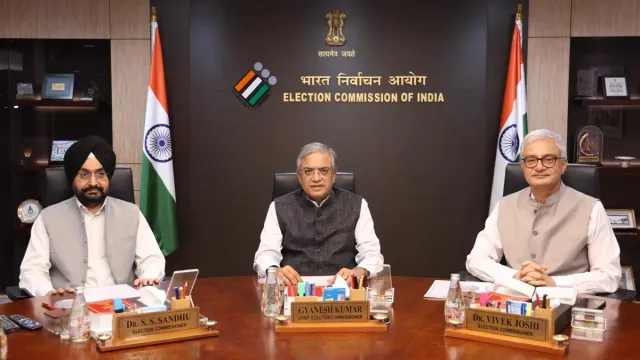
The Election Commission of India (ECI), which has been at the centre of a political storm over the alleged irregularities in its Special Intensive Revision (SIR) exercise, announced two big moves in the last 24 hours. The first move was the announcement of a Special Summary Revision (SSR) of electoral rolls in 17 states and Union Territories, while the second one was a decision to share a "readable" (PDF) version of the voters' list with political parties in the states and UTs where the SSR drive will take place.
Political Parties In Poll-Bound State To Get Readable Voters' List
The states where SSR will be held include Uttar Pradesh, Uttarakhand, Goa, Punjab and Manipur, where polls are due "early next year". The final rolls in these states and UTs will be published on January 4. While the term of the 403-member Uttar Pradesh Assembly ends on May 22 next year, the terms of 60-member Manipur, 40-member Goa, 117-member Punjab and 70-member Uttarakhand assemblies end on different dates in March 2027. The Representation of the People Act, 1950, allows the Election Commission to hold polls "earlier than six months before the term expires".
ALSO READ: What Is Special Summary Revision Announced By EC In 17 States? How It Differs From SIR | Explained
What Is SSR Drive?
The SSR drive, an annual exercise mandated under election law, aims to enrol eligible voters, particularly young and first-time electors, correct electoral roll entries and improve the purity of voter lists.
In its letter to chief electoral officers of these states, the poll authority said January 1, 2027, will be the qualifying date. In SSR, there will be no house-to-house BLO visits, as SIR has already taken place and electors have largely been identified.
Recommended For You
States where an SSR will be held are: Andaman and Nicobar Islands, Assam, Bihar, Chhattisgarh, Goa, Gujarat, Kerala, Lakshadweep, Madhya Pradesh, Manipur, Puducherry, Punjab, Rajasthan, Tamil Nadu, Uttar Pradesh, Uttarakhand, and West Bengal.
EC To Share "Readable" Version Of Voters' List For The First Time
The Election Commission will share "readable" version of voters' list with political parties for the first time. A machine-readable voter list has been a key demand of opposition parties. The EC has till now turned down this demand, citing fudging concerns and court orders. In a key change, the EC will provide political parties with soft copies.
Draft and final electoral rolls (without photos) will now be provided in "readable PDF format" instead of image PDF format. At the draft stage, addition, deletion, and modification supplements will be shared with recognised political parties.
The move comes amid allegations of mass voter deletions without keeping parties in the loop.
'राजनीतिक दलों को Machine readable डिजिटल वोटर लिस्ट देगा चुनाव आयोग' जी, आपने ठीक पढ़ा। नेता विपक्ष राहुल गांधी जी के हौसले के आगे ज्ञानेश कुमार और उसके आकाओं के अहंकार ने घुटने टेक दिए हैं। राहुल गांधी जी लगातार Machine readable डिजिटल वोटर लिस्ट की मांग कर रहे थे, ताकि वोटर लिस्ट में हो रही धांधली पकड़ी जा सके। लेकिन चुनाव आयोग इसके लिए बिल्कुल राजी न था, उसने इस मांग का खूब विरोध किया, लेकिन अब उसे हार माननी पड़ी। ज्ञानेश कुमार और नरेंद्र मोदी समझ गए हैं कि वे हमारे पहाड़ जैसे इरादों को हिला नहीं सकते। 'वोट चोरों' की विदाई अब तय हो चुकी है।
— Congress (@INCIndia) October 16, 2026
ECI has now agreed to provide machine readable electoral rolls to political parties. But the question is: Will it also provide the pre-SIR machine-readable electoral rolls? Because SIR is not only helping the BJP win multiple states but also burying evidence of the electoral crimes committed against the Republic before the SIR. Also, listen to the arguments he made when asked to provide machine-readable electoral rolls.
— Mohit Chauhan (@unmutemohit) October 15, 2026
Why Is Decision To Share Readable PDF Crucial?
The Opposition has been demanding readable voter lists to check for duplication for a long time, but the poll body has turned it down, citing privacy and misuse. In 2018, Congress leader Kamal Nath moved the Supreme Court for readable electoral lists, but the top court rejected the request, backing the EC's argument. Recently, last year, Congress MP Rahul Gandhi renewed his party's demand during his 'vote chori' campaign. In an X post, Congress termed the development as its big victory.
(With PTI Inputs)