
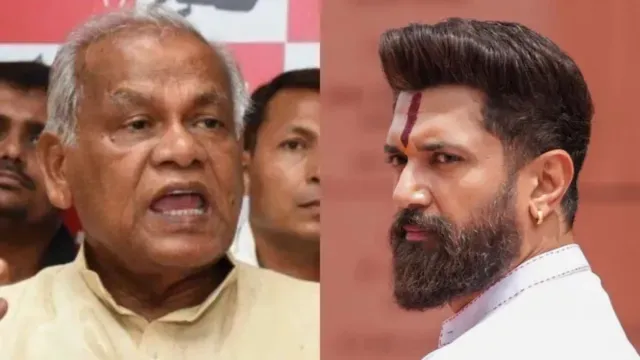
- Manjhi backs SC sub-quota; Paswan opposes creamy layer.
- NDA allies in Bihar face tension over reservation reform.
- Supreme Court allows SC sub-classification; OBC report pending.
The discussion around the reform in the reservation system, especially the implementation of the creamy layer in the Scheduled Castes (SCs), has brought new tensions for the BJP-led NDA as two important allies in Bihar have come face-to-face.
Hindustani Awam Morcha (HAM) chief and Union Minister Jitan Ram Manjhi has supported the demands of 'quota within quota'. He comes from the Musahar community and has been demanding sub-quotas for the marginalised communities. Manjhi's son, Santosh Kumar Suman, who is the Minister of Minor Water Resources in Bihar, has called for a review of the country's reservation policy. He wants to identify which classes have benefited and which remain backwards even after 79 years of independence.
Defending the reservation system, the father-son duo have demanded either an increase in the quota or separate arrangements for the marginalised sections who still haven't benefitted from the reservation system in the last seven decades.
Chirag Paswan objects to sub-quota
Chirag Paswan, another NDA leader from Bihar and a Union Minister, has objected to the implementation of the creamy layer provision in SC/ST reservations and said those advocating for this should resign first.
His statement was an apparent dig at Manjhi. He stressed that reservation policies were not based on economic status, but were designed to address centuries-old social discrimination, exclusion, and untouchability.
Tussle for Dalit leadership
This isn't the first time these two leaders have openly clashed over any issue. There have been numerous occasions in the past when these two Dalit leaders have taken diametrically opposed positions.
Political analysts believe that this open confrontation between the two leaders is actually a political battle for Dalit leadership in the state.
The BJP has strategically avoided any debate on sub-quotas within Dalits. In fact, it has opposed the Supreme Court verdict directing the implementation of the creamy layer in the SC and ST categories. The stand is perhaps guided by the awareness of the uncertain consequences of such a debate.
SC ordered sub-categorisation
In August 2024, the Supreme Court, in a 6:1 majority decision, allowed states to sub-classify castes within the Scheduled Castes (SCs), based on socio-economic backwardness and under-representation in government jobs, so that a larger share of the 15 per cent SC quota could go to the more backward among them.
The court also asked governments to establish appropriate criteria to prevent the "creamy layer" of SCs and STs from benefiting from reservations. In the process, the Supreme Court overturned the earlier decision of a five-judge bench in the E.V. Chinnayya case, which had held that SCs were a homogeneous group and could not be sub-classified.
OBC reservation status report held
The Modi government constituted a four-member commission headed by Justice (Retd.) G. Rohini in October 2017. Its purpose was to examine the unequal distribution of reservation benefits among OBCs and to scientifically establish mechanisms, criteria, norms, and parameters for sub-categorisation within them.
The commission submitted its report to President Draupadi Murmu on July 21, 2023. However, the report has not yet been made public. Clearly, the government likely does not want to stir up any new major problems or controversies, especially at a time when it is facing challenges to keep its upper-caste votebank intact.