New Delhi | S K Singh: A meritorious student, Ananya turned dull and lethargic after one of her exams did not go well. One day the 16-year-old texted her mother, "You deserve a better daughter than me." The sign was clear, but her mother did not understand then. The next day Ananya ended her life in her room. 17-year-old Tanya's behaviour had changed a lot during Covid-19. She would remain alone and experienced frequent mood swings and increased irritability. Unaware of her mental state, the family members took these things seriously when she went to the roof of the building to attempt suicide. Thankfully, she decided against it and returned downstairs. Kavya, who used to prefer light, slowly started liking darkness. She would stay alone and listen to sad songs. It took six months for her family to understand that she was in depression.
Ananya is no more in this world, but Tanya and Kavya are undergoing treatment and they have been doing much better. Experts say that children always give some indication before taking suicidal steps. If those signs are understood then suicides can be prevented. There is never a single cause of suicide. There are many factors working together. It is important to pay attention to them.
Recently, many incidents of student suicides have come in the limelight. The Uttar Pradesh Board of Secondary Education released the results of class 10th and 12th on April 25. At least seven students died by suicide within 24 hours of the announcement of results. Similarly, at least nine students ended their lives within 48 hours of the Andhra Pradesh Board declaring the intermediate results. Two more children tried, but were rescued. Earlier, there were reports of four students dying by suicide in two-and-a-quarter months from February 14 to April 21 in IIT Madras. In February, the case of Darshan Solanki, a BTech first year student at IIT Bombay, gained national attention. Kota, famous for coaching for competitive exams, and Delhi have also witnessed several incidents of student suicides this year.
However, this spike in student suicide cases is not sudden. Union Minister of State for Education Subhash Sarkar told the Rajya Sabha recently that from 2018 to mid-March 2023, a total of 61 students died by suicide in Indian Institutes of Technology (IITs), National Institutes of Technology (NITs) and Indian Institutes of Management (IIMs). Of these, 33 were students of IITs.
A survey of medical college students was conducted for a report in the Indian Journal of Psychiatry, a journal of the Indian Psychiatric Society. The study, conducted during February and March 2022, included 787 students with an average age of 21.08 years. Of these, 293 students, that is, 37.2 per cent said they had suicidal thoughts, 86 students or 10.9 per cent said that they were thinking of attempting suicide, 26 students or 3.3 per cent said that they had attempted suicide at some point in the past. The major causes behind these suicides or attempted suicides include poor sleep, a history of psychiatric illness in the family, bullying, depression and excessive stress.
Rising Cases Of Student Suicides
If we look at the statistics of the National Crime Records Bureau (NCRB), since 2018, every year more than 10,000 students (including girl students) have died by suicide due to some reason or the other. In the year 2021, of the total 1,64,033 cases of suicide, the number of students was 13,089. The alarming thing is that the percentage of students in the total suicide is increasing. Student suicide data is available with NCRB since 1995. In 1995, students accounted for less than 7 per cent of all suicides. It also declined in subsequent years, but in 2020 and 2021 this figure crossed 8 per cent. Comparing the figures of 2011 and 2021, total suicides increased by 21 per cent during this period, but student suicides increased by 70 per cent. In 2011, 21 students died by suicide every day. In 2021, this number increased to 36 per day, that is, three every two hours. The year 2021 saw the highest number of 56,543 suicide cases in the age group of 18-30.
According to the World Health Organization (WHO), about 8 lakh people die by suicide every year in the world. The total number of people who attempt suicide is even more alarming as it is 20 times those who die. This means every year 1.6 crore people try to end their lives. The suicide rate in India (per one lakh population) is higher than the world average. According to WHO, the global suicide rate in 2019 was 9. According to NCRB, this rate was 10.4 in India that year, which increased to 11.3 in 2020 and 12 in 2021.
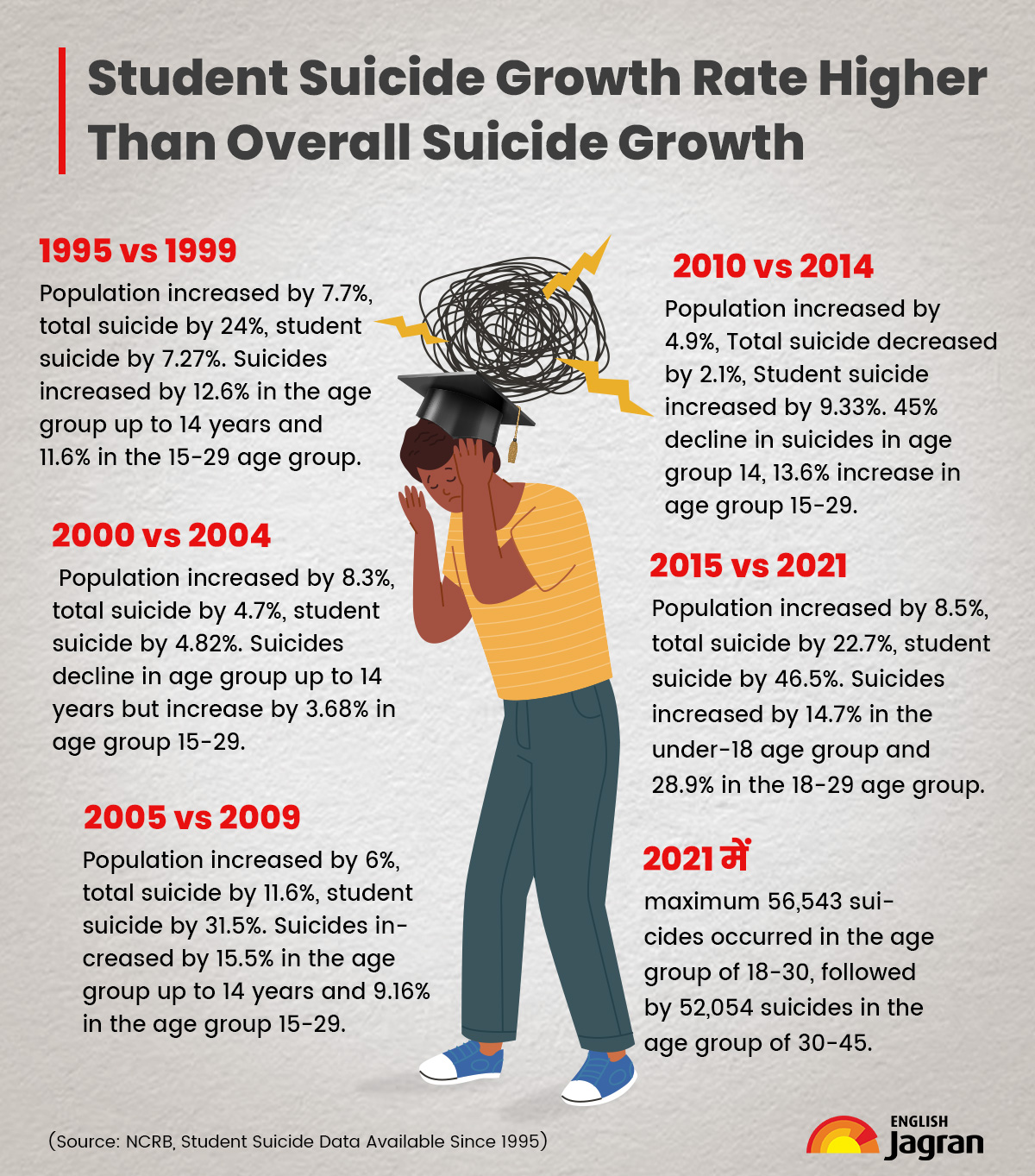
Student Suicide Growth Rate Higher Than Overall Suicide Growth
Suicide Cases Increased Due To Higher Reporting
Rohini Rajeev, senior psychotherapist, founder and clinical head of The Able Mind, a Bengaluru-based organisation, says, "There is much more reporting now than there was 10 years ago. Often children eat some poisonous substance. They think that eating it will kill them, but in most cases the child only has an upset stomach. Earlier, the parents used to get the child treated at home. If the child was taken to the hospital, they used to tell the doctor that he accidentally drank poison in his sleep. All they wanted was that the case should not be registered with the police." The parents feel that if this becomes known to everyone, then people will question their parenting style. Now the situation has changed a lot as parents feel that there are avenues of help available.
Acknowledging increased reporting, Dr V Senthil Kumar Reddy, Professor in the Department of Psychiatry at the National Institute of Mental Health and Neuro Sciences (NIMHANS), Bengaluru, talks about the Werther Effect. “When more suicide cases come to light, then people who are already suffering from various problems are triggered. This especially happens in students and those people who easily get involved into things. They think this is the best way to get out of problems."
Quoting the World Health Organization (WHO) report, Dr Reddy says, “Reporting of suicide should be done very sensitively, as the reporting done in the media can affect others as well. Many a times, even before the doctors reach any conclusion, the media calls an incident a suicide.”
According to Dr Om Prakash, Professor and Deputy Medical Superintendent, Department of Psychiatry at Ihbas Hospital, Delhi, "Suicide is a very complex phenomenon, so seriousness should be taken while reporting it. After the change in the law (the Mental Healthcare Act 2017 decriminalized suicide), there has been awareness among the people. Yet, we have records of only those cases that come to the hospitals. It is expected that the data will improve further with Aadhaar and digitisation."
Nalini, director of Delhi-based counselling organisation Sumaitri, also believes there is rising awareness around the issue. She says, "When I became a new volunteer 25 years ago, it was very difficult to refer someone to a psychiatrist or a counsellor. If I directly asked someone to go to a psychiatrist, he would have asked whether he was mad. This was the situation till 10 years back. But now people are going to psychiatrists and therapists before coming to us. Many times children themselves contact online counsellors without informing their parents. From this point of view, awareness has increased a lot which is a good thing."
Reasons For Suicide Or Stress
There is no single reason for suicide. Many reasons are working together. There comes a time when many factors dominate the person into thinking about ending one's life. Dr Chittaranjan Andrade, Senior Professor in the Department of Clinical Psychopharmacology and Neurotoxicology at NIMHANS and having over four decades of experience, considers depression and stress as the main causes of suicide. He says, "Students represent a population that is uniquely vulnerable to stress for 2 reasons: they are exposed to stress from multiple fronts and they have not yet acquired mature coping skills."
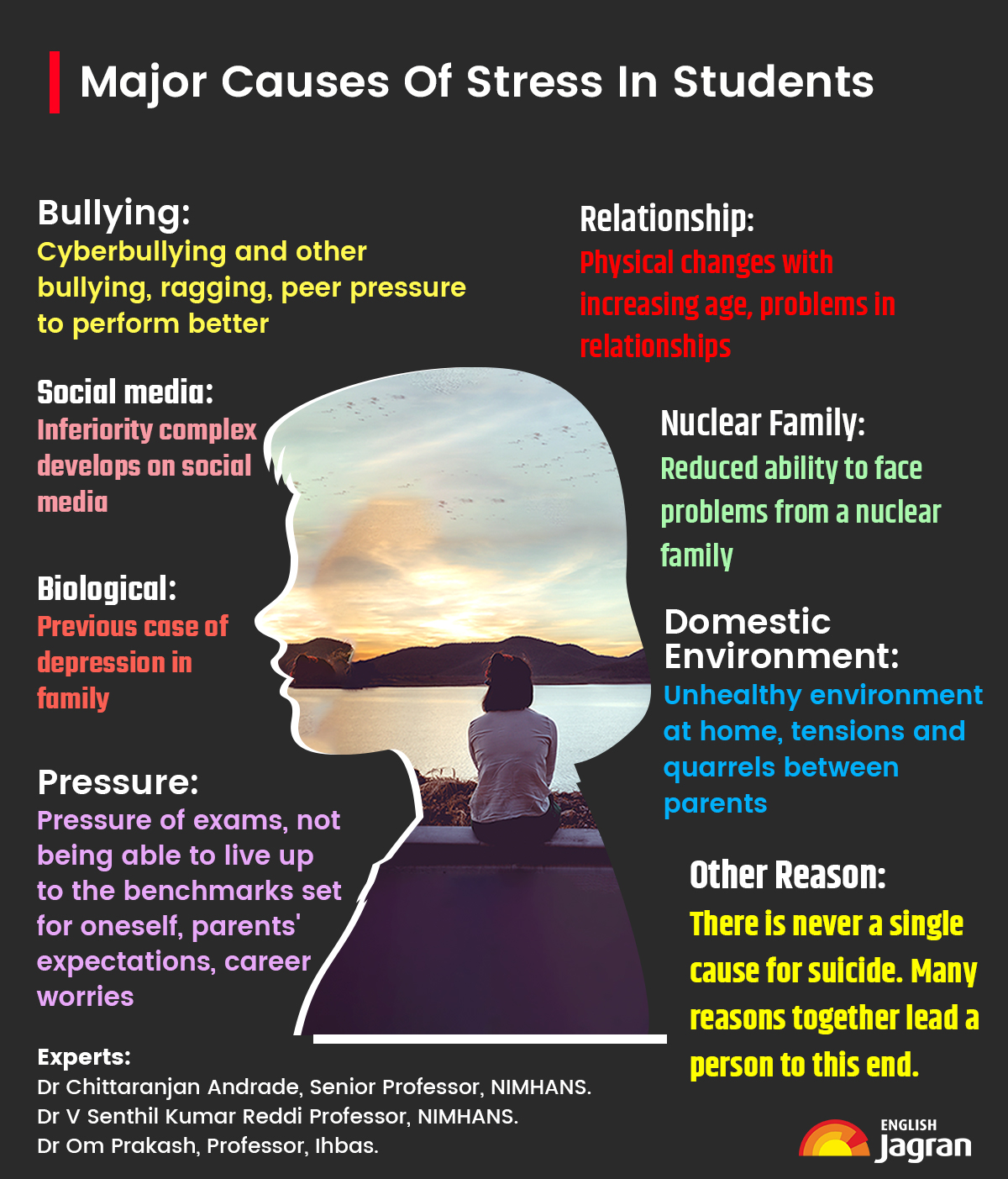
Major Causes Of Stress In Students
According to Dr Andrade, there are many types of stress in students - biological changes (including sexual maturation), boyfriend-girlfriend problems, peer pressure, bullying (including cyberbullying), examination pressure, parental expectations, career concerns, and others. Instead of spending time with family and friends and playing sports, students spend more time online, and hence they lack peer support.
Dr Reddy says, "It is possible that there is a biological weakness in the student, someone in the family has been a victim of depression in the past. Even if the relationship between the parents is not good, the child does not feel safe. The child's ability to cope with these most difficult situations is affected. In such a situation, it is possible that he starts taking drugs. Mood disorder can also be seen in him.
He says, nowadays children spend a lot of time on the Internet. It is possible that the child may ask for help from someone there. People often show only the positive side on social media. This makes the child feel that everyone is living a good life, and only his life is the problem. In this way, where he went to seek help, he starts feeling more alone.
It is also possible that the child may think of focusing more on studies. He has high expectations of himself and succumbs to the pressure. Maybe the benchmark he has set for himself is way beyond his capability. If he does not reach that benchmark, he considers himself a failure. Even this can create frustration in his mind.
Dr Om Prakash gives some other reasons, "Be it school, college or coaching institute, we have maintained ratings everywhere. Even at home, two children are compared to see who is good in studies and who is weak." He says, "Families create a lot of pressure on students. Apart from the family, this pressure is also from society. It is planted in the minds of the children that this target has to be achieved. People don't understand that every child has his own potential."
According to Dr Om Prakash, there is more tension in the middle class. He does not compare with the lower class people and wants to go to the newly rich class. All its pressure falls on the child. He feels that he is not able to fulfil the aspirations of the family.
He adds another important point, "It is also important to consider the child's ability to cope with a problem. While reporting in the media, it is written that the child committed suicide after the teacher scolded or someone said something. But the teacher scolded other children as well, so why did only one commit suicide? It means that the teacher's scolding was not the problem, the child could not tolerate that scolding."
Things like annoyance, restlessness, stress, depression are going on simultaneously in children. Without understanding this complex process, we tend to pick one reason.
Rohini also says, "There is never a single reason for suicide, many reasons together lead a person to this end. It does not happen that a student fails in one exam or if someone makes fun of him once, he will commit suicide. There are many reasons behind it. It is important to see how his state of mind is at a particular point of time, and how his support system is."
He says, the youth keep their problems within themselves, do not share them with anyone quickly. He feels that people will make fun of him, call him psycho. Due to increasing awareness, children are now slowly opening up in big cities, but they still hesitate in Tier 2-Tier 3 cities.
According to Nalini, “The fear of losing privacy is one of the reasons for not sharing your problems with anyone. The child feels that if he tells his friends, they will all 'judge' him. There are some things that he cannot share with everyone. For example, he may not want to talk to his parents about relationship problems. Due to not sharing with anyone, the problem gradually becomes so big that he cannot handle himself.
Asked if the Covid-19 pandemic has had an impact, Nalini says, "Before the pandemic, 20 per cent to 25 per cent of the calls we received were from students. Now 30 per cent to 35 per cent of phones belong to students. The number of calls increases a lot at the time of board results. In March-April, almost half of the calls are from students only. Students are under stress due to not getting expected marks or failing."
Covid has other effects too. At that time people had to stay locked in the house for a long time. Economic problems came in front of every class of people. Earlier, according to their capacity, they had to remove the children from the schools where they were teaching and put them in low-cost schools. All these things also affected the mind of the children.
According to Nalini, "Of the calls we get from students, the biggest problem is relationships. Economic problems are also a reason. People have started talking about sexual identity (Gay/Lesbian) as well. Loneliness is more in such people because they cannot talk to anyone about it.
She gives another reason, “Earlier families were joint and there was no social media. Everyone in the house used to talk to each other. That environment is no longer there. In a nuclear family, if both parents are working, then the child is alone at home. He meets other people only on social media. What people show on social media is not like that in reality. It increases the anxiety level in children."
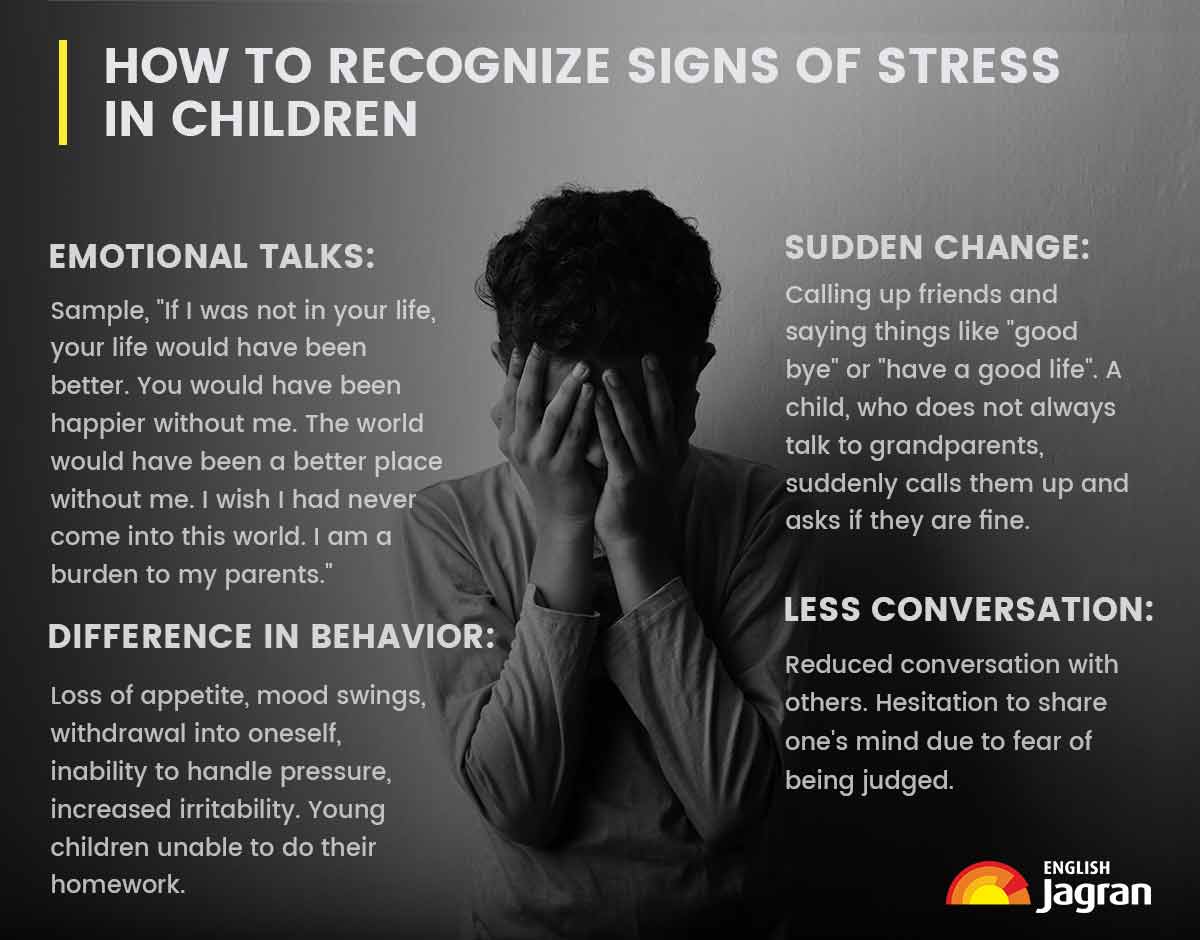
How To Recognise Stress In Children
Symptoms of Depression/Stress In A Child
Some of the visible signs of stress are sudden mood swings, withdrawing into oneself, reduced interaction with others, and talking about loss of will to live. According to Dr Andrade, “Unfortunately, parents are often not aware that there is a problem with the child. Sometimes classmates or online friends can signal depression or suicidal thoughts before parents.”
Rohini explains, “Usually the child does not talk about dying directly, he tries to convey his point of view indirectly. Like, 'If I was not in your life, your life would have been better'. He did not meet his friends for a few days and suddenly met them and said 'goodbye'. A child who does not talk to grandparents suddenly calls them and tells them to take care of themselves."
She says, “There is a general belief that those who talk about suicide do not actually do it, whereas it is not so. If the child directly talks about dying, it clearly means that he is asking for help. In response, we should not say “stop joking".
What To Do When Prompted
Dr Andrade explains, "Parents should interact more with the child, spend more time with them, counsel the child with emotional support. Parents should see that the child's expectations are not lost. Hope is the key, without it life has no meaning."
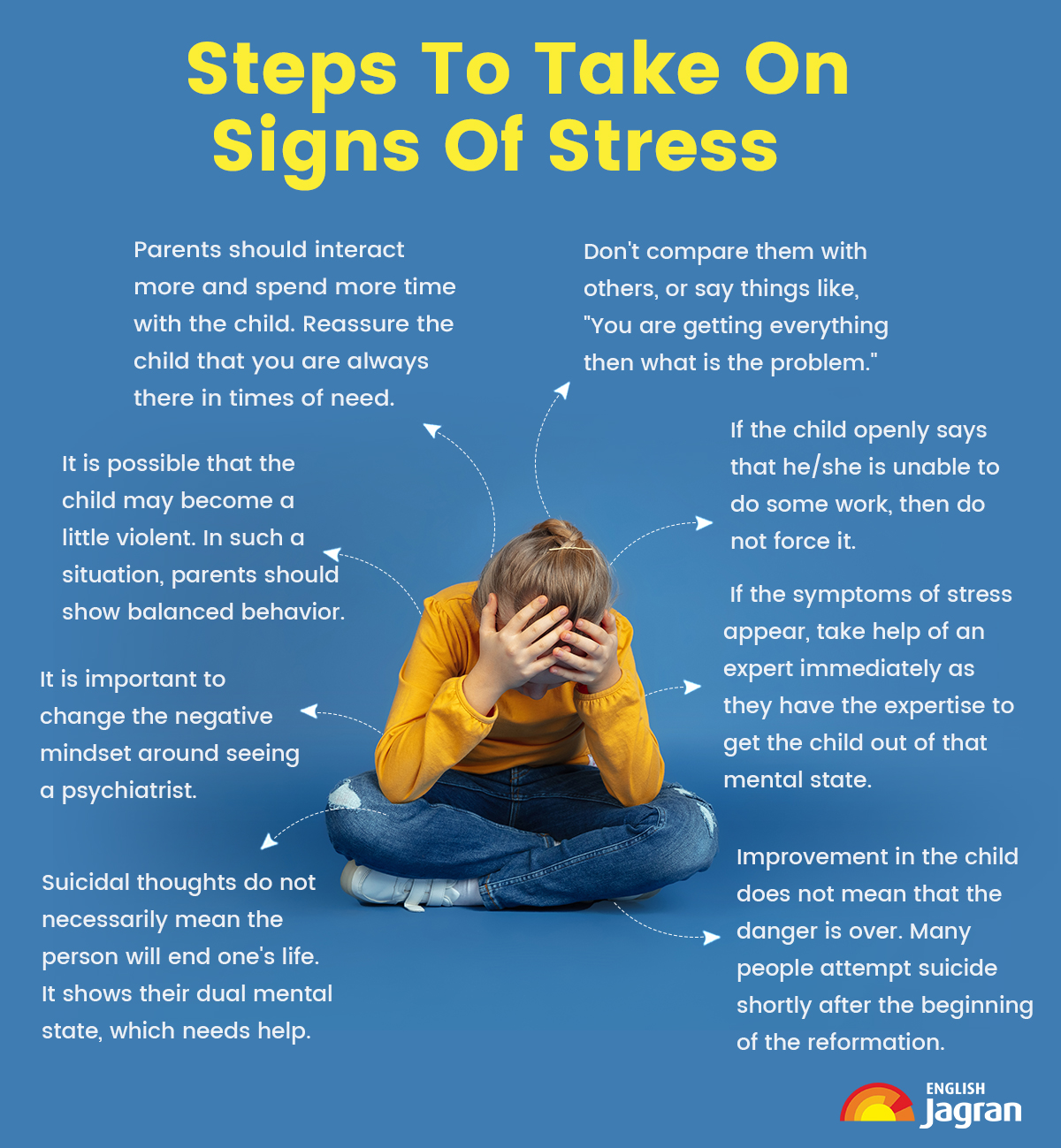
Take These Steps When You See Signs Of Stress
Dr Andrade says, Some suicides are completely unexpected because they are impulsive, triggered by a sudden relationship crisis or adverse examination result. It is important, therefore, for parents to keep communication lines wide open between themselves and their children, and this must be a way of life, cultivated from an early age."
According to Dr Reddy, "Parents have to create such an atmosphere in the house that the child can share all his problems with them. Many times children are unable to speak their mind for fear of scolding or criticism. Parents should listen to the child without being judgmental. Often parents hear the child's problem and dismiss it and say that we have struggled more than you, your life is very easy. By doing this, the child will gradually avoid sharing his point of view with you."
He explains, "The child needs to be taught how to solve his own problems. This learning will help them to deal with other problems in the future as well. Instead of keeping children completely away from technology and the internet, they should develop the ability to understand both its good and bad sides.
That is why Nalini says, "At Sumaitri Sanstha, we do not advise anyone to do anything. People listen to advice, but hardly follow it. So we try to make the kids capable enough to solve their own problems." She says, "We have also done counselling in many IITs. We have seen that there is a lot of tension among students above the age of 20 years. We tell them that if you feel like this, then you must speak your mind to someone or the other. Be it a family member or a friend. If you do not find any such person, then you can take help by calling a helpline number."
Dr Om Prakash makes a serious point, "Having thoughts of suicide is an emergency. Just as it is advised to take someone to the hospital immediately after a heart attack, similarly if a child talks about suicide, we should immediately take him to the doctor. One should try to get him admitted in the hospital for a few days. Such children need support. He needs someone to listen."
Need To Change Thinking
Sneha Rao, who runs a counselling organisation in her name after losing her daughter Ananya about a year ago, says, "Many parents tell me that they want to get their child admitted to IIT or a certain school. I say, you give the best education to the child, but it does not mean that every child has to score above 95 per cent. Every child's talent is different. Along with parents, children should also understand that not everyone can become Einstein or Abdul Kalam."
She says, "If your child shows signs of stress, discard any stigma or taboo and immediately consult a specialist, as they have the expertise to get the child out of that mental state. It is important for parents to understand what is going on in the child's life. Sometimes even their silence screams that I need help, but in our busy lives we tend to ignore those signals."
80-85 per cent of children become normal after two-three sittings, only 15 per cent of children require multiple sittings. Many times after two-three sittings the counsellor realises that the parents also need counselling. Then it becomes family therapy. According to Sneha, "A girl child came to me who was very difficult to explain. The girl felt that her parents needed counselling first. Actually, she was right. The parenting style of her parents was not right. Even grandparents may need to see a psychiatrist. I had a child come to me whose grandfather had said something to him that had stuck in his heart. Grandfather passed away, but the child could not get out of it."
Change In Learning Style
Dr Reddy of NIMHANS says, "Community, institutions, policy makers, educational institutions, teachers and parents all should look at what changes can be made to overcome this problem. There was competition among people earlier also, but today it is very high. We need to design a curriculum that focuses on the 'application' of knowledge rather than 'replication' of it."
He says, "There is a need to develop such a method of study in which group learning is encouraged. Instead of giving individual assignments to students, such projects should be given in which many students work together. This will lead to better coordination between them and create a healthy environment. This will work as life skill training. Coping strategies are included in the curriculum in many countries. Policy makers should consider this so that such a policy can be implemented at the right time and in the right way."
According to Dr Om Prakash, "It should be discussed in the school curriculum, in the media, in every household so that awareness increases among the people. It is necessary to make the child mentally strong so that the child does not go into depression or stress, does not get distracted by minor problems. Give him the opportunity to do small things. Like, send him to bring vegetables or any other item, ask a member of the house to drop him somewhere."
The good thing is that efforts have started in this direction. The IIT Council, the apex coordination body of all 23 IITs in the country, held its 55th meeting in Bhubaneswar on 18 April. On this occasion, Union Education Minister Dharmendra Pradhan said, "Recently some such incidents happened in various IIT campuses which should never have happened. It is the responsibility of all the faculty, deans and directors to ensure that there is no discrimination in any campus environment."
All IITs have also been asked to submit reports on specific reasons behind dropout among students suffering from mental health and taking suicidal steps. IIT Madras organizes 'Wellness Suggestion Series' for students after several students commit suicide in recent months. In this, along with giving information about mental health, ways to reduce stress are told. According to reports, IIT Bombay is considering reducing the syllabus for undergraduate classes. A Lite version of the academic plan will be released soon.
But there is still a long way to go. NCRB statistics show that people up to the age of 29 are committing the maximum number of suicides. Their number is more than 41 per cent in the total cases of suicide. More deaths occur due to suicide than road accidents in the country. According to NCRB, 1,55,622 people died in road accidents in 2021 while 1,64,033 people committed suicide. The Ministry of Health and Family Welfare has told on the Tele-Manas website that 15 per cent of adults in the country have mental health problems and need help.
That is why Sneha says, "We have failed as a society. If today we have children immersed in depression, then tomorrow the whole country will be immersed in this depression, because children are the future. That's why we should also take it like an epidemic. Even if we act now, it will take three generations for normalcy to return. The whole society has to come together to fight this pandemic. If we want to see our country healthy tomorrow, then we have to change our attitude towards mental health and children."