
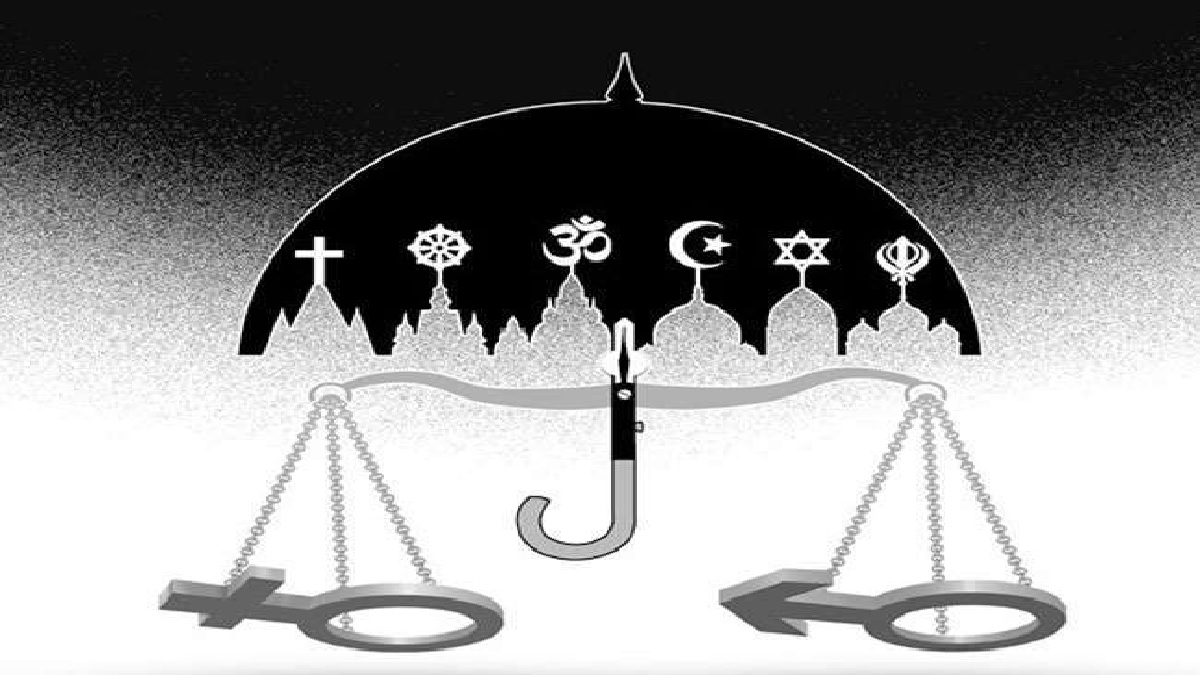
THE GUJARAT government on Saturday moved a proposal to constitute a committee, headed by a retired High Court judge, to evaluate all the aspects of implementing the Uniform Civil Code(UCC) in the poll-bound state. Assembly elections are scheduled to be held in the state later this year.
Harsh Saghavi, the Home Minister of Gujarat said, "Under the leadership of PM Narendra Modi & Union HM Amit Shah, CM Bhupendra Patel has taken a historic decision in the cabinet meeting today - of forming a committee for implementing the Uniform Civil Code in the state."
Earlier, the Uttarakhand government had announced its decision to implement UCC in the state. The same month, Himachal Pradesh Chief Minister Jairam Thakur had also announced that the UCC would be brought in the state.
What is UCC?
The Uniform Civil Code(UCC) resonates with the formulation of one law for India that would be applicable to all religious matters such as marriage, divorce, inheritance, and adoption. The term is mentioned in Part 4, Article 44 of the Indian Constitution. Article 44 states, "The State shall endeavour to secure for the citizens a uniform civil code throughout the territory of India."
Recommended For You
This issue has been at the focal point in Indian politics for over a decade now, and debate on its implementation has always been at the forefront.
The main intention behind its implementation is to replace the existing system of fragmented personal laws, which administers interpersonal relationships and matters related to them across different religious communities.
What Do We Follow Now?
In India, different religious communities are governed currently by a system of personal laws, which have been codified over the years via continuous legislation. These laws largely focus on marriage, divorce, adoption, inheritance, succession and a few others.
For example, Hindu personal law is codified under bills that govern succession, adoptions, maintenance, and guardianship. As with Hindu Personal Law, Muslims also have their own personal laws. However, they are not codified per se and are based on the religious texts of Muslims.
Christian marriages and divorces are also governed by the Indian Christian Marriages Act and the Indian Divorce Act.
There are also more "secular" laws which are beyond the purview of religion, such as the Special Marriage Act, under which inter-religious marriage takes place. There are certain exceptions for the states of Assam, Nagaland, Mizoram, Andhra Pradesh, and Goa to protect their religious identity with respect to family law.
The Benefits and Drawbacks
The Uniform Civil Code is intended to provide unified law to all the citizens of the country.
Personal laws of various religions differ; there is no consistency in the processes of marriage, adoption, and others that are treated differently for people from different communities. It clashes with the 'Equality Before Law' under Article 14 of the Indian Constitution.
Besides, reforms to personal laws have been inconsistent. There are multiple amendments made in Hindu personal laws, while Muslim law has seen comparatively fewer changes.
Personal laws have been derived from tradition and customs, and they, apparently, tend to give undue advantage to men. This is evident in examples such as Muslim men being allowed to have one or more wives while they are married to one woman. Whereas, women are not allowed to have multiple husbands during the course of their first relationship. They can only re-marry if they are divorced.
This gives way to gender inequality as there are many personal laws that are misogynistic in nature.
A UCC may lead to consistency in laws and may also lead to a gender-equal society when it comes to personal laws.
There are many loopholes in personal laws. Allowing personal laws to continue means that we have created an alternative judicial system based on values that date back thousands of years.
Amid the many benefits of a unified law, there are also flaws associated with it.
At the same time, UCC may reinforce equality before the law, but at the same time it clashes with the right to freedom of religion, which is a constitutional entitlement to all citizens of the country.
UCC is also being seen as a process to suppress the rights of minorities as personal laws is one of the way to exercise the right to practise their own religion.
The UCC is also considered as an attempt to erode the diverse ethos of the country and to collude the broader framework of country with different religious beliefs into one.
It is suggestive that instead of gaining political mileage, intellectual leaders from different communities should try to evolve a consensus with an intention of treating each person with dignity, something to which personal laws have failed to adhere so far.