
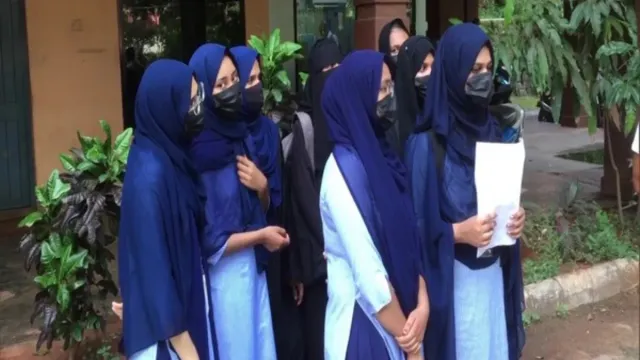
- Allahabad HC disallows hijab/scarf in schools.
- School uniforms promote discipline, equality, secular environment.
- Court cited previous judgments on institutional authority.
Legal Correspondent, Jagran: In a significant decision, the Allahabad High Court on Monday observed that wearing a headscarf or hijab is not permitted in schools and that a school uniform promotes discipline, equality among children, institutional identity and a secular environment, as it applies equally to students of all religions.
A division bench of Justices Jahangir Jamshed Munir and Indrajit Shukla made the observation while dismissing a petition filed by Sukaina Rizvi, a minor student of Tagore Public School in Prayagraj's Attarsuiya. She had sought permission to wear a headscarf, or hijab, in addition to the school's prescribed dress code.
The petitioner, a student, had graduated from high school at the school and wanted to enrol in Class 11. At the time of admission, the school management stated that wearing a headscarf violated the dress code and therefore she could not be granted admission. The student submitted two complaints (on May 14 and June 10, 2026) to the District Magistrate.
Recommended For You
The District Magistrate requested a report from the District School Inspector. Subsequently, the Assistant District Inspector of Schools heard both sides. The Principal clarified that the school is a co-educational institution, where students from all communities study, and a uniform dress code applies to all. Granting special exemptions to any one student could disrupt the system.
The girl stated that she had been wearing a headscarf since Class 6, and no objections had ever been raised. She even presented her ID card and group photographs from Classes 8, 9, and 10 to the court to support her claim.
The student's lawyer argued that wearing a headscarf is a part of the freedom of expression guaranteed under Article 19(1)(a) of the Constitution. It also relates to her dignity and bodily autonomy. Wearing a headscarf is part of her religious practice, he argued.
The state government and the CBSE also represented themselves in the matter. The counsel for the government and CBSE argued that the school was a private, unaided institution, not under the direct control of the state.
The decision to require uniforms is a matter of school policy, aimed at maintaining uniformity among students, the authorities submitted.
The High Court rejected the girl's argument of having adorned the scarf for a long time, saying that the failure to raise objections earlier could be due to laxity, negligence, lack of willpower, or even decency.
HC cited judgements of Kerala, Bombay and Karnataka HCs
The court also cited the Kerala High Court's observation in Fathima Thasneem vs State of Kerala, that a student's right to choose her dress and the institution's right to manage her are both fundamental, but when there is a conflict, the institution's larger interests should take precedence. It also reiterated the Bombay High Court's observation that covering the head does not constitute an essential part of Islam.
The famous judgment of the Full Bench of the Karnataka High Court in Resham vs State of Karnataka (Hijab Case 2022) was also cited in detail, which held that wearing of hijab is not a compulsory religious practice of Islam and the authority to decide the uniform rests with the institution.
This decision was challenged in the Supreme Court, where a two-judge bench delivered a split verdict. There has been no final and universally accepted Supreme Court decision on this issue.