

When floor space is capped at under 150 square feet, your only path to survival is going up. Most small home guides tell you to 'declutter'; we’re telling you to leverage your vertical footprint.
By reclaiming the unused air space between waist height and your ceiling, you can easily add 30 to 50 square feet of usable storage without feeling boxed in.
5 Smart Ways to Style & Position Your Shelving
Below are 5 vertical shelf ideas perfect for maximum load capacity, minimal footprint, and zero rental-deposit damage
1. Tension Rod Floor-to-Ceiling Modular Shelving
Best For: Renters, high ceilings, and non-permanent wall setups
Average Footprint: 12 inches deep × 24–36 inches wide
Weight Capacity: 15–25 lbs per shelf (depending on tension lock)
If drilling into drywall makes your landlord sweat, tension-mounted vertical shelf systems are your best friend. Modern tension columns lock securely between floor and ceiling using high-torque spring mechanisms, giving you a custom built-in look with zero hardware left behind.
Pro Tip: Always stick a rubber grip pad under the top plate to protect textured ceilings and prevent micro-slippage over time.
Why it works: It forces your eyes upward, drawing attention to ceiling height rather than cramped floor space.
How to style it: Keep heavier, bulkier items (like storage baskets or books) on the lower three tiers. Reserve the top two shelves for trailing plants (like pothos or philodendrons) to create a cascading green wall.
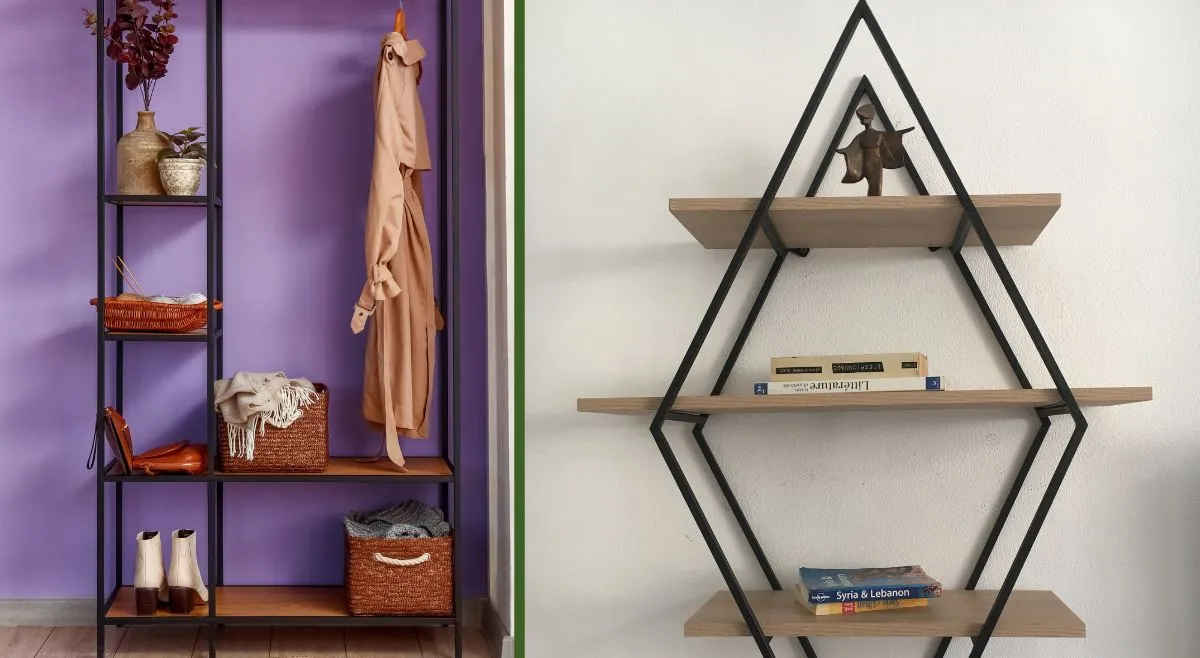
Tension Rod Floor-to-Ceiling Modular Shelving (Canva)
2. Ladder Shelves with Integrated Desk Nooks
A ladder shelf leans against the wall. It is narrow at the top and wider at the bottom. Some models have a small desk built into the middle. You get storage and a work spot in one piece.
Why it works for small spaces: The footprint is tiny. Most ladder shelves take up less than 1.5 sq ft of floor at the base. That is about the size of a large shoebox. Yet they hold a lot, because everything goes up instead of out.
Weight capacity: what to expect
- Each shelf usually holds 10 to 20 lbs (4 to 9 kg).
- The desk part holds around 30 to 50 lbs (14 to 23 kg). That is enough for a laptop, a lamp, and a coffee mug.
-The whole unit can often hold 80 to 150 lbs (36 to 68 kg), but check the label.
Keep heavy things low. Put books and plants on the bottom shelves. Put light items like candles and small frames at the top.
Best for studio apartments: In a studio, one corner often has to be the bed, the office, and the living room. A ladder shelf with a desk nook lets you work in the day and fold it all away by night. Pick a slim frame and a light color to keep the room feeling open.
Quick tip: Fix the top to the wall with a safety strap. It stops the shelf from tipping if someone leans on it.
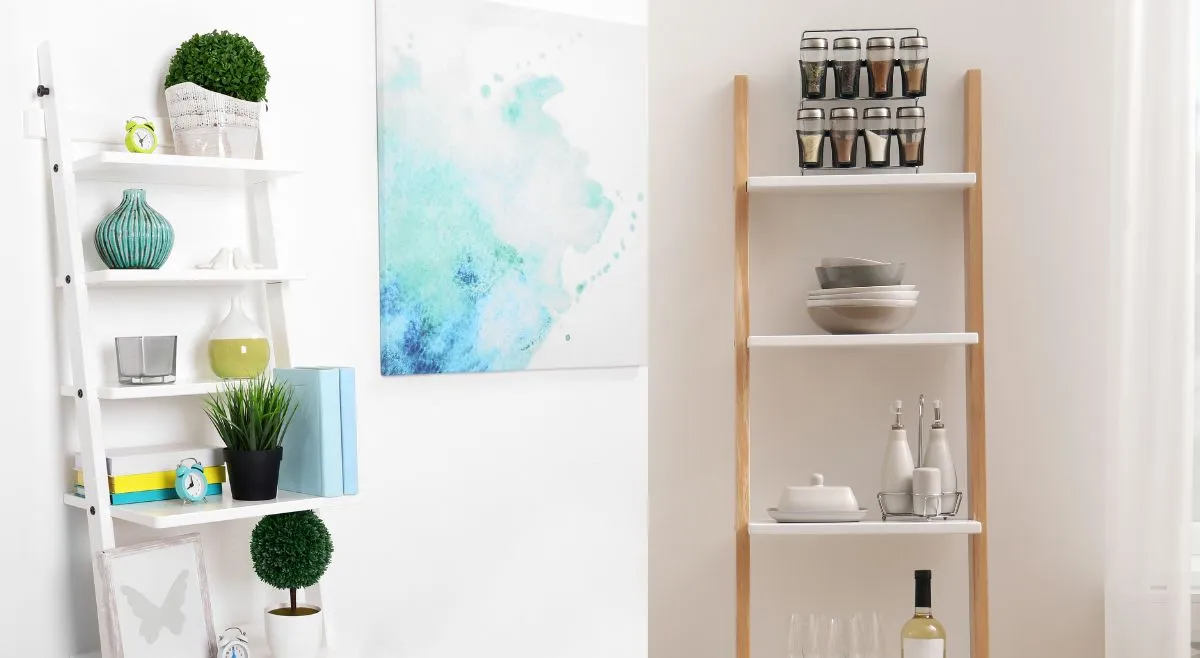
Ladder Shelves with Integrated Desk Nooks (Canva)
3. Wall-Mounted Pegboard Shelving with Adjustable Depth
A pegboard is a board full of small holes. You push pegs, hooks, and shelves into the holes. You can move them any time. That is the magic.
Why 'adjustable depth' matters
Not every item needs the same shelf size. A spice jar needs 3 inches. A cookbook needs 8. With adjustable depth, you set each shelf to fit what you own. No wasted space.
In the kitchen
-Hang pots, pans, and utensils on hooks.
-Add a narrow shelf for spices and oils.
-Use small bins for foil, bags, and sponges.
-Wipe-clean finishes are best here, as cooking can get greasy.
In the home office
-Use deeper shelves for notebooks and files.
-Add cups for pens and scissors.
-Hang headphones and cables on hooks.
-Add a small shelf at eye level for a plant or photo.
Why it is so flexible?
Your life changes, and your pegboard can change with it. Moved the kitchen stuff? Just shift the pegs. There is no drilling and no patching holes.
Quick tip: Mount the board on the wall studs, not just the drywall. A full board of tools and pans gets heavy.
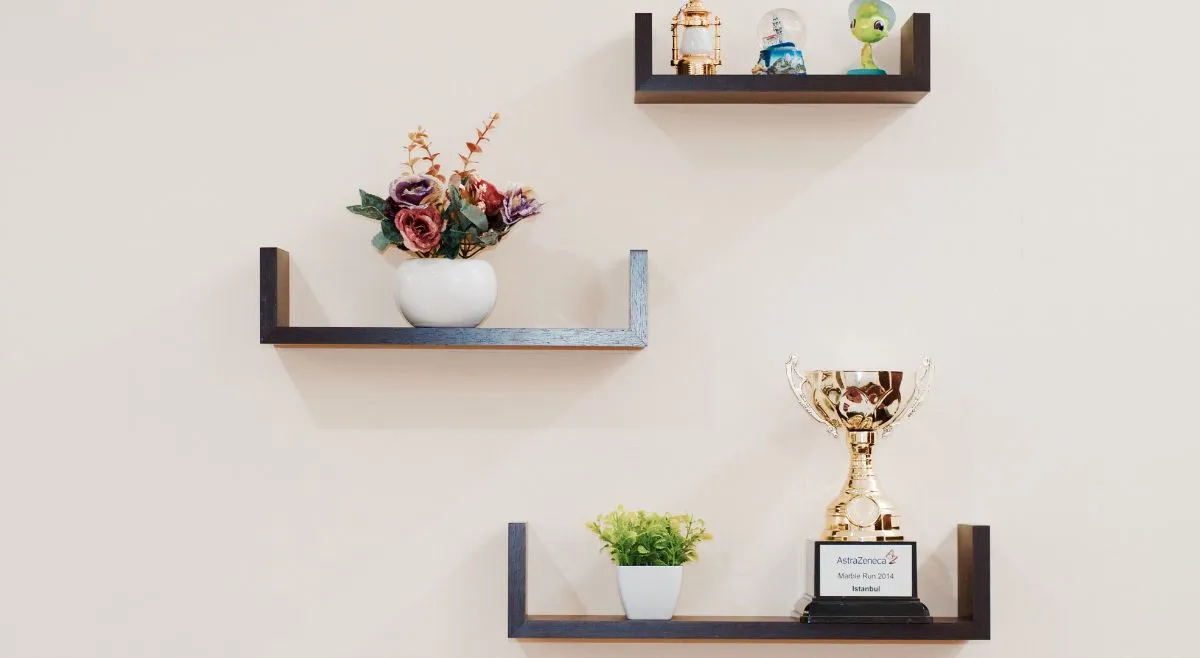
Wall-Mounted Pegboard Shelving with Adjustable Depth (Canva)
4. Floating Corner Wedges (The Dead Zone Killer)
Corners are the most ignored part of a room. They sit empty, and dust gathers there. Floating corner shelves change that. They are small triangle-shaped shelves that fit right into the corner.
Why they are great?
They use space no one else uses. They take almost nothing from the room and add lots of storage. They also look light because they have no legs or brackets showing.
The staggering trick
Do not line the shelves up like steps. Stagger them instead.
- Place the shelves at different heights.
- Leave big gaps between them.
- Alternate the sides if you can, so the corner does not look heavy.
- Keep the top shelves lighter in look and the lower ones a bit fuller.
How this helps light
Light needs room to travel. Staggered shelves leave open gaps for sunlight to pass through. The corner stays bright, and the room feels bigger. A tall solid block of shelves would do the opposite.
What to put on them
Small plants, a candle, a little speaker, or a favorite book. Do not overfill. Space between things is part of the look.
Quick tip: Corners are not always perfectly square. Check with a level before you fix anything.
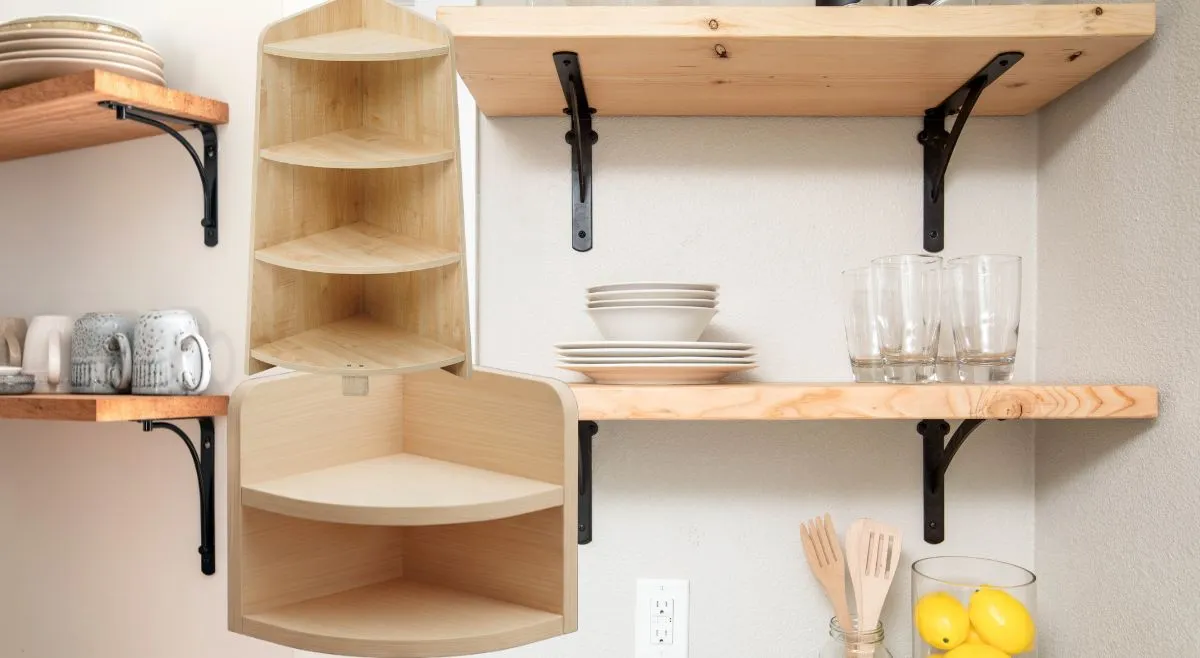
Floating Corner Wedges (Canva)
5. Over-the-Door Tiered Pantry And Utility Racks
The back of a door is free storage. Most people never use it. An over-the-door rack hangs on the top edge and gives you several tiers of shelves. No drilling is needed.
Where to use them
Pantry door: cans, snacks, spices, and sauces.
Laundry or utility door: cleaning sprays, detergent, and sponges.
Bathroom door: towels, toiletries, and extra toilet rolls.
The 1.5 mm door gap rule
Doors need a small gap to close properly. Before you buy, check two things:
- The hooks on the rack must be thin enough to slide over the door. Measure the door thickness too.
- Keep about 1.5 mm of clearance where the door meets the frame. If the hooks are too thick, the door will not shut. It can also scrape the frame and wear it out.
ALSO READ: 7 Space-Saving Living Room Designs For Compact Homes
- Look for slim, flat hooks. Some racks have rubber or felt tips. These protect the paint and stop rattling.
Stopping the door from sagging
Too much weight can pull a door down over time. To avoid this:
- Keep the total load under about 15 to 25 lbs (7 to 11 kg), unless the rack says otherwise.
- Put lighter items on the top shelves and heavier ones lower down.
- Do not fill every shelf to the brim.
- Check the hinges now and then. Tighten any loose screws.
Quick tip: If a door starts to drag on the floor, remove some weight and tighten the top hinge screws.
Over the Door Tiered Pantry (Canva)
ALSO READ: Floor-To-Ceiling Bookshelf Designs: 5 Statement Styles To Make Your Living Room Look Expensive
Lastly, small homes need smart storage. When floor space runs out, look up. Each of these four easy ideas really works; all you need is a sense of your space and smart organisation.
Start with one idea, like a corner shelf or a door rack, and see how it feels. Small changes add up fast, and your home will feel calmer and roomier.
FAQs
What materials would be ideal for drilling vertical shelves in a small house?
Ideal materials for building vertical shelves in a small house are lightweight but sturdy, such as engineered wood, bamboo, metal, and even transparent acrylic.
How can I ensure my vertical shelves are stable and safe?
Always anchor vertical shelves directly into wall studs with heavy-duty hardware. For heavier items, distribute weight evenly across shelves, and opt for professional installation for maximum safety and stability.