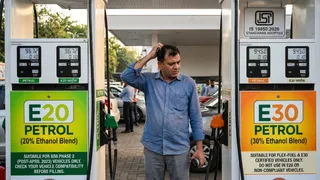
E30 Petrol Vehicle Compatibility India: The Indian government has recently notified that petrol with higher ethanol blends, E22 to E30, will not attract excise duty. This is the first major financial benefit announced for higher ethanol blends above the E20 standard. The move is being seen as a necessary financial foundation for the regularisation of higher ethanol-blended fuel. In simpler words, the Indian government is expected to roll out higher ethanol blends soon in the country. But do you know what the difference is between E20 and E30 petrol? Or what kind of changes can you expect in your car with E30?
E20 Vs E30 Petrol: What’s Different?
E20 and E30 are ratings used with a certain kind of flex fuel. Flex fuel is an alternative to traditional fossil fuels, such as petrol and diesel, and it is a blend of two different fuels. In the case of petrol, the other fuel is ethanol, and thus, the rating starts with the letter E, which stands for Ethanol. The numerics stand for the percentage of ethanol blended with petrol. This way, E20 means a flex fuel with 20 per cent of ethanol and 80 per cent of petrol, and similarly, in E30, it means that the fuel type contains 30 per cent of ethanol with 70 per cent gasoline. The first major difference between E20 and E30 fuel is that the latter one contains a higher percentage of ethanol.
Also Read: Zero Excise Duty On E22 To E30 Blends: Here’s What The Big Ethanol Push Means For You
E20 Vs E30 Petrol: Material Degradation and Hardware Differences
As mentioned earlier, the most significant difference between E20 and E30 is that the latter contains a higher percentage of ethanol. Higher ethanol is expected to result in material degradation with incompatible vehicles. While non-BS-6 phase 2 vehicles are incompatible with E20, vehicles manufactured after April 2023 are at odds with E30 petrol. A higher level of ethanol is expected to damage metal tanks, fuel lines, and carburettors in the older vehicles. Additionally, as per several reports, older fuel hoses, seals, and gaskets are not ethanol-resistant, and they might get damaged from E20 and E30 petrol.
Now, coming to the E20-compatible vehicles. While E20-compatible cars come equipped with robust engine seals and hoses that are robust enough to withstand the extra 10 per cent of ethanol, it is not recommended to use E30 petrol in an E20-compatible car. The Engine Control Unit (ECU) and fuel injectors of an E20 vehicle are specially calibrated for 20 per cent of Ethanol blended with 80 per cent petrol. Running an E20 vehicle on E30 petrol might result in severe knocking and even piston damage.
Also Read: Govt Eyes Isobutanol-Diesel Blend: Why Ethanol Is Out And How It Works?
E20 Vs E30 Petrol: Changes To Expect In Your Car
The consequences of running a vehicle on E30 petrol vary depending on the vehicle type. To begin with, older vehicles (vehicles from the pre-BS-6 phase 2 stage) are expected to notice corrosion in the fuel tank, constant drying up and breaking of rubber hoses, rubber gaskets, dropping fuel efficiency, and internal damage in the engine. Using E30 petrol in an E20 car is expected to result in the wear and tear of the internal parts of the engine, along with reduced mileage. It is also worth noting that E20-compatible vehicles will notice wear and tear in a rather long period of time when compared to older vehicles.