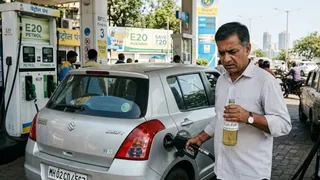
Ethanol Blending Mileage Drop India: The Indian government’s Ethanol Blending Program (EBP) or E20 petrol has remained one of the hot topics across the country and social media over the past few months. Social media platforms are full of genuine concerns regarding E20 petrol damage to the engine, while it is also flooded with fake videos, misinformation, and fake news about the topic. One of the most genuine concerns getting out of this discussion is: Does E20 petrol damage the engine or reduce mileage? The same question was recently raised in the Rajya Sabha, and the government has responded to it.
What Is E20 Petrol?
E20 is a rating given to a certain type of flex fuel. A flex fuel is a blend of two types of fuel, and it acts as an alternative to traditional fuel types, such as petrol and diesel. Flex fuel can be obtained by blending petrol with an oxygenate, such as Ethanol or Methanol. Damage to the engine metal and plastics, along with phase separation, are some of the most common risks associated with Methanol blend fuel, and thus, most of the major global automotive manufacturers prefer ethanol blend petrol.
E20 simply means a fuel type that contains 20 per cent ethanol blended with 80 per cent petrol. Similarly, E25, E30, or E85 are fuel blend ratings. In these ratings, E is used here for Ethanol, while the number stands for the percentage of Ethanol in the fuel type.
Does E20 Fuel Damage Engines?
The government, in its reply to a question raised in the Rajya Sabha, has said that 23 crore vehicles running on E20 petrol don’t show verified evidence of widespread engine failure or vehicle breakdown attributable to ethanol-blended petrol (E20).
Minister of State for Petroleum and Natural Gas Suresh Gopi said, "More than 20 crore two-wheelers and over 3 crore petrol cars, including a large number of older vehicles manufactured before E20 certification, have been operating on these fuels without any verified evidence of widespread engine failure or vehicle breakdown attributable to ethanol blending."
The minister further added that manufacturer service data also supports these findings. "One leading four-wheeler manufacturer serviced 2.84 crore vehicles during FY 2025-26, including 1.5 crore older, non-E20-certified vehicles, without reporting any vehicular damage attributable to E20 fuel." Similarly, "one leading two-wheeler manufacturer reported, based on extensive service data, no higher incidence of damage in vehicles operating on E20 compared with earlier fuel blends."
Also Read: 23 Crore Vehicles Running On E20 Petrol Show No Engine Failure: Govt Tells Rajya Sabha
Does E20 Petrol Reduce Mileage?
Several vehicle users have reported reduced mileage after the rollout of E20 petrol. While E20 petrol might not damage vehicles compatible with ethanol-blended fuel, the fuel efficiency is certainly an area that will be affected. Why? Well, while ethanol certainly has a higher Research Octane Number (RON), it has a lower energy density when compared to regular gasoline. Due to lower energy density, the ECU will be required to inject an increased amount of fuel to achieve the same amount of power.
Government-backed studies by the Ministry of Petroleum and Natural Gas, ARAI, and IIT Kanpur report a fuel efficiency drop ranging between 1 and 5 per cent in vehicles due to E20. Additionally, Maruti Suzuki, the largest car manufacturer in India, conducted internal testing and reported that no evidence of engine damage, abnormal wear, or corrosion was found. The study by Maruti Suzuki further reports a reduction of 3 to 3.5 per cent in fuel efficiency due to ethanol’s low energy density.
Also Read: Does IndianOil XP95 Petrol Contain 20% Ethanol? Here’s What ‘95’ Rating Means For Your Car
E20 Petrol: Why Is It Not Cheaper Than Petrol?
The government also explained why ethanol is not always cheaper than petrol. It stated that it is due to production involving costs such as procurement, transportation, storage, and taxes. The government noted that farmers are paid a fair price for ethanol supplied under the programme. For instance, maize-based ethanol is purchased at around Rs 71.86 per litre, before adding costs such as GST, transportation, and storage.
It further explained that when global crude oil prices are around USD 70 per barrel, producing E20 can cost the same as or even more than regular petrol. Ethanol becomes a cheaper alternative mainly when crude oil prices rise significantly, usually reaching USD 120-130 per barrel or higher.