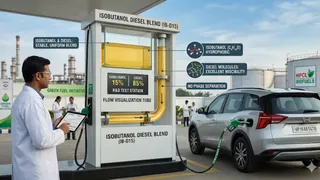
Isobutanol-Diesel Blend: While ethanol-blended petrol has become the new reality in India, the Isobutanol-diesel blend is potentially the next one. The Indian government might soon mandate the blending of isobutanol with diesel. The move is in line with the country’s efforts to reduce crude oil imports. Notably, the government has also amended the Central Motor Vehicle Act, 1989, to recognise higher ethanol blends in the country to mitigate the effect of crude oil imports.
Proposal Later This Year?
Speaking at a Confederation of Indian Industry event, V Umashankar, secretary of the Ministry of Road Transport and Highways in India, mentioned that the government is discussing this proposal very seriously and a draft might be rolled out later this year. Notably, policymakers have now turned towards Isobutanol blending with diesel after an unsuccessful attempt at diesel-ethanol blending.
Also Read: Skoda Discounts June 2026: Save Up To Rs 1.25 Lakh On Slavia, Kushaq, And Kylaq
What Is Isobutanol?
Isobutanol is a biofuel made from ethanol, and it has various factors that make it more suitable for blending with diesel. To begin with, Isobutanol has a higher energy density, which is closer to petroleum diesel itself. Additionally, isobutanol mixes well with diesel and doesn’t undergo ‘phase separation’. Lastly, it has less hygroscopicity, which means that it absorbs less water than ethanol, and solves the issue of potential corrosion.
Also Read: 2026 Audi Q7 Unveiled: Feature-Packed Luxury SUV Goes From 0-100 Km/h In Just 4.8 Seconds
Why Not Ethanol?
Nitin Gadkari, the Union Minister of Road Transport and Highways in India, shared in September 2025 regarding the experiments of blending 10 per cent ethanol with diesel, but they turned out to be unsuccessful, and now efforts will be carried out to blend diesel with isobutanol. Ethanol cannot be readily mixed with diesel. Ethanol has a lower cetane number, which essentially means that it is resistant to high compression-ignition. As we are aware, diesel engines work on a compression-ignition, they need a fuel which has a higher cetane number. Additionally, Ethanol doesn’t mix well with diesel, and it undergoes ‘Phase Separation’ quickly and settles below. Lastly, diesel also acts as a lubricant for high-pressure fuel injectors. Ethanol, on the other hand, is a solvent, and it quickly dissolves away. This could lead to higher wear and tear.
Also Read: Royal Enfield Bullet 650 Video Review: Can This Be Your New Retro Twin Cylinder Motorcycle?
Why Diesel Blending Is Required?
India currently imports more than 85 per cent of its fuel needs. The government is seeking to reduce its dependence on crude oil imports. While ethanol-blended petrol will reduce the impact of global crude oil imports, isobutanol-diesel blending will further support the country’s goal towards secure energy and a cleaner, greener, and more sustainable alternative to traditional types.
Also Read: New Bajaj ADV Spied Again: Check Expected Features And Specs
Isobutanol-Diesel Blend: Will Prices Reduce?
With isobutanol-blended diesel and ethanol-blended petrol reducing India’s crude oil imports, many believe that fuel prices in the country may sharply fall. However, that’s not the case, as the primary goal behind flex fuel alternatives is long-term energy security and carbon emission reduction. In simpler words, this means that the current retail prices of fuel might not reduce immediately. But increased use of domestically produced fuel might reduce fuel prices in the long run.