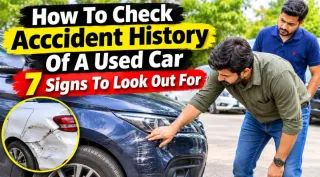
The pre-owned car market is increasing rapidly in India, but it comes with its own set of challenges. Especially in terms of an accident or a structurally damaged vehicle. Compromised crumple zones, repacked airbag assemblies, bent chassis rails, and bent tie rods pose serious safety risks. Thus, a second-hand car requires careful inspection before buying. By checking glass stamps, paint mismatch, and bolt head paint, one can easily identify an accident-involved vehicle.
1. Paint Mismatch
Take the car to a location with ample amount of bright daylight to check it for paint mismatch. Check how light is reflecting off of the body panels, including the hood, doors, fenders, and roof. Factory-painted panels have a smooth and flat finish, whereas aftermarket paint/respray looks like orange skin, and thus, it is called the “Orange Peel”.
2. Welding Marks
Pop up the bonnet and look for irregular, rough gas-torch welds in inner fenders, strut mounts, and radiator cross members. The cross member is a heavy steel bar that runs horizontally across the lower front part of the chassis.
Similarly, pop up the boot and take the spare tyre out of it. Now look for irregular, rough gas torch welds or wrinkling in the metal of the boot floor. Now, remove the weatherstripping rubber seal from the door frames, and check for pinch welding on the A, B, and C pillars of the vehicle.
Also Read: Updated Toyota Innova Facelift Launched In Indonesia: Gets Dual 12.3-Inch Screens And More
3. Bolthead
Inspect the bolteads holding bonnet latches, front fenders, and door hinges. These boltheads come painted by the car manufacturer. Whenever a panel is removed for dent fixing or replacement, the tools used to remove these boltheads strip the paint off of them.
4. Chassis Frame Rails
Get a torch and flash it between the engine bay and behind the front bumper. Now, look at the longitudinal metal frame extending from the firewall to the radiator core support. If these lines feature welding, wrinkling, or rippled metal, it means that the vehicle has an accident history in the front section.
Also Read: Royal Enfield Himalayan 750 Debut Today: Gets Traction Control, Cruise Control, And More
5. Glass Stamps
All glass parts, including the windshield, all of the windows, and the rear screen, are marked with a manufacturer stamp, and they also feature an embedded date code or year digit. Check if a glass area is missing the manufacturer stamp or the year code, written as “26 (for 2026)”. This means that the glass was replaced, and the vehicle was involved in a crash.
6. Airbags Warning Light
Turn on the ignition on and don’t crank the engine just yet. Now observe the warning lights appearing on the instrument cluster closely. Look at the Airbag warning light; it should go off independently. Remember: if the Airbag warning light turns off along with the oil light, it means that the Airbag system has been bypassed.
Also Read: JSW Combat SUV Interior Spied: 15.6-Inch Touchscreen, ADAS, And More Expected
7. Seatbelts
Inspect front seatbelts carefully. Slowly pull out the whole seatbelt, and check out the base for any cuts marks. Additionally, also check the year mentioned on the label of the seatbelt. If the seatbelt’s label mentions a different year than the car’s manufacturing year, it means that the car was involved in a crash. Additionally, the cut marks on the base of the seatbelt mean that the pretensioner was engaged, meaning the car was in a crash.
How To Check Used Car Accident History?
Identifying an accident-involved vehicle doesn’t require specialized mechanical knowledge. One can carefully inspect a pre-owned vehicle for structural damage by making sure to go through these checkpoints:
Checkpoint | What To Look For | Pro Tip |
Paint Mismatch | Look for paint variation in bright daylight | Don’t try to inspect the car’s paint in a garage or low lighting |
Welding Marks | Look for irregular, rough gas-torch welding in inner fenders, boot floor, and radiator cross members | Make sure to remove the rubber seal on the door frame to check for pinch welding markings |
Bolt head | Look for stripped-off paint at bolts holding bonnet latches, door hinges, and front fenders | Not a single bolt head should be missing paint. |
Chassis Frame Rails | Look for straight, smooth, uncreased steel at the longitudinal frame rails | Don’t just look for bends; also look for rough welding marks/rippled marks |
Glass Stamps | Look for the brand logo and year code | Make sure that all factory glass has the same year code |
Airbags Assembly | Inspect the Airbag warning light | Check out the Airbag warning light carefully |
Seatbelt | Inspect tags placed at the base of the front seatbelts | Don’t forget to look for cut marks at the base |
Frequently Asked Questions (FAQs)
Here are some of the most frequently asked questions about the inspection of a used car to check its accident history.
Can I Check If A Vehicle Has Been Involved In An Accident?
Yes, checking the accident history of a vehicle doesn’t require specialised mechanical knowledge, and a person can easily check whether the vehicle was involved in an accident by going through these checkpoints: Paint Mismatch, Welding Marks, Bolt Head Paint, Glass Stamps, Airbag Warning Light, Seatbelt Label, and Chassis Frame Rails.
How To Check Used Car Accident History Online For Free?
Vehicle accident history can also be checked online by going through the insurance records of a vehicle. Specifically, check for No Claim Bonus (NCB) in policy documents. If a vehicle’s NCB is zero, it means that the insurance was claimed for the preceding policy year.
Can I Get My Used Car Checked By An Expert?
Yes, one can easily get their used car checked by an expert for its history. Several third-party apps and inspection services provide these kinds of services, and charges range between ₹1,000 and ₹2,000.