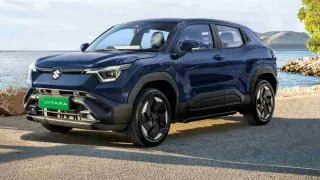
Maruti Suzuki eVitara Range: The Maruti Suzuki eVitara has scored a 4-star rating in crash tests organised by the Japan NCAP. Notably, the eVitara has a 5-star rating from Bharat NCAP in India, and it is manufactured at the brand’s Gujarat-based plant. Let’s take a look at the safety features and the range of the Maruti Suzuki eVitara.
Maruti Suzuki eVitara: 4-Star In Japan NCAP
As mentioned earlier, the Maruti Suzuki eVitara has scored a 4-star rating in Japan NCAP crash tests. Japan NCAP evaluates cars based on three primary categories: Preventive Safety (85.8 points), Collision Safety (100 points), and Emergency Call Systems (100 points). To achieve a complete 5-star rating, a vehicle needs to get an A-star rating in the Preventive Safety and Collision Safety categories. While the eVitara scored an A-rating in the former, it got a B-rating in the latter, leading it to achieve a 4-star safety rating. It is worth mentioning that the ANCAP (Australian NCAP) has also awarded the eVitara a 4-star rating.
Also Read: Hyundai Bayon Colour Options And Safety Features Revealed: Gets Over 23 ADAS Functions
Maruti Suzuki eVitara: Safety
In terms of safety, the first-ever electric Maruti car comes loaded with features such as 7 airbags, ABS with EBD (electronic brake force distribution), an electronic parking brake with auto-hold function, hill hold assist, and a Level 2 ADAS suite. The Level 2 ADAS suite is exclusively available with top-spec trims of the electric SUV in the country.
Also Read: Hyundai Bayon India Launch On October 26: Check Features And Specs
Maruti Suzuki E Vitara: Range & Battery Pack
The Maruti Suzuki E Vitara comes equipped with options of either a 49 kWh or a 61 kWh battery pack. The E Vitara by Maruti Suzuki also gets a Front-Wheel Drive and All Wheel Drive configuration (Maruti Suzuki’s All Grip); however, the All Grip will be offered only with the 61 kWh battery pack. The Maruti Suzuki E Vitara has an ARAI-claimed range of up to 543 kilometres, once fully charged. The Maruti Suzuki Vitara, with its front-wheel drive version, can generate 142 bhp and 189 Nm of torque, respectively. The all-wheel drive variant, on the other hand, generates 172 bhp and 300 Nm of torque.