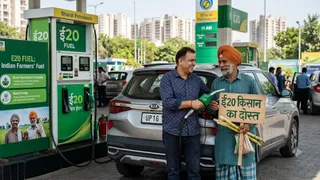
E20 Petrol Problems: Over the past few weeks, social media has been flooded with alarming claims about E20 petrol. "Your engine will fail." "Mileage will drop by 40%." "Fuel pumps will be destroyed." "Sell your car before it's too late." The problem isn't that people are asking questions. The problem is that many of the loudest voices are presenting isolated incidents as universal truths.
India has been gradually rolling out E20 petrol for nearly three years now. During this period, millions of vehicles have consumed billions of litres of ethanol-blended fuel. If E20 was genuinely an engine-killer, we'd already be witnessing one of the biggest automotive crises in the country's history. We're not.
That doesn't mean ethanol has zero drawbacks. It does. But the online narrative often ignores context, engineering, and how modern automobiles are actually designed. Let's separate facts from fear.
Why Is India Blending Ethanol in Petrol?
India's ethanol programme wasn't introduced overnight. It serves multiple objectives. The country imports a significant portion of its crude oil. Every percentage increase in ethanol blending reduces dependence on imported fuel while supporting domestic agriculture, particularly sugarcane production.
There are environmental benefits too. Ethanol contains oxygen, allowing cleaner combustion and helping reduce tailpipe emissions. Whether one agrees with the policy or not, E20 isn't a random experiment. It is part of a long-term national energy strategy that has been in development for years.
ALSO READ: Government Debunks E20 Fuel Misinformation; Issues Clear Warning Over Fake News
Is Your Vehicle Safe From Ethanol?
The real question is whether your car can safely use it. For most people, the answer is yes. If Your Car Was Built After 2017-18, You Probably Don't Need to panic. This is perhaps the biggest fact missing from most viral videos.
From April 2017 onwards, every new passenger vehicle sold in India had to comply with BS4 emission norms nationwide. These regulations didn't merely reduce emissions; they also pushed manufacturers to adopt more sophisticated engine management systems and fuel system components capable of handling ethanol-blended petrol.
Modern BS4 and BS6 petrol cars typically feature:
Closed-loop fuel injection
Oxygen (O₂) sensors
Electronic Engine Control Units (ECUs)
Ethanol-resistant seals, hoses, and fuel system materials
These systems constantly monitor combustion and automatically adjust the air-fuel mixture. Contrary to popular belief, the jump from E10 to E20 does not require a dramatic increase in fuel delivery. The ECU simply compensates within its normal operating range, something it was already designed to do.
This isn't new technology. Countries like Brazil have been running significantly higher ethanol blends for decades without widespread engine failures. India also started working on the Ethanol Blending Programme back in 2003, and it has been more than 20 years since then.
ALSO READ: Own An Older Car And Worried About E20 Petrol Damage? Use These Expert Tips To Protect Your Vehicle
E20 Has Some Downsides, But They're Exaggerated
Every Fuel sold in India or abroad has its own share of problems. Petrol offers lower mileage, Diesel is not clean, and CNG takes space and time. E20 also has its own problems and offers slightly lower energy density than pure petrol, which means fuel economy might reduce marginally. In real-world driving, most users may notice around a 5-8% drop in mileage, not the dramatic 30-40% figures often circulating online.
Similarly, ethanol is hygroscopic, meaning it absorbs moisture. Does that sound worrying? Only if your car spends months parked with half a tank of fuel in extremely humid conditions.
For vehicles driven regularly, modern sealed fuel systems make moisture-related issues extremely uncommon. Likewise, ethanol's cleaning properties can loosen deposits inside neglected fuel systems. If an old fuel filter or injector clogs after years of poor maintenance, ethanol may expose the existing problem earlier. That doesn't mean ethanol created the fault.
Also Read: Maruti Suzuki Baleno Facelift To Be Launched Soon: Here’s What We Know So Far
Vehicles That Actually Need More Attention
Older BS3 cars, carburettor-equipped vehicles, and certain pre-2010 models deserve additional caution. These vehicles may use older rubber compounds, fuel pumps, and seals that weren't originally designed with higher ethanol blends in mind.
Similarly, carburettor engines cannot automatically compensate for changing fuel composition like modern electronic fuel injection systems. Owners of such vehicles should inspect fuel lines periodically, replace ageing rubber components with ethanol-compatible materials where required, and ensure routine maintenance isn't ignored.
But this represents a relatively small percentage of India's current vehicle fleet. The average petrol car sold over the last seven to eight years is significantly better equipped to handle E20 than social media would have you believe.
Anyways, the registration period barring petrol vehicles in Delhi-NCR is 15 years, and 10 years for diesel vehicles. As of 2026, any vehicle registered in 2011 must have reached its RC age.
Also Read: Nissan Tekton Launch On July 9: Panoramic Sunroof To Hybrid Engine; Here’s What To Expect
Social Media Rewards Panic
There's a reason negative headlines spread faster. "No problem after 20,000 km" rarely goes viral. "My engine failed because of E20" certainly does. Unfortunately, many viral videos skip important questions, such as
How old was the vehicle?
What was its maintenance history?
Was the fuel pump already failing?
Were aftermarket modifications involved?
Was poor-quality fuel used?
Without this context, blaming ethanol alone becomes convenient, but not necessarily accurate. If one neglected component finally fails after years of wear, the new fuel often becomes the easiest scapegoat.
Correlation should never be mistaken for causation. Like in the case of a viral YouTuber claiming his new Toyota Innova Hycross’ engine was damaged due to Ethanol Fuel. The Japanese company did a thorough investigation and gave Ethanol a clean chit, stating the problem arose due to adulterated fuel.
Should You Change Anything?
If you own a BS4 or BS6 petrol vehicle purchased after roughly 2017-18, there is little reason to panic. Instead, focus on the basics that matter far more than ethanol percentage, like Service your vehicle on schedule, replace fuel filters when recommended, and use fuel from reputed filling stations.
It’s a sad reality that, despite fast-paced urbanization, the majority of the population still lives in rural areas, and chances of adulteration of fuel in these areas can be rampant. India has had a history of selling low-quality fuel, but urbanization and quality checks have stopped mixing, at least in Urban India.
If your vehicle is much older, particularly a BS3 or carburettor model, consult a trusted mechanic about fuel hoses, seals and preventive maintenance. That advice would have been sensible even without E20.
Also Read: Honda ZR-V Launch This Month: Gets 22.79 Kmpl Mileage, ADAS, And More
Is Everything Ok Then?
No, nobody is claiming that E20 will solve the world hunger problems or make India a superpower. It certainly has its share of problems, but nothing that can’t be controlled eventually. Like the fuel efficiency matter, our auto OEMs reached a level of optimization to offer 28 kmpl mileage (Maruti Suzuki Ciaz) after many decades of research and development.
Ethanol is a fairly new fuel globally, more so in India, and this mileage drop problem will be solved soon. As for the choice of fuel, like someone recently in a protest demanding E0, E5, E10, E20 nozzles, that’s practically impossible. These pumps are not water dispensers but business-yielding machines optimized for maximum efficiency.
As per multiple reports, E0 XP100 sold by Indian Oil was discontinued as producing and selling 100% petrol in a crisis like the Iran-US war, when every second day Iran was shutting the Strait of Hormuz, takes a lot of resources, and sales are not as much as required to maintain these nozzles.
Still, to instill confidence, the BJP-led government should ask OMCs to sell zero percent blended petrol to people who wish to fill their vehicles with ‘Pure Petrol’. Further, the auto industry needs to launch more flex-fuel vehicles so that people can buy affordable E85 fuel.
The Bottom Line
The ethanol debate deserves nuance, not fear. Yes, E20 isn't identical to pure petrol. It can reduce fuel economy, and older vehicles may require additional attention, but these are not as bad as being portrayed. The Indian auto industry has undergone many drastic changes in the past few years, and the BS4 to BS6 transition was one of them.
We skipped a whole level of fuel standards and quickly jumped from BS4 to BS6 overnight, which resulted in a massive drop in the mileage of most modern vehicles. People were talking about these changes for many years, but social media was not prevalent then, and neither was bipartisan politics.
Case in point, my first car was a Maruti Suzuki Swift BS4 that used to return me a handsome 17-18kmpl mileage on a 1.2-litre petrol engine. I then switched to Kia Sonet 1.0 Petrol BS6, and my mileage was 11 kmpl, despite having a smaller engine.
Modern automobiles are engineered with safety margins, adaptive electronics, and fuel systems designed to tolerate variations in fuel quality and composition. The bigger danger today isn't ethanol. It's misinformation.
Before making expensive decisions based on a viral reel, ask a simple question: is the advice backed by engineering, long-term data and real-world experience, or is it simply designed to generate clicks?
Your car deserves evidence, not outrage.