India's outbound travel story keeps getting bigger. According to the Ministry of Tourism, Indian nationals made 32.8 million overseas departures in 2025, which is 6.3% more than in 2024. Southeast Asia remains a favourite, with Thailand alone welcoming 2.48 million Indian visitors last year, followed by Malaysia with 1.57 million and Singapore with 1.21 million.
Most of these travellers plan, pay for and manage their trips on their phones. They book flights on travel apps, load forex cards through banking apps and use credit cards that come with airport lounge access. However, the moment they land, one basic need is often left to chance, which is a working mobile connection. Zetexa Global, a USA-based licensed telecom operator, sees this gap as the next big opportunity for India's banks, fintechs and travel platforms.
The Brands That Own the Trip Can Also Own the Connection
Most Indian travellers sort out mobile data on their own, either through an international roaming pack or by buying a local SIM card or eSIM (embedded SIM) for each trip. GSMA Intelligence found that only 8% of consumers who know about eSIM discovered it through their mobile operator, and the GSMA notes that this gap creates space for fintechs and digital-native travel brands to embed connectivity in their products. ABI Research found that outside the US, travel is often the reason for a person's first eSIM download.
Banks and wallets have started acting on this. In India, a leading travel fintech, powered by Zetexa, already offers an international eSIM with plans in 120+ countries inside its app, alongside its forex cards, flight bookings and visa services. Globally, digital banks such as Revolut also sell eSIMs inside their apps.
What Indian Travellers Need From an In-App Connection
A 2025 travel report based on data from over one million outbound Indian travellers found that millennials and Gen Z accounted for 9 in 10 international trips. Three things matter most to them.
Keeping the home number: Indian travellers rely on their home number for bank alerts and one-time passwords (OTPs). An eSIM lets them keep that SIM active while the eSIM handles local data, calls and messages at the destination.
One app for the whole trip: A traveller who already uses one app for forex, lounge access and bookings is more likely to buy connectivity there too, instead of searching for a separate provider.
Data that works on landing: Travellers want a plan that is ready before they board, so they can book a cab, open maps or reach their hotel the moment they leave the airport.
What Indian Banks, Fintechs and Travel Platforms Should Get Right
This season, Zetexa met fintechs, travel platforms and education brands at ITB Asia and the Singapore Fintech Festival (SFF) in Singapore, ICEF Berlin in Germany and World Travel Market (WTM) in London. These conversations point to three areas that decide whether embedded connectivity becomes a customer habit.
Timing: Connectivity sells best at the moments that matter in a trip, such as when a visa is approved, when a forex card is loaded, when a flight is booked and when the card is first used abroad.
Pricing: Customers tend to use what they choose and pay for. One large fintech partner saw only 13 to 14% of customers take an eSIM bundled with its forex card, whereas the attach rate rose to between 50 and 60% once the eSIM was sold on its own.
Reuse: An eSIM does not need to be replaced after every trip. Hence, when customers keep one eSIM and simply add a plan for each new destination, they come back to the same app for every trip.
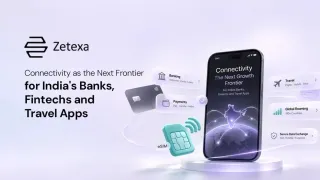
Through a single API, Zetexa lets banks, fintechs and travel platforms sell travel eSIMs in 200+ countries under their own brand, with that name shown on the customer's phone. Customers keep one eSIM for every trip, the brand's app keeps working even when data runs out, and lounge access and fast track fit into the same order. A branded microsite can go live in a day.
The Road Ahead for 2027
The Tourism Authority of Thailand expects Indian arrivals to reach 2.55 million in 2026 and a record 2.7 million in 2027. Indian students heading abroad also need a working local number on the day they arrive for bank accounts, university portals and housing.
The brands that add it as part of the trip are likely to become the first app an Indian traveller opens after landing.
A View From Zetexa Global
Amit Agarwal, Founder and CEO of Zetexa Global, said, "Indian travelers already trust their banking and travel apps with their money, their bookings and their lounge access. Connectivity is the natural next step, because a traveler who lands without data cannot use any of those services. What we heard in Singapore, Berlin and London this season tells us that 2027 will be the year many Indian banks and fintechs make that move."