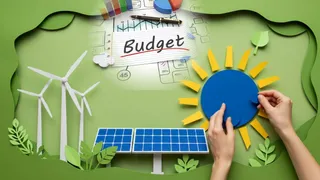
Union Budget 2026: The Union Budget for the upcoming financial year will be tabled in Lok Sabha on February 1, 2026, after the Budget session commences on January 28 with the presidential address.
Ahead of the Budget, Union Finance Minister Nirmala Sitharaman has been meeting industry experts, representatives of states, economists, and other stakeholders, seeking their suggestions and demands for the next financial year's budget (Budget 2026-27).
The government has also sought input from common citizens.
Meanwhile, founders, industry experts from Green Energy, Clean Energy And Renewable Sectors have put in their expectations and demands for the upcoming budget.
The demands includes provide stronger fiscal support, major initiatives for research and development, reduction in customs duty, and initiation of PM KUSUM 2.0.
Emphasising the need for clean energy in nation-building, Ratan Bokadia, Managing Director, Oswal Energies Ltd, believes that with the enhancement of its clean energy roadmap, India is now relying on green hydrogen and green ammonia to a great extent, as they are going to be the factors that will lead to the long-term energy security and net-zero emissions goals.
Bokadia noted that the progress that was made under the National Green Hydrogen Mission in 2025 not only provided the much-needed policy clarity but also encouraged early investments through production and electrolyser manufacturing.
Putting in his demand for the upcoming budget, Bokadia stated that the industry is expecting the Union Budget 2026 to provide stronger fiscal support that will help in the scaling of projects and cost competitiveness.
"Heightened capital subsidies, broadened production-linked incentives, and easier access to low-cost financing will be the driving factors for the commercial adoption to be faster," He said further.
Highlighting India's journey toward net-zero carbon emissions, Surbhi Puri, Director, Green Power International, noted that the year 2025 was significant in India's journey to achieve net-zero carbon emissions by 2070 while fostering sustainable and inclusive development.
Pointing out the Industry's expectations from the upcoming Budget, she said, "From the upcoming budget, we expect to strengthen these efforts through targeted support for research and development, skilling of the workforce, and incentives for domestic manufacturing."
Further reduction in customs duty on imported machinery would help lower overall project costs and accelerate the deployment of advanced technologies that support the transition to lower carbon emissions across the sector.
Echoing the need for policy support for the rapid growth of the renewable energy sector, Dr Faruk G. Patel, Founder, Chairman & Managing Director of KPI Green Energy, highlighted that India’s renewable energy journey is transitioning into an era of innovation, scale, and economic opportunity.
"In 2025 alone, the country added around 48–50 GW of renewable capacity, backed by approx Rs 2 trillion in investments, taking its total non-fossil fuel capacity to about 262–263 GW, a remarkable momentum toward the 500 GW by 2030 target," Patel noted.
Putting up his demand, the KPI Green Energy Founder said, "we look forward to continued policy support that accelerates the deployment of hybrid energy systems, energy storage, and green hydrogen value chains."
"Strengthening incentives for domestic manufacturing of clean energy components, enhancing tax clarity for novel technologies, and establishing robust capital support mechanisms, such as viability gap funding, will not only sustain investor confidence but also propel India’s global leadership in renewables — creating jobs, strengthening energy security, and driving long-term economic growth," he added.
Meanwhile, Vinay Rustagi, Chief Business Officer at Premier Energies, expects some major favourable announcements from the sector.
"The renewable sector has been a major priority area for the government, and we expect more favourable announcements supporting the sector in this budget," said Rustagi.
"The two signature schemes, PM Surya Ghar Yojana and PM KUSUM, are expected to ramp up significantly and should get much higher budgetary allocation. We are also expectingthe rollout of the PM KUSUM 2.0 scheme with higher targets and incentives," he added.
Raj Kumar Medimi — Executive Director, Trinity Cleantech said that the upcoming Union Budget presents a critical opportunity to strengthen the country’s power and energy infrastructure at the grassroots level.
"We expect the Budget to place sharper emphasis on transmission and distribution (T&D) upgrades, reduction of technical losses, and large-scale modernization of transformers and substations, which form the backbone of reliable power delivery," Medimi noted.