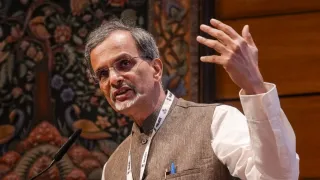
India's economic growth can translate into meaningful transformation only when its gains are shared fairly between workers and corporates, Chief Economic Adviser (CEA) V Anantha Nageswaran said, stressing that fairness is not an act of charity but a condition for a healthy and sustainable market economy.
"Growth changes the country only when it is shared honestly between those who do the work and those who put up the money," he said at a keynote address at an AIMA event here.
He argued that the debate over fairness should not be framed as a choice between workers and businesses. Instead, he said, both are part of the same economic bargain, with capital entitled to earn a fair return while workers must have a meaningful share in the prosperity generated by their work.
"Fairness, of course, is not charity," he said, adding, a sustainable market ultimately depends on consumers having enough purchasing power to buy the goods and services businesses produce.
"A healthy market needs customers who can afford to buy, and those customers are, in the end, someone's workers," he said.
Observing that capital deserves a fair return, he said there is an honest way to earn that return, and there is a self-defeating way...if we held down wages, delay paying suppliers, and keep the difference as profit, that becomes self-defeating. It works until the customers run out of savings. The honest way is to lower real costs, and some of that responsibility lies with the governments."
On the government part, Nageswaran said it must ensure cheaper power, affordable land, and reduce the compliance burden so that the cost of doing business is lowered.
"Lowering the cost of doing business is at the core of what governments can and should do to create jobs. Governments do not themselves create lasting jobs. What they can do is to make it easier for economic activity to occur, and it is that activity carried out by businesses that creates jobs," he said.
Stressing that India's economic challenge is no longer simply to grow faster, the CEA said, but to ensure that growth translates into better jobs, higher wages and greater economic security for ordinary Indians.
He also argued that the country must now focus on turning growth into "transformation".
India's growth outlook was increasingly settled, with even cautious forecasts placing medium-term annual growth at around 6.5-7 per cent, he said, adding that the economy grew 7.8 per cent in the first quarter despite headwinds from the West Asia crisis.
Growth, he said, "measures how much larger the economy becomes each year. Transformation is about the character of that growth as to who benefits from it, how many workers move from insecure employment into productive and stable jobs, and whether households actually experience an improvement in their standard of living.
He pointed to measures taken since the government returned to office in June 2024, including an employment-focused first Budget, trade agreements aimed at opening foreign markets, efforts to reduce compliance requirements, fiscal consolidation, stronger banking-sector balance sheets and improved access to credit.
"Growth becomes transformation when it is fair," the CEA said, stressing that fairness should be understood not merely as a moral principle but in the "plain accounting sense" of who receives what from the wealth being created.
The competitive economies of the world, he said, are not necessarily those that pay workers the least, but they are those that make workers more productive, strengthen their suppliers and allow both to share in the value they help create.
Disclaimer: This story has been directly published from the agency feed (PTI). No changes have been made by 'The Daily Jagran' staff except the headline.