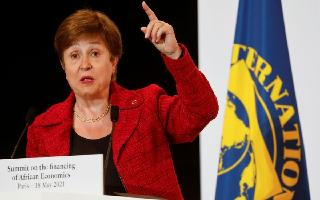
AMID the slowing down of the economies globally, International Monetary Fund (IMF) chief Kristalina Georgieva recently has said that one-third of the global economy will be impacted by the recession in 2023 while asserting that the new year will be tougher than 2022 as the US, EU and China will see their economies slow down.
"We expect one-third of the world economy to be in recession," Georgieva said during a CBS news programme on Sunday adding that "even countries not facing recessionary trends, would feel the financial stress,".
It comes at a time when the ongoing conflict in Ukraine shows no signs of abating after more than 10 months, with spiralling inflation, higher interest rates and the surge in coronavirus infections in China fuelled by the Omicron variant. "Even in countries that are not in recession, it would feel like a recession for hundreds of millions of people," she explained further.
China has scrapped its zero Covid policy and opened its economy following a wave of anti-government protests. The IMF chief further warned that China, the world's second-largest economy, will face a difficult start to 2023.
"For the next couple of months, it would be tough for China, and the impact on Chinese growth would be negative, the impact on the region will be negative, the impact on global growth will be negative," she said, adding, "for the first time in 40 years China's growth in 2022 is likely to be at or below global growth".
In October last year, the IMF had trimmed its growth forecast for 2023 to 2.7 per cent due to the war in Ukraine and higher interest rates as central banks worldwide attempt to rein in rising prices. Since then China has scrapped its zero Covid policy and started to reopen its economy, even as coronavirus infections have spread rapidly in the country.
"Global growth is forecast to slow from 6 per cent in 2021 to 3.2 per cent in 2022 and 2.7 per cent in 2023. This is the weakest growth profile since 2001 except for the global financial crisis and the acute phase of the COVID-19 pandemic," it said.
(With Agencies Inputs)