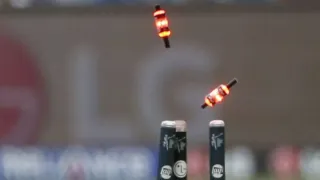
Imagine a bowler hitting the stumps, but the stumps have no bails on top. Is the batter still able to be given out? Yes, and there is a specific law in cricket to deal with such situations.
The bails are normally an important part of the wicket. They sit on top of the three stumps, and their removal helps the umpire decide whether a batter has been bowled, run out or stumped. However, there are occasions when umpires can allow a match to continue without them.
The provision comes under Law 8.5 of the Marylebone Cricket Club (MCC) Laws of Cricket. It allows umpires to dispense with bails when conditions make it difficult to keep them in place. Strong winds are one example.
So, what happens to dismissals when the bails are gone? The rules still allow batters to be given out, but the umpire has to judge whether the wicket has been broken.
ALSO READ: BCCI Faces Fresh Trouble As Communication Gap Between Team India Staff And CoE Comes To Light
Why Can Umpires Remove Bails During a Match?
Strong winds can turn something as simple as keeping the bails on the stumps into a problem. If they keep flying off, play has to stop while the umpires put them back. Repeating that process throughout a match can cause unnecessary delays.
This is where Law 8.5 comes into play. If the conditions warrant it, the umpires can agree to continue without bails rather than repeatedly interrupting play.
There is an important condition, though. The decision applies to both ends of the pitch. Bails cannot be used at one end and removed at the other.
ALSO READ: Steve Smith Creates History Against South Africa, Goes Past Steve Waugh In Elite Test List
The arrangement is also temporary. Once conditions improve enough for the bails to remain in place, they must be brought back.
How Does an Umpire Decide If the Wicket Is Broken Without Bails?
Normally, the sight of a bail coming off the stumps gives the umpire a clear indication that the wicket has been broken. Without bails, that familiar sign is missing.
Law 29.5 explains how the wicket can be broken when the umpires have agreed to dispense with bails. What has happened to the stumps and whether the action satisfies the requirements of the law determines it.
For instance, a fielder can break the wicket by striking a stump with the ball. A fielder can also do so with a hand holding the ball, provided the action satisfies the relevant conditions.
The umpire must be satisfied that the wicket has been fairly broken. Simply seeing the stumps shake or move does not, by itself, settle every dismissal.
Can a Batter Be Run Out or Stumped Without Bails?
Yes. A missing bail does not give a batter immunity from a run-out or a stumping.
If a batter is outside their ground, a fielder can run out the batter by hitting the wicket with the ball. The dismissal must still meet the usual requirements under the Laws of Cricket.
The same applies to a stumping. If the wicketkeeper gathers the ball and breaks the wicket while the batter is out of their ground, the batter can be given out if all the conditions for the dismissal are met.
There is also a provision for a situation in which a stump has already been knocked out of the ground. Under Law 29.4, a fielder may have to pull out a remaining stump while holding the ball to complete the act of breaking the wicket.
In short, the absence of bails does not change the basic principles behind these dismissals. What changes is the way the umpire determines whether the wicket has been broken.
When Did Umpires Remove Bails During a Ranji Trophy Match?
Bails being removed during a match is not always a result of bad weather. An unusual incident involving Maharashtra batter Ankeet Bawne in a Ranji Trophy match against Services in November 2024 made headlines.
Bawne was given out caught but disagreed with the decision. He believed the ball had touched the ground before the fielder completed the catch and refused to leave the field.
The disagreement brought play to a standstill for around 15 minutes. During the delay, the umpires removed the bails and went to consult the match referee.
Bawne eventually left the field, allowing the game to resume. He was later handed a one-match suspension for dissent.
The incident was different from the procedure set out under Law 8.5. The bails were removed during the dispute and stoppage, rather than because weather conditions made it impossible to keep them on the stumps.
What Are the Official Rules Governing Cricket Bails?
The MCC Laws cover not just how bails are used during a match but also their dimensions and their role in determining a broken wicket.
In standard men’s cricket, a bail measures 4.31 inches, or 10.95 cm, in length. It consists of a central barrel and two projections called spigots, which rest in grooves on top of the stumps.
Under normal playing conditions, the wicket is considered broken when at least one bail is completely removed from the stumps, subject to the exceptions provided in Law 29.
That distinction matters. If a bail lifts momentarily but settles back into its original position without being completely removed, the wicket is not broken on that basis alone. The Laws also account for situations in which a fallen bail becomes lodged between the stumps.
When umpires agree to play without bails, Law 29.5 provides the alternative method for determining whether the wicket has been broken.
Can a Cricket Match Continue With Bare Stumps?
It can do. The laws of cricket allow for situations where the bails cannot be kept securely on the stumps, and in such cases, play may continue if the umpires consider it appropriate.
The rule might seem odd, as fans are used to seeing the bails fly off every time a wicket falls. But their absence does not bring every dismissal into question or automatically stop the match.
Instead, the umpire has to decide whether or not the wicket has been broken by the law. It is a small change to the familiar setup, but one that makes a difference to how dismissals are assessed.