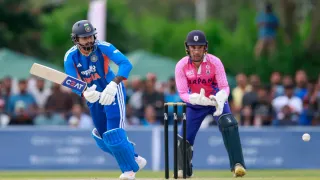
India captain Shreyas Iyer escaped what could have been an embarrassing moment in his captaincy career as India edged past Japan by two runs in the only T20I of the historic Suzuki Cup on September 22.
The match was reduced to just five overs per side after rain left the outfield wet. Iyer won the toss and decided to bat first, but India’s top order struggled badly on a tricky surface.
Abhishek Sharma, who has been in excellent form recently, was dismissed for a golden duck. Sanju Samson and Ishan Kishan also failed to make an impact, scoring only in single digits.
Iyer managed 16 runs from 12 balls and helped India reach 32/5, setting Japan a target of 33.
ALSO READ: Sai Sudharsan, Kumar Kushagra, Tanush Kotian Rescue India A After Early Collapse vs Australia A
Shreyas Iyer on India's batting struggles
India eventually held on for a two-run victory, but Iyer admitted after the game that batting on the Sano International Cricket Ground surface was far from easy.
With the ball turning sharply, Iyer decided against using India’s two pacers, Arshdeep Singh and Yash Thakur. The decision almost backfired as Ravi Bishnoi conceded 10 runs in his only over.
Washington Sundar provided India with a couple of important wickets, while Ishan Kishan made a big contribution in the field by producing a direct hit from the deep for a run-out.
ALSO READ: India vs Japan Wide Controversy: Umpire’s Decision Under Scrutiny; What Do ICC Rules Say?
Axar Patel eventually made the difference. He gave away only seven runs from his two overs and was trusted to bowl the final over. The left-arm spinner kept his nerve and helped India avoid what would have been a shock defeat against Japan, who are ranked 41st in T20I cricket.
A different challenge awaits at the Asian Games
The match also gave India a chance to get a feel for conditions in Japan ahead of their Asian Games 2026 campaign. However, the team did not get much time to prepare before the game as their practice session had to be cancelled because of a typhoon.
The five-over contest provided some useful lessons, particularly about how much the conditions can influence batting in Japan. However, India will play their Asian Games matches at a different venue — Korogi Sports Park in Nisshin.
The surface there has generally favoured batting, as seen during the women’s competition. Harmanpreet Kaur-led India went on to win the gold medal in the women’s event.
Iyer’s India will begin their Asian Games 2026 campaign on September 28. They will face either Afghanistan, Nepal or Japan, with all three teams placed in Group A.
The second-placed team from Group A will meet India in the quarter-finals.
Japan making it through to the quarter-finals ahead of Nepal would be a surprise. Nepal have featured in the previous two T20 World Cups and are ranked 16th in the T20I rankings.
They have the same rating points as Namibia and are currently ahead of Scotland and the United Arab Emirates.
For India, the narrow win over Japan may not have been the most convincing performance, but it offered valuable match practice ahead of the Asian Games.