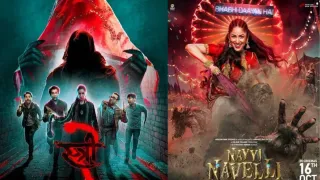
Bollywood’s witch is no longer just a woman with supernatural powers who frightens people in the dark. She can be a symbol of male insecurity, a woman punished for refusing to conform, or a figure through whom filmmakers expose the absurdity of patriarchal expectations.
In films such as Stree and Nayyi Navelli, the question is not simply whether a woman is a witch, but why the people around her are so eager to believe that she is one.
Comedy makes these subjects accessible by turning familiar power dynamics upside down, allowing audiences to laugh at the very assumptions they might otherwise take for granted.
Makdee, Stree, Roohi, Bulbbul and the recently released Nayyi Navelli reveal how the supernatural woman has become a way to examine fear, gender bias and the policing of female behaviour.
Stree Made The Witch A Vehicle For Satire
Amar Kaushik’s Stree, starring Shraddha Kapoor, Rajkummar Rao, Pankaj Tripathi and Aparshakti Khurana, remains one of the clearest examples of horror-comedy being used to challenge patriarchal attitudes.
Set in Chanderi, the film draws on the Karnataka urban legend of Nale Ba, associated with a spirit that calls out to residents and lures them into opening their doors.
In the film, a female spirit abducts men at night. The town responds with warnings, rules and elaborate precautions, turning everyday life into a comic exercise in male anxiety.
The reversal is deliberate: men experience the fear and vulnerability that women routinely encounter when moving through public spaces. They become cautious about going out alone, worry about being targeted and depend on protective measures.
The comedy works because the audience recognises the absurdity of a social order that takes male safety for granted while treating women’s fear as ordinary.
In a 2018 interview with The Indian Express, co-writer Raj Nidimoru explained how the idea developed from an urban legend he encountered in his hometown of Tirupati.
“What if this was for real? What if she doesn’t steal babies but targets men?” he recalled wondering.
Nidimoru also explained why the writers called the character Stree, rather than simply a chudail or pisaach. The choice gave the story a broader social meaning. He acknowledged that the gender reversal created humour while drawing attention to the dangers women face in real life.
The film’s closing shift from “O Stree, Kal Aana” to “O Stree, Raksha Karna” also matters. It is an ironic ending that questions how society treats a powerful woman: as a threat when she is feared and as a protector when she becomes useful.
Nayyi Navelli Brings The Witch Into The Family
Yami Gautam Dhar’s Nayyi Navelli, released on October 16, 2026, takes the idea of suspicion around a powerful woman into a domestic setting.
Directed by Balaji Mohan, the fantasy horror-comedy follows Mohini, a new bride whose arrival brings harmony to a chaotic Meerut household. Her brother-in-law Bantu begins to suspect that she is a daayan.
The premise lends itself to a pointed question: why does a woman who appears to be an ideal daughter-in-law become suspicious simply because her behaviour unsettles the family’s established order?
The film’s first half offers a more interesting interpretation than a straightforward witch hunt. Mohini helps women in the household feel valued and confident, challenging the way they have been treated and encouraging them to recognise their own worth.
That creates an opportunity for comedy to expose gender bias. The men’s suspicion of Mohini can be read alongside their discomfort with a woman who changes the household dynamic without seeking their permission.
Roohi Used The Witch To Disrupt Bollywood’s Romantic Rules
In Roohi (2021), Janhvi Kapoor plays a woman possessed by a spirit that targets grooms and abducts brides. Rajkummar Rao and Varun Sharma play two men caught in the supernatural chaos.
The movie’s most recognisable comic moment reworks the “palat” sequence from Dilwale Dulhania Le Jayenge. When Varun Sharma’s character tells the possessed woman to turn around, she rotates her neck unnaturally, transforming a familiar romantic gesture into a horror gag.
Director Hardik Mehta explained the thinking behind the scene in an interview with The Indian Express: “In our universe, the chudail is filmy.”
He described the moment as a combination of a familiar Bollywood memory and a conventional horror image. The joke depends on the audience knowing both.
Mehta also said that the film draws on northern Indian folklore about the mudiyapairi, a witch associated with targeting grooms and abducting brides.
Roohi uses the witch to destabilise the conventions through which Hindi cinema traditionally presents romance and marriage.
Ek Thi Daayan Shows How Easily Female Power Becomes A Threat
Kannan Iyer’s Ek Thi Daayan (2013), starring Emraan Hashmi, Konkona Sen Sharma, Huma Qureshi and Kalki Koechlin, offers a darker treatment of the witch.
The story follows a magician haunted by childhood memories of a witch, with his present-day life complicated by the possibility that the supernatural threat has returned. Konkona Sen Sharma’s character, Diana, becomes central to the movie’s uncertainty over whether a woman can be trusted.
The movie's emphasis is psychological horror, suspicion and the fear of supernatural influence. Yet it reflects a long-standing cinematic convention: the woman with unusual powers is a figure to be feared, watched and potentially destroyed.
Bulbbul Turned The Monster Into A Response To Patriarchy
Anvita Dutt’s Bulbbul (2020), starring Triptii Dimri, Avinash Tiwary, Rahul Bose and Paoli Dam, has a witch who has become a more complicated figure.
Set in late 19th-century Bengal, the film follows Bulbbul, a child bride who grows into a woman living within a wealthy household shaped by male authority. When a series of deaths is attributed to a chudail, the supernatural figure becomes a source of fear and speculation.
The film gradually connects the witch legend to the violence and oppression Bulbbul experiences. The woman whom society fears is not simply presented as evil; her transformation becomes a response to a world that has denied her autonomy.
Actor Rahul Bose articulated the film’s central idea in an interview with India Today, “Every time a woman threatens patriarchy, she is supposed to be a witch.”
Bose went on to describe the label as a way of marginalising women who challenge established power structures.
Why The Witch Works So Well As A Comic Character
These movies demonstrate different ways of using supernatural women to examine social attitudes.
Stree turns male vulnerability into a joke. Roohi disrupts the romantic conventions surrounding marriage. Nayyi Navelli places suspicion on a woman inside the family, while Bulbbul shows how the witch label can conceal the violence that produced her.
Every witch provides filmmakers with a character who can stand outside the rules of ordinary society. That makes her useful for exposing the rules themselves.
FAQs
Q1. Which Bollywood movies feature witches?
A1. Stree, Roohi, Makdee, Ek Thi Daayan and Nayyi Navelli feature witches or witch-related supernatural characters.
Q2. Is Nayyi Navelli a horror-comedy?
A2. Yes. The film combines supernatural horror, family comedy and mythology, with Yami Gautam Dhar playing a bride suspected of being a daayan.