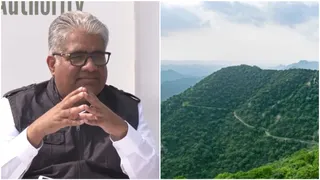
Amid the row over the Supreme Court order accepting the Centre's recommendation on the definition of Aravalli, Union Minister of Environment, Forest & Climate Change, Bhupendra Yadav, said that there is no relaxation on the Aravalli.
He clarified that despite the order, 90 per cent of the area comes under the protected zone. While speaking to the media in Bengal's South 24 Parganas, Yadav said, "There are no relaxations on the Aravalli. The Aravalli range spreads across four states of the country, including Delhi, Haryana, Rajasthan, and Gujarat. A petition regarding it has been pending in court since 1985. There should be mining norms, and we agree to that."
In his explanation amid row over the "100-metre" criterion, Yadav said the definition of Aravalli hills and range has been standardised across states on the directions of the Supreme Court to remove ambiguity and prevent misuse, particularly practices that allowed mining to continue dangerously close to hill bases.
Yadav added that some YouTube channels misinterpreted the concept of 100-metre range. "The Supreme Court has stated that the Aravalli should have a similar definition in all four states... Some YouTube channels misinterpret the 100‑metre range as the top 100 metres, which is not true. The 100 metres refers to the spread of the hill from top to bottom, and a gap between two ranges will also be considered part of the Aravalli range. With this definition, 90% of the area comes under the protected zone," Yadav said.
According to a report by news agency PTI, citing sources in the Environment Ministry, while hearing long-pending cases on illegal mining in the Aravallis, the Supreme Court had constituted a committee in May 2024 to recommend a "uniform definition", as states were following inconsistent criteria while granting mining permissions.
ALSO READ: Why Is Supreme Court’s New Definition Of Aravali Hills Facing Backlash? Activists Speak Out
The committee was chaired by the Environment Ministry secretary and comprised representatives from Rajasthan, Haryana, Gujarat, and Delhi, along with technical bodies.
The committee concluded that only Rajasthan had a formally established definition, which the state has been following since 2006.
According to that definition, landforms rising 100 metres or more above local relief, such as hills, and prohibits mining within the lowest bounding contour enclosing such hills, irrespective of the height or slope of landforms inside the contour.
The report added that the definition was agreed to be adopted by all four states, along with additional safeguards to make it objective and transparent.
Among these additional safeguards are, treating hills located within 500 metres of each other as a single range, mandatory mapping of hills and ranges on Survey of India maps before any mining decision and clear identification of core and inviolate areas where mining is prohibited.
(With PTI Inputs)