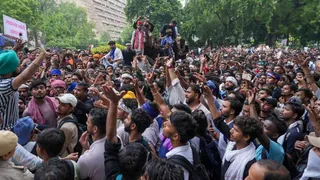
Amid CJP protest, the Delhi High Court has sought a response from the Delhi Police on whether the guidelines issued by the Supreme Court are being followed in a petition alleging surveillance of protesters holding a sit-in at Jantar Mantar.
The matter was heard by a bench comprising Delhi High Court Chief Justice D.K. Upadhyaya and Justice Tejas Karia.
The petition was filed by former Jawaharlal Nehru University Students’ Union (JNUSU) president Aishe Ghosh, who alleged that continuous photography and videography of protesters had been carried out since the beginning of the sit-in and hunger strike by the Cockroach Janata Party (CJP) at Jantar Mantar on June 20.
Ghosh stated that such actions violated the fundamental rights of protesters, including their right to privacy, dignity, freedom of expression, and the right to assemble peacefully.
The petition alleged that the surveillance mechanism was being used to intimidate and discourage student protesters. It further claimed that police personnel repeatedly entered the protest site and stopped vehicles carrying protesters for questioning.
ALSO READ: Resignation, Release And Relief: What Cockroach Janta Party Demanded In Meeting With JP Nadda
In response, appearing for the Delhi Police, Solicitor General Tushar Mehta said that no surveillance was being conducted and that every protest demonstration at Jantar Mantar is routinely recorded. He said the recordings are made only to maintain law and order. “There is no surveillance taking place.” The bench observed that the matter would be heard on Tuesday.
"At Jantar Mantar, every protest is always recorded. In this protest, a hundred people are seen making videos and reels. This is only for the purpose of law and order. There is no surveillance," he argued.
'Surveillance Carried Out By Govt Must Be Lawful, Necessary: SC'
In its landmark 2017 judgement, the Supreme Court held that the right to privacy is an integral part of the right to life and personal liberty guaranteed under Article 21 of the Constitution.
The apex court stated that any surveillance carried out by the government must be lawful, necessary, and proportionate to the purpose for which it is undertaken.
Earlier in the day, thousands of protesters gathered near Parliament Street and marched towards Parliament, demanding accountability over alleged examination irregularities and the resignation of Pradhan.
ALSO READ: From Anna Hazare To CJP Protest: How Delhi’s Streets Became Stage For Major Movements Since 2011
Security personnel stopped the march, resulting in clashes during which baton charges were carried out to disperse the crowd.