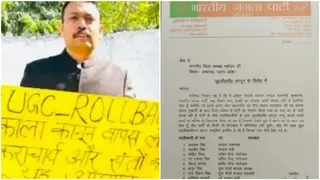
The new draft rules of the University Grant Commission (UGC) has triggered a massive uproar across the country with concerns rising over the controversial provisions and missing safeguards in it. The Central government and the BJP are facing heat over it.
Amid a wave of criticism, a city magistrate in Uttar Pradesh's Bareilly, Alankar Agnihotri, has resigned from his post expressing resentment over the regulations, describing it as concerning for the rights of children from the upper-caste community.
The regulation, mandaing Equity Cell in educational institutions, is also becoming a crisis for the ruling BJP as over a dozen party workers have resigned from their posts from Noida to Lucknow. In Noida, a BJP Yuva Morcha vice president, Raju Pandit, has quit his post, citing UGC norms.
In his resignation letter, he called the policy a "black law" against the interests of children from the upper-caste community.
In Lucknow, 11 office-bearers from the Bakshi Ka Talaab assembly constituency have collectively submitted their resignations to the district president.
Eleven officials, including the general secretary of the Kumhrawan division of this assembly constituency, have resigned en masse from the party over UGC regulations.
Why BJP should worry?
There are many reasons which could prove the UGC regulations as one of the worst gambit for the ruling party.
Upper caste vote bank: Since the formation of the BJP, the upper caste general category has been a core voter base for the BJP. According to a post-poll survey of Lokniti-CSDS after Lok Sabha elections, the upper-caste voter remained intact with the BJP in Uttar Pradesh, despite it was overpowered by the Samajwadi Party in social engineering and reduced to 33 seats.
History of protests against SC/ST Act: It is not the first time that the general category has taken to the streets against the BJP. In 2018, massive protests were launched in UP, Madhya Pradesh and other north Indian states after the protests erupted against Modi government's amendment to restore the SC/ST Act in August that year.
The amendment was introduced after the Supreme Court has put in safeguards against the immediate arrest under the act, citing concerns over its misuse.
Political analysists later cited the backlash as one of the factors BJP fell short of majority in MP Assembly elections. The controversy has been widely seen as a reason for reopening caste fault lines.
No penalising provision for false complaint in regulation: One of the main concern of the protestors is the lack of penalising provision for those lodging false complaint. The earlier 2012 regulations provided for fines and penalties for fake complaints of discrimination, which have been omitted in the 2026 regulations.
Caste-divide: Caste division has long posed electoral challenges for the BJP as it has a record of securing victories by consolidating Hindu votes. In 2024, Samajwadi Party was successful in leveraging caste equations to give a massive jolt to BJP. The new regulation now presents a fresh challenge for BJP as it will have to pacify its core voter base while preventing such a dilution that could alienate other communities.
All about new UGC Equity Rules
The new rules mandate the prohibition of any discrimination based on religion, caste, sex, place of birth, and disability. Particular emphasis is placed on protecting the rights of students and employees belonging to SC, ST, OBC, EWS, and those with disabilities.
1. According to the UGC directive, university and college will now be mandated to establish an Equal Opportunity Center to provide guidance to students and staff from disadvantaged groups on academic, financial, and social matters.
2. The committee will investigate complaints of discrimination and ensure action is taken. Furthermore, every institution has been mandated to establish an Equality Helpline.
3. A provision has been made to keep the identity of the complainant confidential, while in serious cases, there will be a system for immediate notification to the police.
4. An Equity Ambassador will also be designated in each department or hostel. Anyone dissatisfied with the decision of the Equity Committee will have a 30-day appeal to the University Ombudsman. The UGC will establish a national-level monitoring committee and require annual compliance reports from institutions.
5. Failure to comply with the rules could result in severe action against universities, including deprivation of UGC programs, discontinuation of online/ODL programs, and removal from the accredited list.