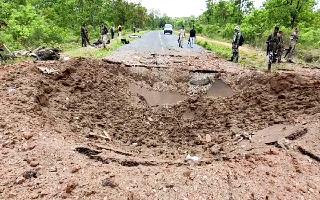
As many as 11 security personnel were killed on Wednesday in an attack by Maoists in Dantewada of Chhattisgarh. In one of the biggest attack in last two years, the Maoists blew up a vehicle carrying 10 district reserve guard (DRG) personnel in Aranpur area of Dantewada. The driver was also killed in the blast which destroyed the vehicle entirely and left a 10-feet deep crater on the road.
Improvised Explosive Device (IED) attack in south Bastar region, a forested tri-junction of Chhattisgarh, Telangana and Odisha, is seen as the last major challenge for the security forces. The southern tip of Sukma district in the south Bastar region is an area prone to attacks. In 2010, 75 CRPF and one Chhattisgarh police personnel were killed in Dantewada in one of the deadliest Maoist ambush.
The latest ambush in Dantewada has brought the IED challenge to light once again. According to the security officials, lack of technology and the rising desperation of Naxals are the primary reasons behind IED blast. The extremist, they say, use IEDs in an attempt to avoid direct combat with security forces.
While Left Wing Extremism (LWE) has been stamped out in Jharkhand and Bihar, as per government claims, border areas of Chhattisgarh continue to face attacks through stealthily placed IEDs.
What Happened In Dantewada
The security personnel killed in Dantewada had been dispatched to the spot after intel on Naxal presence was received, said Chhattisgarh Home Minister Tamradhwaj Sahu. Further, an official said a general alert had been issued to the security agencies to be alert as it was the period Naxal-sponsored TCOC, an armed operation.
"Unfortunately, the Naxals were successful in trapping the DRG vehicle in Dantewada. The exact reasons behind this incident are being investigated," PTI quoted a senior security officer in Delhi.
Maoist Ambush Plan
The TCOC is an armed operation undertaken by the Maoists in March-June to strengthen their cadres and launch major attacks on security forces as forests are devoid of green cover, thereby increasing visibility and line of sight to ambush.
These areas are controlled by the Dandakaranya Special Zonal Committee of the Maoists and led by the 'elusive' Hidma, stated to be the commander of the PLGA battalion no. 1 which is accused by police agencies of planning and executing hundreds of ambushes against the forces over the last two decades.
Security Operations In Bastar Region
The security forces have been building remote outposts and roads in an attempt to "capture, dominate, and hold" these regions. According to a security officer based in Bastar, the Central Reserve Police Force (CRPF) has established up to 15 forward operating bases in Chhattisgarh over the past three years, and more are planned.
These sites are being built so that local small units of commandos can successfully strike the Naxals in their strongholds and seize these areas for use by government organisations for development projects, the officer said.
Challenges For Security Forces In Bastar
Some of the major obstacles for the troops and government organisations functioning in these areas are the distant locations, deep forests, and poor cell phone coverage.
Further, there are two reasons, according to a CRPF officer, why IEDs continue to be a major problem. The first is that Maoists no longer possess sophisticated firearms, rifles, or ammunition. They resort to surprise strikes rather than engaging in a one-on-one conflict, the officer claimed.
The second issue is that the security forces do not have foolproof technology to detect the IEDs. The explosives are placed under blacktop roads, beneath culverts or bridges. A person triggers the IED from afar when a security vehicle or patrol is detected.
Many IEDs explode even when the troops are on foot and their trigger mechanism gets activated just due to the pressure of the feet. These incidents have injured more than 100 personnel over the last two years, the officer said.
(With inputs from agencies)