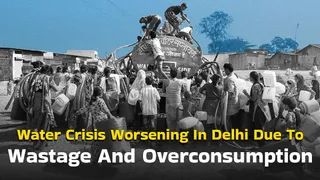
Delhi is facing the horrors of a severe water crisis again. Every summer, Delhi grapples with water scarcity, but this time the problem has reached historic levels. Mismanagement of water, inadequate storage, leakages and wastage are some of the many reasons why Delhiites face the water crisis every summer. Reports suggest that the average Indian wastes 30 per cent of their daily water needs.
According to the United States Geological Survey, a faucet dripping 10 drops per minute wastes 3.6 litres of water daily. Additionally, each toilet flush uses about six litres of water. Data from the Centre for Science and Environment (CSE) suggests that daily water wastage amounts to 4.84 trillion cubic metres or 48.42 billion one-litre bottles, while approximately 160 million people in the country do not have access to clean and fresh water.
Former IAS officer KBS Sidhu highlights in his article that during the monsoon season, continuous rainfall and the overflowing Yamuna River submerge large parts of the city, forcing thousands of residents to flee their homes and seek refuge in higher areas. Amidst the floods, the city also faces an acute shortage of drinking water, creating a paradox where people are wading through waist-deep water but are thirsty.
He also explains that Ramesh Negi, a retired IAS officer of the 1984 batch and a batchmate, highlighted that one of the most critical issues in managing Delhi's water resources is the lack of awareness among all sections of society about proper water usage. The elite class, often the biggest culprit, misuses the 20,000 litres of free water provided each month, especially in multi-story mansions, while both the rich and the poor suffer. There was a significant disparity in water distribution, with planned areas receiving 70 to 100 litres per person per day (LPCD), while unplanned areas received only 20 to 40 litres. The situation worsened during peak summers due to climate change.
Rumi Aijaz, in his research paper "Water Supply in Delhi-Five Issues," states that despite concerns about the inadequate availability of raw water, wastage continues in various ways. DJB estimates that up to 40 per cent of the total supplied water is lost in distribution. A portion of the treated water is lost due to pipeline leakage. In some areas, illegal tapping from pipelines is an issue. Misuse of water by tanker mafias is another problem. During the summer season, pipelines do not provide enough water. Moreover, many houses in unauthorised colonies have not yet received a water pipe supply from DJB. In such situations, people have no option but to resort to alternative measures, such as government and private water tankers, to obtain water.
Assistant Professor Ritu Singh of the Environmental Science Department, Central University Of Rajasthan states that the national capital Delhi is currently facing a water crisis. Many areas have been declared dry zones. A daily shortage of 50 million gallons of water is reported in Delhi. Climate change is a major cause of water scarcity, while overuse and wastage have exacerbated the water crisis. She mentions that around 160 million people in this country do not have access to clean and fresh water. If Delhiites are facing water scarcity today, it is due to two reasons – extreme heat and dependency on neighbouring states for water.
India Facing a Water Crisis
India is home to approximately 18 per cent of the global population but has only four per cent of the world's water resources. According to the World Bank, India's per capita water availability is around 1,100 cubic metres, significantly below the internationally recognized threshold of 1,700 m³ for water stress and alarmingly close to the 1,000 m³ per capita water scarcity limit. In contrast, the global per capita water availability is 5,500 cubic meters. Population growth and economic development have put pressure on water resources. Half a century ago, in 1970, per capita water availability in India was 2.5 times the current level. In 1970, per capita freshwater availability was 2,594 m³. According to the World Bank, this figure steadily decreased to 1,661 m³ in 1990 and 1,036 m³ in 2020.
Northern and northwestern India are more stressed than other regions. In 2020, Punjab extracted 164.4 per cent of its limit. According to the Ministry of Jal Shakti, Rajasthan extracted 150.2 per cent of its annual groundwater in 2020, Haryana extracted 134.6 per cent and Delhi extracted 101.4 per cent.
In many places, underground leaks go undetected, causing losses. In Europe, America, Singapore and Japan, water audits are conducted at every level to prevent wastage. Consumers' water consumption is also audited to identify and take steps to prevent household wastage.
Wastewater Management Irregularities
Rumi Aijaz states that about 80 per cent (720 MGD) of the water supplied to consumers goes down the drain as wastewater. To prevent harm to living beings and the environment, wastewater generated in various premises needs to be safely transferred through underground sewers and then treated for reuse for drinking/non-drinking purposes, disposal into surface water bodies, or groundwater recharge. In Delhi, there are several shortcomings in wastewater management. He suggests that more efforts are needed to conserve and enhance the capacities of existing and potential water sources in Delhi.
Encroachment On Water Bodies
According to the water body census report released by the Ministry of Jal Shakti in 2023, 216 out of 893 water bodies, or 24.19 per cent, in Delhi are encroached upon. The report states that 132 of the encroached water bodies had more than 75 per cent encroachment. Experts say that local community participation is crucial in preserving and maintaining these water bodies, but the owning agencies do not allow community work or participation for these water bodies.
Unequal Distribution
Additionally, there is a significant inequity in water supply in Delhi and during the summer season, the underprivileged urban residents living in unplanned and informal settlements face difficulties. According to a CSE report, a study by the Centre for Science and Environment (CSE) on the challenges of water supply, sanitation and water management in the dense, unplanned settlement of Sangam Vihar in South Delhi revealed that this settlement with a population of over one million receives an extremely low supply of 45 litres per person per day.
Need To Learn From Singapore And Israel To Prevent Wastage
Delhi needs to learn from other countries to tackle the water crisis. Countries like Singapore, Israel and many major cities worldwide are addressing the drinking water crisis by preventing water wastage and treating wastewater. More than half of the drinking water in Delhi is wasted through theft and leakage.
In places like Singapore and Tokyo, this wastage is around five per cent. A former member of the Delhi Jal Board, RS Tyagi, says that steps should be taken to prevent water wastage during distribution and at home with the help of technology, similar to Singapore. The water crisis can be addressed by using treated wastewater.
Delhi produces approximately 550 MGD of treated wastewater, of which 89 MGD is used. The remaining water flows are wasted. Singapore aims to treat 70 per cent of wastewater for use as drinking water by 2030. Other countries are also working in this direction to meet their drinking water needs.
Water Harvesting
Rumi Aijaz states that rainwater harvesting (RWH) can effectively collect and store rainwater for future use and help recharge groundwater. Although Delhi receives an average annual rainfall of over 600 mm, very little is used or stored. The biggest problem with rainwater harvesting is the lack of interest from consumers. Additionally, some buildings have structural deficiencies, such as a lack of space for constructing rainwater tanks or pits. In such cases, RWH established in private societies can make more efforts. The Delhi Jal Board (DJB) can identify potential areas in the city where RWH structures can be installed to collect rainwater falling on roads, flyovers, waterlogged areas and open spaces.
Preventing Leakages Is Crucial
Proper management of water by preventing leakage can prevent wastage in Delhi. Aijaz states that 40 per cent of the total treated water supplied by DJB is wasted due to pipeline leakage, misuse of treated water and unmetered connections. Thus, appropriate measures need to be taken to prevent the loss of potable water. Firstly, better technologies should be used to detect leaks to identify defects in pipes and fix them before leaks occur.
Sewage Treatment Plants In Delhi
According to the Delhi Economic Survey (FY 2023-24), Delhi has a total of 20 sewage treatment plants (STPs) with a total capacity of 632 MGD, but only 550.07 MGD is being utilised, resulting in 87 per cent capacity utilisation. Currently, approximately 792 MGD of wastewater is generated, of which only 550 MGD is treated. The largest STP in Asia, located in Okhla, is in its final stage of completion.
(Note: This story has been translated by Ankit Kumar for Jagran English.)