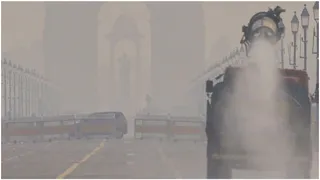
Delhi Air Pollution: After days of 'poor' and 'very poor' air quality, Delhi on Sunday woke up to a hazy morning with the air quality index (AQI) shooting up to 461. The AQI on Sunday was the season's worst. The spike in pollution level started on Saturday itself when the AQI at around 8 AM stood at 390, 10 notches below the 'severe' category.
On Saturday, the 24-hour average AQI stood at 431. The Commission for Air Quality Management (CAQM) has invoked Stage-IV actions under the Graded Response Action Plan (GRAP) with immediate effect to curb further worsening of air pollution levels in Delhi-NCR.
On Saturday, the Delhi Directorate of Education directed all schools to conduct classes for students up to Class IX and XI in a hybrid mode.
Why a sudden spike in the air pollution?
While the factors like traffic emission, industrial pollution, and others remain a contributing factor to Delhi's air pollution crisis, what has added for worse is the weather patterns, especially Western Disturbance, as it has caused a very low wind speed.
On Saturday, the average wind speed was less than 10 kmph, which prevented the dilution and movement of pollutants. However, the weather conditions are likely the same in Delhi as in the neighbouring states, and still, the AQI is high in the national capital, and that is due to its topography.
Surrounded by an elevated perimeter, the cold air in the capital is trapped beneath the warm air, due to which pollutants remain closer to the ground.
When national capital expect relief?
The air quality will continue to remain a big challenge for the national capital, but it will get some relief from the 'severe' air pollution from Monday, as the Air Quality Early Warning System For Delhi, in its 10-day forecast, has stated that the AQI (PM2.5) is expected to be around 330 on Monday morning.
This would predominantly be due to the rise in wind speed from 10 kmph to 25 kmph. The AQI would improve from 'very poor' to 'poor' category for a few days ahead until it again takes an upward trend from December 18.
(With PTI Inputs)