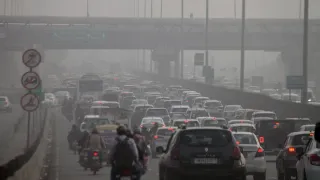
Pollution in Delhi-NCR, including the national capital, remains a serious challenge, harming both public health and Delhi’s global reputation. The recent decision by the Delhi government to stop refueling older petrol and diesel vehicles at fuel stations, in an effort to gradually remove them from the roads, is a commendable move, considering vehicular emissions are a leading cause of pollution. However, addressing only this source is not enough—other significant contributors also demand urgent action.
To effectively combat pollution, it is crucial to tackle all major sources while strengthening the public transport system in Delhi-NCR. Pollution in the city is not a new issue. Over the years, various measures have been taken, such as relocating polluting industries out of Delhi, reducing harmful elements like lead and benzene in petrol, and lowering sulfur levels in fuels. The switch from diesel to CNG for buses and commercial vehicles was also an important step.
Following Supreme Court directives, the public transport system was supposed to improve, with a plan to double the number of buses from around 6,000 in 2006-2008 to 12,000. However, the opposite has happened—the DTC bus count has now fallen below 4,000, showing a clear lack of focus on strengthening public transport. This shortfall, combined with the rising number of private vehicles due to population growth, has worsened the environmental crisis. Expanding the fleet of electric buses and promoting electric vehicles are now essential solutions.
Moreover, classifying vehicles for pollution control purely based on age is not entirely effective. Many privately owned vehicles are used sparingly and may not contribute as much to pollution if properly maintained, while commercial vehicles with higher usage may pollute more regardless of age. High-emission vehicles, irrespective of how old they are, must be phased out. Poorly maintained CNG vehicles and buses are also major contributors to nitrogen oxide pollution. Current vehicle fitness tests are inadequate, as they often overlook emission levels. Therefore, removing vehicles based on emission performance is necessary.
According to studies by the Central Pollution Control Board (CPCB) and IIT Kanpur, Delhi’s six main sources of pollution are vehicles, industries, construction activities, waste burning, stubble burning in winter, and resuspended dust. Each of these must be addressed with equal urgency. Despite bans, waste burning continues due to weak enforcement by civic agencies. Additionally, cooperation with neighboring states is vital to controlling regional pollution sources.
One area that has been largely neglected is the monitoring of secondary pollutants such as ozone-forming substances, volatile organic compounds (VOCs), and semi-volatile organic compounds (SVOCs), which contribute 16-20 per cent to Delhi's overall pollution. It is crucial to improve monitoring systems and identify these sources to create a more effective, comprehensive pollution control strategy.