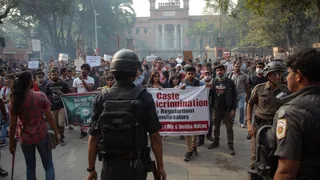
Amid the protests staged by the Delhi University students, the central univerrsity has issued a ban on all public meetings and demonstrations for a month. Even though the university's order did not clarify whether the ban was related to the newly made rules of the UGC, it did highlight that the recent demonstrations were violent.
The DU students had carried out demonstrations on campus following the recent regulations on caste equity under the University Grants Commission.
What Does The Order Say
The DU issued an order on February 17, stating, "Information received indicates that unrestricted public gatherings may lead to traffic disruption, threats to human life, and disturbance of public peace." The restriction prohibits the assembly of five or more persons, the shouting of slogans, and the carrying of hazardous materials like mashals or torches.
The order was a swift response to the week-long protests that rocked the North campus.
How Did The Protests Come Into The Limelight?
The UGC guidelines on caste equity emerged as a controversy as some argued that the rules were unfair for the general category, while others opined that the reaction is purely based on jealousy of the upper caste students.
The matter worsened after the All India Forum for Equity, backed by the left-wing All India Students' Association (AISA), organised a protest supporting the UGC regulations. The demonstration was challenged by the BJP-affiliated Akhil Bharatiya Vidyarthi Parishad (ABVP).
The incident gained attention on social media after a YouTuber claiming to be a Brahmin journalist alleged that she was assaulted and subjected to “rape threats by a mob of nearly 500 people."
The YouTuber said, "The girls around me whispered rape threats in my ears just because I am a Brahmin; 'aaj tu chal, tera nanga parade niklega,' is what they said," she told reporters, alleging that police “remained passive."
The claims were then objected to by the AISA members, who posted the female students making casteist slurs and shoving a woman to the ground. AISA activists and another journalist claimed the woman provoked the crowd and attempted to snatch equipment from other reporters.
SC Questions Constitutional Validity of 2026 Rules
Seeing the gravity of the situation, the Supreme Court has stayed the operation of the new regulations. It will examine the constitutional validity of the 2026 rules. A bench headed by Chief Justice of India Surya Kant commented there was "complete vagueness" in the rules and there was also potential for misuse.
As of now, the SC directed the institutions to stick to 2012 and follow it until further orders.