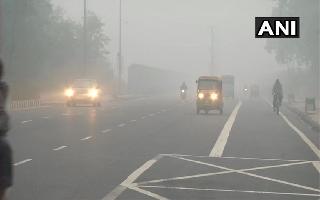
New Delhi | Jagran News Desk: Continuing with the chilling weather, the temperature in the national capital dropped on Friday morning to 6.8 degrees Celsius. Dense fog also engulfed parts of Delhi-NCR, leading to poor visibility in many areas. The dense fog also led to delay in 10 trains running in the Northern Railway region. According to the India Meteorological Department (IMD), the lowest visibility at Palam area was recorded at 1000 metre, while 500 metres at Safdarjung airport area at 7 am today.
Meanwhile, the IMD has also predicted moderate fog on Saturday also at isolated places across the national capital. The IMD also said that Delhi will witness shallow fog till January 28. Delhi will see fog or mist on Friday morning and mainly clear sky later in the day.
According to the IMD, from January 22 to January 24, rainfall is expected in many areas of Jammu and Kashmir, Ladakh, Punjab, Haryana and Himachal Pradesh. Drizzling is also expected in Delhi, Chandigarh and adjoining areas on 23 January. The IMD said that the Western Disturbance Turf is active at an altitude of 5.8 km above sea level, due to which drizzle or light rain in North India may again bring down the minimum temperature.
“The wind speed may slightly reduce on Friday but it is likely to rise again on Saturday and is expected to reach around 30km/hr,” said Kuldeep Srivastava, a scientist at IMD said.
“A western disturbance is predicted to impact the hills on January 22 and after it passes, the minimum and maximum temperatures are likely to dip to 5 and 18 degrees Celsius, respectively from January 25,” the official explained.
Meanwhile, the air quality in Delhi again deteriorated to the very poor category on Friday morning with an AQI of 301, according to the latest estimates updated by System of Air Quality and Weather Forecasting And Research (SAFAR). several areas in the national capital including Delhi University, Mathura Road, Indira Gandhi International Airport (Terminal-3) recorded air quality in the very poor category with an AQI of 304, 304 and 301 respectively.
The SAFAR also predicted that under the influence of a fresh Western disturbance, winds are forecast to increase on January 23 and marginal improvement in AQI is predicted on January 23 and 24 but within the very poor category.