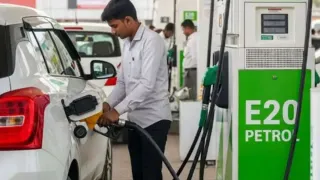
Jaiprakash Ranjan, New Delhi: As the debate over E20 fuel (petrol blended with 20 per cent ethanol) continues in India, questions have been raised about its performance, reliability, and whether other countries have already adopted the fuel on a large scale.
Addressing these concerns, the Ministry of Petroleum and Natural Gas has maintained that E20 is not unique to India and is already being sold in several countries.
The ministry stated, "E20 fuel was introduced only after extensive laboratory, vehicle, and field testing by India's leading technical institutions. Science led the way, ensuring reliability, performance, and confidence on every journey."
However, an independent investigation by Dainik Jagran indicates that only Brazil and Thailand have E20 petrol widely available as part of their regular fuel use. In most other countries, E5 or E10 remains the standard fuel blend.
ALSO READ: Relax, Your Vehicle Is Not Dying Yet: Why Owners Don't Need To Fear E20 Fuel
Brazil, Thailand - Top Consumers
Brazil has been blending ethanol with petrol for decades and is considered the global leader in ethanol fuel adoption.
Brazil is the only country that has operated a large-scale ethanol blending programme since the late 1980s. The blending ratio there typically ranges between E18 and E27.5.
At Brazilian fuel stations, a wide range of ethanol fuels from E20 to E100 are available for flex-fuel vehicles. Brazil has given automobile manufacturers decades to adapt engines accordingly.
Similarly, Thailand has also been promoting E10 and E20 for nearly the last 15 years. A few other countries support ethanol blending only on a pilot or limited basis. The country began selling E20 in 2008 and continues to actively promote it. The government offers E10, E20, and E85 fuels, along with subsidies for E20. Over time, E20 has become a commonly used fuel across the country.
ALSO READ: 'No Proposal For Export': Govt Dismisses Reports Of Bhutan Rejecting India's E20 Petrol Offer
However, India is in a different position, as E20 has now become a standard fuel for petrol vehicles nationwide.
What about other countries?
In most countries, ethanol blending remains more limited:
- In the United States, E10 is widely available.
- E15 is available only at a limited number of fuel stations.
- E20 is neither approved nor commonly available for regular passenger vehicles.
Minnesota had proposed making E20 mandatory, but the plan was never implemented after it failed to receive approval. Higher ethanol blends such as E25 and E30 are generally restricted to flex-fuel vehicles and are available only at select locations.
Recently, in Germany and France, E5 petrol has been available. E10 has now been introduced, but it has yet to achieve widespread adoption despite government encouragement. E85 is available at limited stations for flex-fuel vehicles, but no European country has promoted or adopted E20 as its standard petrol fuel.
India's rapid transition to E20
India has expanded its ethanol blending programme, as the average blending rate reached around 19-20 per cent in the financial year 2024-25. More than 10 billion litres of ethanol are now used annually for blending with petrol.
India's ethanol production capacity has also increased significantly from around 4 billion litres in 2014 to more than 18 billion litres today.
The government claims that since 2014, ethanol blending in petrol has helped save approximately Rs 1.44 lakh crore in crude oil import costs.
Is ethanol safe for every vehicle?
For most vehicle owners, the answer is yes. If your car was manufactured after 2017-18, you probably don't need to panic. This is perhaps the biggest fact missing from most viral videos.
From April 2017 onwards, every new passenger vehicle sold in India had to comply with BS4 emission norms nationwide. These regulations did not merely reduce emissions; they also required manufacturers to adopt more advanced engine management systems and fuel system components capable of handling ethanol-blended petrol.