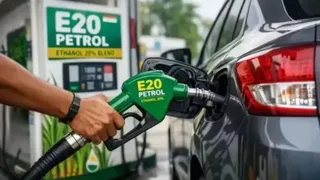
Jagran Bureau, New Delhi: The recent ruling by the Raipur District Consumer Commission has added a new dimension to the ongoing controversy surrounding E-20 (petrol mixed with 20 per cent ethanol).
The Commission ruled against Maruti Suzuki for selling a customer a car that was not E-20 compliant and ordered the company to pay compensation. This marks the first time a court has held that auto manufacturers are not providing consumers with complete information regarding E-20-compatible vehicles.
Maruti Suzuki Attributes Issue To Fuel Adulteration
Maruti Suzuki has stated that the issue was caused by fuel adulteration rather than a manufacturing defect. Speaking to Dainik Jagran, several car manufacturers acknowledged a recent rise in complaints of fuel adulteration at their service centres. While these companies have not released public statements, they noted that E-20 petrol might slightly reduce mileage.
Automakers Highlight Impact Of E-20 And Fuel Adulteration On Vehicles
An official from a leading automobile company told Jagran.com, "We are finding that many vehicles have high levels of sulfur and chlorine in their systems, which damages engines, fuel lines, and rubber components. This is likely due to poor fuel quality." Industry officials note that the ethanol in E-20 damages rubber components, an issue already acknowledged by the government; it is further worsened by fuel adulteration.
Officials stated that India has roughly 300 million two-wheelers and 70 to 80 million cars on the road. Of these, only about 70 million are BS-6 compliant vehicles produced since 2023, which are designed to handle E-20 fuel. This indicates that approximately 78 per cent of the vehicles currently in use were not originally designed for E-20.
Ministry Of Petroleum Rejects E-20 Incompatibility Claims
The Ministry of Petroleum and Natural Gas dismissed the argument that E-20 fuel cannot be used in vehicles manufactured for E-10.
"One public concern centres on vehicle manuals that specify E-10 compliance. However, it is important to understand that a manual simply reflects the fuel standards in place when the vehicle was certified. It does not mean the vehicle suddenly becomes unsafe when fuel standards evolve after extensive scientific testing, engineering validation, and regulatory approval," the ministry stated.
The ministry further stated, "The transition from E-10 to E-20 was not based on speculation, but on years of testing, field experience, and consultations with vehicle manufacturers since 2021."
Furthermore, the ministry noted that vehicle manufacturers were in full agreement with the transition, which is why all these vehicles remain covered under warranty.
Gadkari Admits E-20 Fuel Damage; Announces Free Part Replacements
However, Union Road Transport and Highways Minister Nitin Gadkari recently admitted in an interview that E-20 fuel causes damage to the rubber parts of vehicles. Gadkari stated that parts of older cars (manufactured for E-10 or lower blends) that are affected by E-20 will be replaced free of cost during servicing. Gadkari claimed that vehicle manufacturers have been instructed to replace these parts at no additional cost to the customer. However, at least two major auto companies told Dainik Jagran that they have not received any such instructions.
There are approximately 100,266 petrol pumps in India. Almost all petrol pumps currently offer E-20. The Ministry of Petroleum has clarified that E-20 will be the standard nationwide, and it will no longer be possible to provide pure petrol (E-0) or E-10 separately.
Meanwhile, the central government has announced plans to establish 500 E-85 petrol pumps across the country by the end of this year. E-85 petrol is also slightly cheaper than E-20. However, only Maruti Suzuki has launched an E-85-powered vehicle in the country. More companies are expected to launch their models soon. Sales of the more expensive premium petrol will continue at all stations.