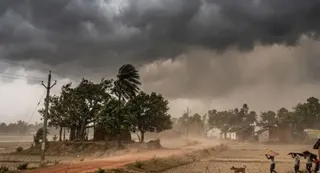
India might experience the arrival of the El Nino weather phenomenon earlier this year, with weather agencies from across the globe suggesting the rapid rise in Pacific Ocean temperatures might disrupt the Indian monsoon season, potentially leading to drought.
International weather agencies said this destructive weather condition can persist throughout the monsoon season, and its likelihood has now jumped to 82 per cent from 61 per cent a month ago.
This development comes at a time when several parts of the country have already witnessed abnormal rainfall patterns and increasing temperatures, and international forecasts have projected an early arrival of El Nino, potentially intensifying the impact of this phenomenon over India's four-month southwest monsoon season.
What does the Indian Meteorological Department say?
Indian Meteorological Department (IMD) Chief Mrityunjay Mahapatra said, "In the first forecast for this monsoon, released last month, IMD already considered the probability of emergence of an El Nino during the latter half of the season. However, according to recent predictions, an early El Nino development would significantly impact monsoon rainfall and thus increase the risk of droughts in the country."
The below normal monsoon, at 92 per cent of the long-term average, was the lowest forecast for the season rainfall by the national weather agency since the adoption of a new multi-model ensemble system in 2007. Its second forecast is due next week.
"The equatorial Pacific is fast warming up, leading to the development of an El Nino event by June or July," India Today quoted Dr Madhavan Nair, a climate scientist. "This event could be a very severe El Nino event as we had in 1997 and 2015."
What is El Nino?
El Nino is a naturally destructive climatic phenomenon occurring in the Pacific Ocean that impacts global weather. El Nino leads to abnormal warm ocean water that affects wind patterns, too. Consequently, global rainfall cycle changes can create devastating drought, heavy rains and floods.
El Nino is also linked to India, as, in 70 per cent of the El Nino events since 1980, monsoons were recorded below normal or weak, which, in most cases, resulted in widespread drought.
Earlier this month, the European Meteorological Agency (ECMWF) warned that El Nino may become active in May itself and that the majority of weather models are suggesting it to be one of the strongest El Ninos in the last century, impacting global weather dramatically.
However, despite the concerns, the IMD has forecast that the southwest monsoon may reach the coast of Kerala as early as May 26, roughly six days ahead of its normal arrival date, with weather experts clarifying that an early arrival is not indicative of above-normal seasonal rainfall.