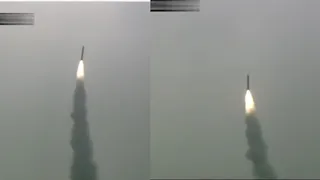
Odisha coast: India on Wednesday carried out the successful test-firing of two indigenously developed Pralay missiles, strengthening the country’s short-range strike capability. The back-to-back launches were conducted from the same launcher, marking a key step towards the missile’s induction into the armed forces.
Back-to-Back Launches
The test was conducted at around 10.30 AM as part of user evaluation trials by the Defence Research and Development Organisation. According to the defence ministry, both missiles followed their planned trajectory and met all mission objectives. Data from tracking sensors confirmed accurate performance during the flight.
What Is the Pralay Missile?
Pralay is a short-range, surface-to-surface missile designed to deliver conventional warheads with high precision. It is a solid-propellant, quasi-ballistic missile equipped with an advanced navigation system.
Key features:
Payload capacity: 500 to 1,000 kg
Range: 150 km to 500 km
Capable of carrying multiple types of conventional warheads
Designed to strike a variety of targets with accuracy
Significance Of The Test
Officials said the successful salvo launch demonstrates the reliability and readiness of the weapon system. The trial brings Pralay closer to operational deployment with the Indian armed forces.
Government And Defence Leadership React
Defence Minister Rajnath Singh congratulated DRDO teams along with the Indian Army, Indian Air Force, defence public sector undertakings and industry partners. He said the successful test validated the missile’s performance and reliability.
ALSO READ: DRDO Conducts Successful Salvo Launch of Indigenously Developed Pralay Missile
DRDO Chairman and Secretary, Department of Defence Research and Development, Samir V Kamat, also praised the teams involved. He said the results indicate that the Pralay missile system is nearing readiness for induction.
Who Developed Pralay?
The missile has been developed by the Research Centre Imarat, Hyderabad, in collaboration with multiple DRDO laboratories. These include the Defence Research and Development Laboratory, Advanced Systems Laboratory, Armament Research and Development Establishment, High Energy Materials Research Laboratory and Terminal Ballistics Research Laboratory.
Officials said further steps will follow to complete the induction process.