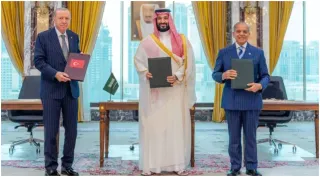
Following the trilateral Mecca Defence Agreement between Pakistan, Saudi Arabia and Turkey, the question now arises whether the Mecca Defence Agreement will change India's options the next time it faces a major security challenge from Pakistan.
On paper, it provides Islamabad with a new collective security arrangement, but the details of the agreement and the very different strategic interests of its three signatories make the implications for future India-Pakistan conflict less clear.
Although Pakistan is at the centre of this new arrangement, the immediate strategic focus of the agreement is on regional balance involving Iran, the Gulf countries and wider West Asia.
This raises an important question for India: if another crisis triggers a military response similar to Operation Sindoor, will Saudi Arabia and Turkey view it as a conflict falling within their new defence commitment to Pakistan?
Pakistan's clarification on questions raised regarding the Mecca Agreement
After joining the trilateral defense agreement, Pakistan is now clarifying questions about its objectives. Pakistan's Deputy Prime Minister and Foreign Minister, Ishaq Dar, has stated that the agreement is purely defensive in nature and is not aimed at targeting any country. He added that the agreement was signed to strengthen peace, stability, and security in the region.
ALSO READ: Why Is Pakistan-Saudi Arabia-Turkiye Defence Agreement A Cause For Concern For India?
In fact, Pakistan's participation in this agreement has raised concerns worldwide, given its image. Experts say that Pakistan not only promotes terrorism in India and Afghanistan, but also does not recognise Israel as a country.
Furthermore, Pakistan is the only nuclear power among Islamic countries. As such, it could influence other Islamic countries to join. This agreement could also cause instability in the region.
Mecca Agreement a result of dialogue and cooperation: Dar
Dar, in a post on X, said the Makkah Agreement is the result of years of dialogue and cooperation between the three countries. It aims to strengthen strategic cooperation to address challenges related to peace and security. He added that the agreement does not replace or replace any existing bilateral or multilateral agreements between the three countries.
The most important condition of the agreement is that any external armed attack on any of the three countries will be considered an attack on the other two countries as well.
The agreement is in line with the right to collective self-defense: Dar
Dar said this provision is consistent with the right to individual and collective self-defense under Article 51 of the UN Charter. He also said the agreement is open to all countries in the region that accept its basic principles and are prepared to resolve differences through mutual respect, cooperation, and peaceful means.
Mecca Agreement sparks new debate on West Asian security
The signing of the "Mecca Joint Defense Agreement" between Saudi Arabia, Pakistan, and Turkey has sparked renewed debate about the politics and security landscape of West Asia. The coming together of three influential Sunni countries is being seen as a sign of a shift in the regional balance of power.
By signing the agreement in Mecca, Saudi Arabia has sought to send a political and strategic message not only to the Sunni Gulf countries but to the entire region, according to analysts. They believe that the escalating tensions with Iran in recent months and the changing security dynamics in West Asia have further increased the need for such cooperation.
According to Reuters, Turkish Vice President Cevdet Yilmaz said the agreement is not aimed at any specific country. A Turkish official also clarified that it is a purely defense and self-defense arrangement and will not affect existing defense agreements with any other country.
(With inputs from news agency PTI)