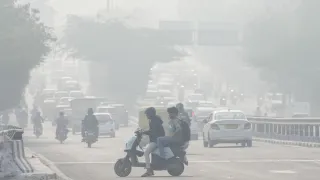
Air Pollution: Air pollution is claiming nearly four lives every minute in India, translating into more than 5,500 daily deaths and over two million deaths annually, according to the State of Global Air 2025 report. Fine particulate matter, particularly PM2.5, penetrates deep into lung tissue and enters the bloodstream. Prolonged exposure causes long-term health damage, including heart disease, stroke, lung cancer, and chronic obstructive pulmonary disease (COPD). Children, the elderly, and individuals with pre-existing medical conditions are particularly vulnerable as toxic air impacts the country year-round.
ALSO READ: Delhi Conducts Two Cloud-Seeding Trials As Air Quality Worsens Ahead Of Diwali; More Planned Ahead
Delhi Air Pollution: AQI Remains 'Very Poor' For Fourth Consecutive Day
Delhi's air quality remained in the 'very poor' category for the fourth consecutive day on Thursday, November 5.
According to data from the Central Pollution Control Board (CPCB), the city's 24-hour average Air Quality Index (AQI) stood at 369 at 4 PM on Thursday:
- Monday, Nov 2: 324 (Very Poor)
- Tuesday, Nov 3: 350 (Very Poor)
- Wednesday, Nov 4: 377 (Very Poor)
Thursday, Nov 5: 369 (Very Poor)
Out of 59 monitoring stations across the national capital, 18 registered air quality in the 'severe' category on Thursday, with Jahangirpuri recording the highest AQI of 454. Neighbouring areas in the National Capital Region (NCR), including Noida, Greater Noida, and Gurugram, also reported alarming pollution levels amidst a heavy layer of smog.
Under CPCB standards, an AQI reading between 301 and 400 is classified as 'very poor,' while readings from 401 to 500 indicate 'severe' pollution levels.
India Ranks Sixth Most Polluted Country
Delhi's toxic air reflects a broader systemic crisis across the country. According to IQAir's World Air Quality Report 2025, India was ranked the sixth most polluted country globally. Delhi ranked fourth among the world's most polluted cities, while New Delhi was the most polluted capital city.
Delhi recorded an annual average PM2.5 concentration of 99.6 micrograms per cubic metre in 2025, which is nearly 20 times the World Health Organization's (WHO) recommended annual safe guideline of 5 micrograms per cubic metre.
Economic Toll: Delhi Loses Billions To Air Pollution
Beyond the health crisis, air pollution imposes a heavy economic burden on the country. Increased hospitalisations, rising healthcare bills, worker absences, and lower productivity directly impact economic growth.
An analysis by the Centre for Research on Energy and Clean Air (CREA), Greenpeace, and AirVisual estimated that air pollution cost New Delhi 5.8 per cent of its annual GDP, amounting to an economic loss of $3.5 billion in the first half of 2020 alone.
What's Ahead?
The Air Quality Early Warning System (AQEWS) for Delhi has indicated no immediate relief, stating that air quality will remain in the 'very poor' category on Thursday before deteriorating to 'severe' from Friday to Sunday.
"The outlook for the subsequent six days indicates that the air quality is likely to remain in the severe to very poor category," the AQEWS bulletin said.
(With Inputs From PTI)