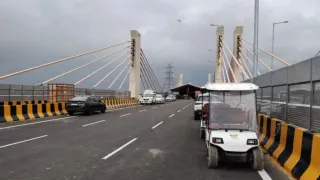
Delhi: In a major relief for commuters across the national capital, the long-awaited Barapullah Phase-3 elevated corridor will open to the public on September 29. Union Home Minister Amit Shah will inaugurate the corridor alongside Chief Minister Rekha Gupta.
In addition to the Barapullah Phase-3 elevated corridor, Shah will also inaugurate the Mukarba Chowk railway underpass to ease traffic congestion in North Delhi.
Mayur Vihar To AIIMS Set For Signal-Free Run
The Barapullah Phase-3 corridor will provide seamless connectivity between East and South Delhi, directly linking Mayur Vihar Phase-1 and AIIMS via signal-free carriageways. At Sarai Kale Khan, the new elevated corridor will merge with the existing Barapullah flyover, completing a stretch of approximately 9 km.
This corridor will allow commuters travelling from East Delhi and Noida to reach AIIMS in around 15 minutes, significantly cutting overall travel time.
Dedicated Cycle Tracks And Modern Infrastructure Among Features
According to Public Works Department (PWD) Minister Parvesh Sahib Singh, the project features a dedicated cycle track, making it the first flyover corridor in India to integrate one for sustainable mobility.
Alongside faster vehicular movement, the project includes pedestrian-friendly infrastructure and modern urban design elements.
Officials stated that both ramps are complete, one extending from Mayur Vihar and the other joining near Sarai Kale Khan. A major highlight of the project is an extra-dosed bridge over the Yamuna River, which will hold the entire corridor together.
Nine-Year Delay And Budget Revision
First approved in 2014, construction began in 2015 with an original completion target of 2017. However, the development faced a nine-year delay due to land acquisition hurdles, planning issues, and complex construction over the Yamuna Riverbed. These setbacks led to significant cost overruns, revising the project's final cost to approximately Rs 1,635 crore.
With all structural work now complete, the corridor is ready to open to the public.
(With Inputs From Agencies)