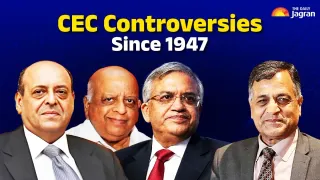
Election Commission Controversies: A fresh controversy has put the Election Commission of India (ECI) under the spotlight since Sepetember, with Opposition parties, student groups and the Cockroach Janta Party (CJP) demanding the resignation of Chief Election Commissioner (CEC) Gyanesh Kumar. The row intensified after a report by The Indian Express highlighted alleged internal disagreements within the Election Commission of India (ECI).
According to the report, Election Commissioners Sukhbir Singh Sandhu and Vivek Joshi raised objections to several decisions taken during the Special Intensive Revision (SIR) of electoral rolls. They reportedly questioned decisions taken without their approval and alleged that their concerns went unanswered on multiple occasions.
The Election Commission, however, maintained that the suggestions made by both commissioners were considered and that decisions were taken after mutual deliberations.
This is not the first time the poll panel has faced questions over its functioning. Since independence, the Election Commission has grown into a powerful three-member constitutional body responsible for overseeing elections across the country. Despite its crucial role in India's democracy, the institution has faced several controversies over the years, ranging from allegations of political bias and executive interference to disagreements among commissioners and concerns over electoral rolls.
ALSO READ: What Is Special Summary Revision Announced By EC In 17 States? How It Differs From SIR | Explained
The latest row has once again brought these past controversies into focus. Here are some of the major disputes involving Chief Election Commissioners and the Election Commission over the years.
1. Gyanesh Kumar: SIR row and internal disagreements
Chief Election Commissioner Gyanesh Kumar has faced mounting criticism over the nationwide Special Intensive Revision of electoral rolls. The exercise reportedly led to the deletion of around 130 million names across India, prompting Opposition parties to question whether the process could exclude eligible voters.
The ECI has defended the revision as an exercise to update electoral rolls, but the Opposition has alleged that it could lead to voter disenfranchisement.
The controversy took a new turn after The Indian Express reported that Election Commissioners Sukhbir Singh Sandhu and Vivek Joshi had raised at least 14 formal objections over 10 months. Their concerns reportedly involved decisions taken without their knowledge and changes to systems overseeing critical electoral databases.
ALSO READ: 'Different Banners, One Cause': Will CJP And INDIA Bloc Protest Together Against CEC Gyanesh Kumar?
The reported differences within the Commission have fuelled political protests and renewed calls for Kumar's resignation. The controversy has also drawn attention to impeachment notices and legal scrutiny in the Supreme Court.
2. Navin Chawla (2006-2009): Allegations of political bias
The controversy surrounding Navin Chawla became one of the most prominent case in the Election Commission's history, raising questions about political neutrality and the powers of the CEC.
The Congress-led UPA government appointed 1969-batch IAS officer Navin Chawla as an election commissioner in May 2005.
The dispute began before in January 2009; Gopalaswami recommended Chawla's removal to then-President Pratibha Patil, citing several instances of alleged partisan conduct. These included claims that proposed election schedules for states such as Gujarat and Uttar Pradesh had been leaked to Congress leaders.
The UPA government rejected Gopalaswami's recommendation, arguing that he could not act unilaterally under Article 324(5) of the Constitution without an appropriate government reference or established statutory grounds. Former President Patil rejected the recommendation.
Two months later, Chawla became Chief Election Commissioner on April 21, 2009, succeeding N. Gopalaswami, and served until July 2010.
3. TN Seshan (1990-1996): The battle over the CEC's powers
TN Seshan, who served as India's 10th Chief Election Commissioner from 1990 to 1996. His tenure was marked by a major institutional dispute over the powers of the CEC and the introduction of a multi-member Election Commission.
In October 1989, SS Dhanoa and VS Seigell were appointed Election Commissioners, with RVS Peri Sastri serving as CEC. These appointments marked the first time the Election Commission was constituted as a multi-member body.
In 1993, when Seshan was CEC and MS Gill and GVG Krishnamurthy served as the other two commissioners, there were reportedly disagreements over the distribution of responsibilities and decision-making powers within the Commission.
According to The Indian Express, Seshan did not assign adequate roles to the two commissioners. There were also disputes over access to official documents and participation in important meetings. Reports further alleged that Seshan used derogatory terms to refer to the two commissioners in an interview.
Seshan opposed the panel body system, arguing that the creation of a multi-member commission could undermine the independence of the CEC's office. He challenged the system introduced under the government of Prime Minister PV Narasimha Rao, which gave the other commissioners equal decision-making powers.
The matter eventually reached the Supreme Court. In 1995, a five-judge Constitution Bench ruled against Seshan and upheld the multi-member structure, establishing majority-based decision-making within the Commission.
The court described the CEC as "first among equals".
Seshan later entered electoral politics, contesting the 1999 Lok Sabha election from Gujarat's Gandhinagar constituency as a Congress candidate against BJP leader LK Advani. He lost the contest.
4. Ashok Lavasa (2019): Dissent over clean chits to PM Modi and Shah
The Election Commission faced another major controversy in 2019 when then-Election Commissioner Ashok Lavasa dissented from decisions giving Prime Minister Narendra Modi and Union Home Minister Amit Shah clean chits over alleged violations of the Model Code of Conduct (MCC) during the Lok Sabha elections.
Lavasa objected to his dissenting opinions allegedly not being recorded in the Commission's final orders. At the time, the ECI comprised CEC Sunil Arora, Election Commissioner Ashok Lavasa, and Sushil Chandra.
The disagreement raised questions about how dissent within the Commission was handled and whether differing opinions were adequately reflected in its decisions.
The ECI responded that the rules governing the publication of dissenting opinions varied from case to case, depending on the nature of the order.
In August 2020, Lavasa resigned before completing his term as Election Commissioner amid reported internal differences and controversy surrounding his dissenting opinions.
5. Rajiv Kumar (2022-2025): Questions over transparency and impartiality
Rajiv Kumar served as India's 25th Chief Election Commissioner from May 15, 2022, to February 18, 2025. It was marked by opposition allegations of political bias and concerns about the Commission's transparency during the 2024 Lok Sabha elections.
Questions over internal disagreements surfaced after Election Commissioner Arun Goel abruptly resigned in March 2024, just weeks before the announcement of the LS election schedule. Media reports suggested that Goel and Kumar had differences over certain decisions and policy matters.
Goel's sudden exit, which followed the retirement of another commissioner, temporarily left Kumar as the sole member of the Commission. The government later appointed new commissioners under a newly enacted selection law.
The controversy did not end with the elections. After the 2024 Lok Sabha results, Opposition parties, particularly the Congress, accused the ECI under Kumar's leadership of lacking transparency and favouring the ruling BJP.
The Commission also faced questions over the publication of final voter turnout figures and alleged discrepancies between votes polled and votes counted. These concerns added to the political debate over the ECI's independence and credibility.